20kw Pure Sine Inverter

Ian0

Joined Aug 7, 2020
13,158
A FIVE KW 60H control transformer is quite heavy, and a 20 KW transformer will probably weigh about four times as much, close to 100 pounds. Are transformers that large still wound on bobbins??
Indeed so.
As an example, If you look inside a 15kVA Victron Quattro, you find two 7.5kVA sectional wound toroids.
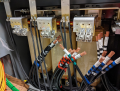
Larger inverters tend to be three-phase, and that means the usual 3-phase triple-bobbin configuration is better than 3 toroids. That’s what is inside a 250kVA inverter.
 

nsaspook

Joined Aug 27, 2009
16,357
Indeed so.
As an example, If you look inside a 15kVA Victron Quattro, you find two 7.5kVA sectional wound toroids.
Larger inverters tend to be three-phase, and that means the usual 3-phase triple-bobbin configuration is better than 3 toroids. That’s what is inside a 250kVA inverter.
+1
1681834294171.png
1681834327548.png
 

MisterBill2

Joined Jan 23, 2018
27,684
Some people still heat their homes with oil or electricity (lots of money).
Electrical heating is becoming the only allowed choice in California, if what I read about the new rules forbidding gas furnaces and gas stoves is true. I wonder about how that will work out, with needing to recharge all of those electric vehicles as well. Especially with the power company skimping on the integrity of the distribution network. It will probably be exciting to see.

And evidently I slipped an order of magnitude in my math for post #18. That happens sometimes. Sorry about that, folks.
 

Ian0

Joined Aug 7, 2020
13,158
Electrical heating is becoming the only allowed choice in California, if what I read about the new rules forbidding gas furnaces and gas stoves is true. I wonder about how that will work out, with needing to recharge all of those electric vehicles as well. Especially with the power company skimping on the integrity of the distribution network. It will probably be exciting to see.
Instead of running a high power boiler in short bursts, the plan seems to be to run a low power heat pump continuously and store the heat in a water tank, and making you buffer more heat that way when demand is low by pricing the electricity accordingly. That might work.
The other plan is buffer the grid by discharging the batteries of electric cars that happen to be plugged in. That could lead to some angry customers.
 

MisterBill2

Joined Jan 23, 2018
27,684
Instead of running a high power boiler in short bursts, the plan seems to be to run a low power heat pump continuously and store the heat in a water tank, and making you buffer more heat that way when demand is low by pricing the electricity accordingly. That might work.
The other plan is buffer the grid by discharging the batteries of electric cars that happen to be plugged in. That could lead to some angry customers.
Heat pumps are an interesting option, I am not sure how efficient they are, or will be, with some of the new refrigerants. Storing warmer water heat in tanks sounds good until the size of tanks for a useful amount of heat is considered. And it may be fine for California where a cold wave means temperatures in the fifties. It will not work well in the northern area where an average winter temperature may not exceed 20 degrees F for weeks at a time.
I am aware of the concept of taking power FROM EV battery packs.
I see that as a very poor concept for anybody who might need reliable transportation available at a possibly unanticipated time. On the day you need to leave several hours earlier than usual the "smart" power system has drained your battery because you have not been using it that much that early in the day. Or there is an urgent need to rush an inured child to the hospital emergency facility very early in the morning.
So I do not ever want some unknowing agent taking away my mobility. In addition, the discharge cycles use up battery life, and battery replacements will be quite costly, we can know that part is true. And for those who do not replace a car yearly that matters.
 
Last edited:

BobTPH

Joined Jun 5, 2013
11,562
I have a heat pump, actually two installed last year. The temp hit -12F this winter and they operated fine. The are rated for full output down to 0F and reduced output down to -20. These are not your father’s heat pumps.
 

MrAl

Joined Jun 17, 2014
13,722
I'm looking for a DIY design for a 20kw pure sine inverter. There are many resources for building 1-3kw versions, but none for an inverter with a 20kw output. If someone has a design they could share or explain to me exactly how to modify one of the smaller inverters to handle the extra power capacity, that would be great. The input is coming from a 220VDC/50amp generator and the output from the inverter should be 220VAC@50hz with about 20kw load capacity, enough to power a household.

I have not worked with electronics for quite some time (decades) and this project is looking much bigger than I had anticipated; I wonder if it makes more sense to buy one, but my friend is insistent that we build it ourselves. :) Thank you for any help you can provide!
Hi,

You mean single phase? That's a big undertaking. I am supposing you know about the "fool load" way of thinking about how to load an inverter and that's why you quoted 20kw for use with an input that is about half of that. We used to have a saying that anyone who buys an inverter that is rated for an output that is what they actually need is a fool, so we started to call that "fool load" as a play on words with "full load". In other words, you dont buy an inverter that you have to run at the full load rating of the inverter you buy one that is rated higher, and twice as high is not a bad idea. That's why i am thinking you quoted 20kw instead of the actual maximum input power available. That will help ensure long term reliability.

I've worked with units up to 30kw but they were three phase and we had our own transformer winding department where we could order up any custom design we needed.
The output transformers we used were EI type and were really big, so big you could not lift one yourself too easily.

You'll probably need parallel transistors because the peak current will be high, which means you should study how to do that effectively.
You'll have to study up on snubber circuits, also transistor drive circuits.
Not sure how you intend to design the output transformer if you use one. You would have to incorporate some leakage inductance unless you want to add an output inductor, which may be simpler for you.
I am assuming you know about the required switching techniques for generating a 'pure' sine wave.
I also assume you understand how feedback systems work.

Testing is critical for these things. An overnight full load test is usually done just to make sure nothing melts down. I've seen output transformer insulation melt down and short out the transformer and blow all the transistors on overnight runs.

I do like the idea of buying an AC generator as one reply advised. That seems to be the best solution if you can get one and if it can regulate well enough for your intended use.
Building a 20kw inverter is a huge undertaking for people who dont work in that industry. Designing one is for the very experienced in that field. Buy lots of extra transistor since they will be popping until you get it right. This also means you should have the physical construction such that you can replace them easily.

That reminds me, the power levels in these things make them dangerous. It's not the voltage shock possibility it's the possibility of injury due to the explosion of various parts of the system. This includes filter capacitors as well as the main power transistors and the transistors that drive them. When the caps blow they can go off like a cannon, and when the transistors blow they can spew hot molten metal in all directions and hot shards of sharp plastic. Not pretty and of course very dangerous. Some of the explosions i have seen and heard are really nuts, very loud and very nasty looking afterwards. Large metal case transistors look like someone used a cutting torch to cut open the tops, and no connecting terminals to be found anymore. Plastic transistors cracked open with most of the plastic missing.
This can be really nasty except for one day of the year, that's the Fourth of July :D
 

MisterBill2

Joined Jan 23, 2018
27,684
OK, SOME heat pumps may be adequate for colder climates, but still, they require a lot of electrical power, and the price is probably impressive indeed. Probably at least twice what a common heat pump will cost.

As for the inverter powered by a generator, one big question is what drives that generator? For 20 KW AC out probably 30 KW shaft input power will be required. That is quite a bit of power that must come from some place.
 

Ian0

Joined Aug 7, 2020
13,158
OK, SOME heat pumps may be adequate for colder climates, but still, they require a lot of electrical power, and the price is probably impressive indeed. Probably at least twice what a common heat pump will cost.

As for the inverter powered by a generator, one big question is what drives that generator? For 20 KW AC out probably 30 KW shaft input power will be required. That is quite a bit of power that must come from some place.
I suspect that he’s not using a generator to run a heat pump. It would be more efficient to burn the fuel.
 

MisterBill2

Joined Jan 23, 2018
27,684
Nope, using grid tied solar.
NOPE!! A quote from post#1"
The input is coming from a 220VDC/50amp generator and the output from the inverter should be 220VAC@50hz with about 20kw load capacity, enough to power a household."so there we have it. But no hint as to what is spinning that generator.
Back a hundred years it would have been a coal fired steam engine spinning the generators. I had an old engineering text that went through all of the calculations, even the two pulleys and the flat belt. And I know there used to be a company that sold tools and generators even larger than 20 KW. Not Harbor Freight, but similar.
 

ApacheKid

Joined Jan 12, 2015
1,762
I'm looking for a DIY design for a 20kw pure sine inverter. There are many resources for building 1-3kw versions, but none for an inverter with a 20kw output. If someone has a design they could share or explain to me exactly how to modify one of the smaller inverters to handle the extra power capacity, that would be great. The input is coming from a 220VDC/50amp generator and the output from the inverter should be 220VAC@50hz with about 20kw load capacity, enough to power a household.

I have not worked with electronics for quite some time (decades) and this project is looking much bigger than I had anticipated; I wonder if it makes more sense to buy one, but my friend is insistent that we build it ourselves. :) Thank you for any help you can provide!
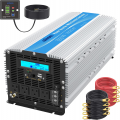
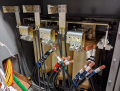
I bought one of these (5KW) some years ago, pretty good too but not 20KW of course.

1682030665863.png
We often lose power for an hour or more during late summer (so called Arizona "monsoon") and this is for keeping my garage freezer running when that happens.

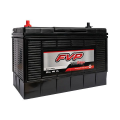
I found some great batteries for this, got them at a great price:

1682030903535.png

That's a FVP31TXXHD, very good for the price - I got four.
 
Last edited:

MisterBill2

Joined Jan 23, 2018
27,684
I bought one of these (5KW) some years ago, pretty good too but not 20KW of course.

View attachment 292527
We often lose power for an hour or more during late summer (so called Arizona "monsoon") and this is for keeping my garage freezer running when that happens.

I found some great batteries for this, got them at a great price:

View attachment 292528

That's a FVP31TXXHD, very good for the price - I got four.
One does not just modify a 1 KW inverter into a 10 KW inverter. For starters, the 0ne KW transformer must be replaced with a 20 KW transformer. Then the transistors need to be replaced with a set of transistors able to switch that 22KW of input power. And the heat sink needs to be able to dissipate 20times as much heat. and this arrangement does not really deliver a true sine wave.
Then the difficult part is the new drive circuit.
And I am still asking what the device is that spins that 5KW generator. Because it will cost quite a bit less to buy a new alternator that provides 20KW oof sine wave power than to create a 20 KW inverter. AND it will be more efficient.
And now I recall that the company that sold generators back then was called "Northern Tool Company", or just "Northern Tool."
That company is still in business and they offer a 9600 watt generator for $1300. not 20 KW, but enough for most homes. Or buy 2 of them.
The generator is listed as requiring 18horsepower to drive it. Easily cheaper than that list of parts near the start of this thread.
 
Last edited:

MrAl

Joined Jun 17, 2014
13,722
I bought one of these (5KW) some years ago, pretty good too but not 20KW of course.

View attachment 292527
We often lose power for an hour or more during late summer (so called Arizona "monsoon") and this is for keeping my garage freezer running when that happens.

I found some great batteries for this, got them at a great price:

View attachment 292528

That's a FVP31TXXHD, very good for the price - I got four.
Wow that's a beast.

5KW is a lot of power though does a freezer really need that much power. Maybe for the startup.
The battery does not have the voltage written on it i was wondering what the voltage was.

Is your power outages due to some grid malfunction or do they impose rolling blackouts where you live?
 

Solar Mike

Joined Apr 26, 2018
34
I'm looking for a DIY design for a 20kw pure sine inverter. ...
Its a pity respondents cannot stick to the topic and actually help.....

Go over to The Backshed forum, you will find full schematics + pcbs and software for several high power inverters that will run up to 20Kw. We mainly design Low Frequency types using second hand torodial iron cores rather than HF versions.

Search for "WarpInverter" , "Nanoverter"

Alternatively look on AliExpress for the base low frequency module without transformer, you might locate one that runs off 220v dc.

Cheers
Mike
 

MrAl

Joined Jun 17, 2014
13,722
Just how does one help someone who wants to run a 20kW inverter off a 11kW generator?
Hi,

As i said previously, just because he wants to build a 20kW inverter does not necessarily mean that he intends to USE it at 20kW.
It is good practice to use an inverter/converter that is rated higher than the load it will normally have to handle. 2x is not unreasonable, both for reliability AND for motor start applications. In fact, for motor start apps it should probably be rated even higher.
So there is the possibility that the inverter will never have to run at 20kW anyway. Heck, it may even run at 5kW most of the time, but i dont think the original poster mentioned that yet.
 
Top