2-digit digital stopwatch

Thread Starter

Kew Aaron

Joined Apr 2, 2018
1
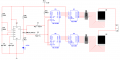
Required to design and implement a two-digits digital stopwatch with start/stop and reset buttons. Components available to be used include: 2*74LS192 counter, 2*74LS48 decoder, 2*common cathode 7 segment display, 555 timer, 2*push button switch, LED, 10μF capacitor, and various resistors (8*330Ω, 1kΩ, 2*10kΩ, 12kΩ, and 51kΩ).
upload_2018-4-2_14-26-9.png

Can someone help me to correct it? Because mine circuit can't work at all.
 

crutschow

Joined Mar 14, 2008
38,508
Why do you have the up and down inputs tied together on the 192 counter?
The poor counter doesn't know which way to go. :rolleyes:
 

WBahn

Joined Mar 31, 2012
32,840
Required to design and implement a two-digits digital stopwatch with start/stop and reset buttons. Components available to be used include: 2*74LS192 counter, 2*74LS48 decoder, 2*common cathode 7 segment display, 555 timer, 2*push button switch, LED, 10μF capacitor, and various resistors (8*330Ω, 1kΩ, 2*10kΩ, 12kΩ, and 51kΩ).
View attachment 149571

Can someone help me to correct it? Because mine circuit can't work at all.
The fundamental problem you have, which is quite common and most of us suffered from it when we were students (and most of us still suffer from it even now, at least from time to time) is that you designed and implemented the entire thing and foolishly expected it to work. I say that this was a foolish expectation because it seldom turns out to be the case. Tiny little problems ranging from completely misunderstanding the problem to connecting a wire to ground instead of power to leaving an unused input unconnected to you name it can cause it to do something other that what you want (including doing nothing at all). But now you have to debug the entire thing because the mistake could be, literally, anywhere -- plus it is highly likely that you have more than one mistake.

The first step in designing anything like this is to break it down into small chunks. Then design the small chunks, implement them, and test them. THEN start bringing them together to build up your system a little bit at a time, testing it at each step to be sure it does what it should at that point. You will discover that you will still make mistakes, but now you can find them and fix them much faster because you pretty much know where they have to be.

There are certainly variations on this approach, but they all have the same things in common -- break the problem into small, manageable subproblems, solve the subproblems separately, and build up the full system incrementally. The important thing (and something that is so often forgotten) is that you need to thoroughly test what you done at each stage.

So you might start by making a one-digit stopwatch. But you might then break that down into making a free running one-digit counter. But you might break that down into making a free running one-second clock. Then you might build up and make a free-running one-digit counter but that doesn't use a display -- you have to use a scope or some LEDs to see the counter state. Then you might build up and add the display for that digit. At any point along this path (once you have the free running clock working) you can add the reset functionality and then the start/stop functionality. Once you have a complete one-digit stopwatch, making it two-digits should be almost trivial.

EDIT: Fix typo.
 
Last edited:
Top