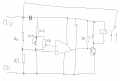
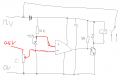
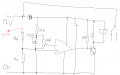
12v light triggered above 2 volts

Thread Starter

Turbovan

Joined Oct 25, 2024
4
Hello, I’d like to design a circuit that powers a typical 12v automotive relay whenever voltage rises above 2.0 volts. It will be sensing a 0-5v signal. Pot adjustable would be fine.

In the end I just need a string of LED’s powered on at exactly 2.0-2.1 and above

Incorporating an AND gate would be optimal. If 12v(1) AND if above 2.0v(1) then on(1)
 

Jerry-Hat-Trick

Joined Aug 31, 2022
822
Sounds like a job for a comparator to me. Presumably you have a 12V supply for the relay. Use a resistive potential divider to provide 2.0V to one side of the comparator so that the output of the comparator swings to the 12V rail when the other comparator input sees 2.0V. With the relay coil connected between 12V and the collector of an NPN transistor transistor with its emiiter to ground, drive the transistor on with the output of the comparator into the base via a suitable resistor.
 

panic mode

Joined Oct 10, 2011
4,974
i agree except for voltage divider as a reference... voltage in vehicle varies, so divider output will also change. you need to use something fixed as a reference point so that what you are comparing to is always the same.
 

panic mode

Joined Oct 10, 2011
4,974
something like this may do it...
TL431 is precision 2.5V reference. allowing you to pick setpoint anywhere between 0-2.5V.
voltage divider is allows you to set about 1/10th of the supply (12V) so you would be right in the middle of the adjustment range. rest is simple.

you could of course pick larger zenere (6.8 or 7.5V) and adjust divider if you like. low voltage zeners are not that great
1729879704452.png
 

AnalogKid

Joined Aug 1, 2013
12,126
something like this may do it...

Don't think so:
It will be sensing a 0-5v signal.
Delete D1.
Disconnect R1 from Vcc, and make it the signal input.
Increase R2 to 10 K.
Add a small filter cap across R2.

Note that the comparator (or opamp) common-mode input voltage range must include its own negative rail (Vee or Vss). If you go with an opamp, you must move R5.

ak

ps. - r.e.f.e.r.e.n.c.e d.e.s.i.g.n.a.t.o.r.s . . .
 
Last edited:

panic mode

Joined Oct 10, 2011
4,974
you are right... i forgot about 0-5V
but that would not work either...

changing lower side resistor of input divider to 10K would make the input always lower than the reference and therefore impossible to adjust trip point.

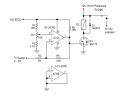
so something like this should do it. reversing of response can be done either by swapping comparator inputs or choosing between NO/NC relay contact.
1729881046427.png
 
Last edited:

sparky 1

Joined Nov 3, 2018
1,218
You want to design a circuit yourself it is described as

A voltage controlled 12V relay, the threshold exactly at 2.0Vdc <> 2.1Vdc
It is an automotive application, It result string of leds being powered.
The typical sensor values are 0 <> 5Vdc

It is not specified if the relay is latched, it might be motion sensed or proximity.
 
Last edited:

AnalogKid

Joined Aug 1, 2013
12,126
To the TS: If the input signal varies above and below the threshold voltage, slowly or rapidly, do you want the output relay to go on and off with it?

ak
 

Thread Starter

Turbovan

Joined Oct 25, 2024
4
Sorry, I clearly did not give enough information. This is an automotive application(1970 dodge) for monitoring an AFR gauge in a turbo application. The gauge outputs a 0-5v supply and . Aftermarket ecu outputs a stable 5v and “signal ground.” I want the circuit to power the coil of an automotive relay any time voltage is above 2.0 volts. I will be using a Hobbs pressure switch to provide 12v to the relay only when positive boost pressure(3+) exists.

So
if sensor voltage > 2v
and if pressure > 3psi
then turn on LED.

Hysteresis should not be important. Sensor voltage should never be over 1.6v any time the pressure switch is closed. Ideally this LED would never turn on. If the conditions are met and the light turns on, there is a bigger problem elsewhere(fuel pressure, excessive boost, tune). It will just be a big red “you’re going to melt something” light.
 
Last edited:

MisterBill2

Joined Jan 23, 2018
27,504
OK, a simple comparator circuit will work, with the comparator IC and the NPN transistor driving the relay powered by the 12 volt system, and the reference setpoint potentiometer supplied from the Aftermarket ecu output of a stable 5v . The output side of the comparator can be like shown in post #6. But the pull-up resistor value may need to be reduced to bias the transistor adequately to switch on the transistor enough to operate the relay.
 

AnalogKid

Joined Aug 1, 2013
12,126
My datasheet says the TL431 internal reference is 2.5 V, so I don't think the circuit in #6 will work. If the available 5 V power source is decently regulated, I would divide that down to 2.0 V as the reference for the comparator. A high impedance 1% divider, such as 301K / 200 K with a filter cap, would be a static current of only 10 uA; that should be a low enough.

ak
 
Last edited:

MisterBill2

Joined Jan 23, 2018
27,504
I was ONLY referencing the circuit on the OUTPUT SIDE of the comparator! And given that the +5 DC voltage available is stable, it does not require an additional stabilizing device.
 

panic mode

Joined Oct 10, 2011
4,974
My datasheet says the TL431 internal reference is 2.5 V, so I don't think the circuit in #6 will work. If the available 5 V source is decently regulated, I would divide than down to 2.0 V as the reference for the comparator. A high impedance divider with a filter cap should be a low enough static current.

ak
oops... i think you are right... for that circuit to work, one need to use lower reference, or divide reference voltage. and Mr Mill is also right that base resistor value was likely too high unless one uses Darlington. Comparator output should be able to sink some 10mA so for 12V supply one can pick lower resistor value. this was only meant as an idea since type of relay is not known. the high current automotive relays have coils that may draw 150-200mA. general purpose 12V relays would need fraction of this....1730123861250.png
 

MisterBill2

Joined Jan 23, 2018
27,504
No regulation for the reference voltage is required! The TS tells us in post #12, and in an earlier post, that the current ECU provides a stable 5 volt supply. Also, because this subsystem is just providing a warning, a solid 2.000 volt switch point reference is not mandated.
 
Top