12v light triggered above 2 volts

Thread Starter

Turbovan

Joined Oct 25, 2024
4
I have been testing what you all have been graciously providing me, but I made a significant mistake with the AFR signal voltage. I need to light my LED at > 1.0 volts. Not 2.0.
Sorry for the mistake
 

Attachments

Last edited:

sghioto

Joined Dec 31, 2017
8,634
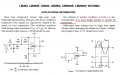
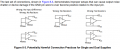
Depending on which application sheet one is reading.
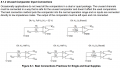
Maybe they are referring to input pins but it doesn't say that specifically. I don't see the any harm leaving the output pin open or grounded.
1730167094008.png
 

boostbuck

Joined Oct 5, 2017
1,047
Maybe they are referring to input pins but it doesn't say that specifically. I don't see the any harm leaving the output pin open or grounded.
"The best connection method puts the comparator into the normal operation range and no inputs are connected directly to low impedance nodes. The output of the comparator must be left open and not connected."

The main concern seems to center around power-up/-down but also protection against any transient extremes.

1730167715826.png
 

MisterBill2

Joined Jan 23, 2018
27,611
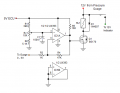
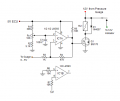
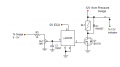
That's the feedback resistor to provide some hysteresis.
Is that what you are referring to?
INDEED It is! positive feedback in a comparator works very well to prevent chattering or other instability. BUT 47K is going to provide a huge amount of hysteresis. typical values are much higher. Of course, a single resistor is simple to change.
 

AnalogKid

Joined Aug 1, 2013
12,147
BUT 47K is going to provide a huge amount of hysteresis.
Disagree. That 47 K resistor (R4) is working with a resistor of only 1 K (R3) to set the hysteresis percentage. That's around 2%, which is very non-huge.

BUT wait, there's more.

Because the device is open collector, the circuit's hysteresis is asymmetrical. The series hysteresis impedance seen by the non-inverting terminal is 47 K when the output is low, and 57 K when the output is high. Thus, the *two* hysteresis percentages are 2.1% and 1.75%. This adds another layer to the hysteresis calculation. And given the extra-noisy environment that is an automobile, one could argue that these numbers are not high (huge?) enough.

If the asymmetrical hysteresis is an issue / too confusing / whatever, the simple solution is to change the device to an LM358 dual opamp. With this change, the source impedance for R4 will be near zero in both the high and low output states. AND, R5 can be deleted, saving a "huge amount" of money.

ak
 
Last edited:

sghioto

Joined Dec 31, 2017
8,634
Disagree. That 47 K resistor (R4) is working with a resistor of only 1 K (R3) to set the hysteresis percentage. That's around 2%, which is very non-huge.
Actually it's around 5%.
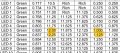
When triggered at 1 volt the voltage on pin3 increases to 1.05 volts and drops to .97 volts at deactivation.
 

AnalogKid

Joined Aug 1, 2013
12,147
You beat me to it. After I posted my numbers based only on the output states, I ran them for real including the effects of the two input threshold levels.

Better round numbers: +/-2% spread without the input conditions. +/-4% spread with. Less non-huge.

ak
 

MisterBill2

Joined Jan 23, 2018
27,611
My comment was a hip-shot after being used to comparator circuits that involved high impedance sources. And certainly the results are worth being aware of. And undoubtedly an education for a lot of folks. Also a reminder to me that low impedance circuits are quite different.
 
Top