Zener Diode usage in Voltage Divider

Thread Starter

dhinesh.ganesan

Joined Oct 19, 2017
48
Hi all
I am designing a rotator circuit which consists of a 5v stepper motorenter link description here and 5v DRV8834 driver ICenter link description here. The driver IC got 1 pins which is a step to control the motor. The problem/question is that only a two lines come from the camera top section. The camera top section runs at 12V. Is that possible to use the same 12V line to toggle as a 5V step pulse as well? The idea is as soon as the bottom section is connected to the top section, the Intelligent circuit should recognize whether the rotator is receiving 12V power or 5V step signal. If it is 12V then the system stays on and shouldn't consume current as well doesn't harm the motor. When it receives 5V step signal it goes through the 5V buck regulator (only if needed?) and supply the voltage to the motor and turns on the rotator. Is that possible to connect? I have attached the rough block diagram. Please let me know your ideas.


Latest.PNG

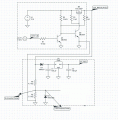
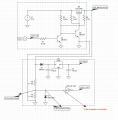
This is the schematic I've been recommended for generating 5V pulse using 12V power line. My doubt is I am using a voltage divider to get a 5V pulse and I am getting a 5V inverted pulse at Point 1 as I required but when I place the Zener diode it is getting down to 3.8V inverted pulse at the point 2 and the pulse completely disappears when I connect to Schmitt trigger inverter. I've found that the total power consumption of the circuit is 12x.050=0.6W which means the 1N4732A Zener current at test conditions is 53mA. Is that the reason why I am getting 3.8V (less current makes less voltage). I've also used 1N750 where the Zener current is 20mA at test conditions but still, it is generating 3.5V. Is anything I am making mistake? do you think the Zener current/Zener diode is not suitable? I need a 5V Inverted pulse and also why the Schmitt trigger inverter is not seeing any pulse?. Could anyone help me please. Thank in advance.
 
Last edited:

GopherT

Joined Nov 23, 2012
8,009
1) Are you sure the black band on the zener is on the far side of your ground connection?

2) What is the load on your 7805?

3) what kind of 12v power supply are you using?

4) your 7805 is not really designed for on/off switching like that (especially with 100uF to stabilize the voltage. What is the goal with that? Why not connect those to the 12v source directly and use a second p-channel mosfet to switch?
 
Last edited:

Thread Starter

dhinesh.ganesan

Joined Oct 19, 2017
48
1) Are you sure the black band on the zener is on the far side of your ground connection?

2) What is the load on your 7805?

3) what kind of 12v power supply are you using?
Thanks for your help.
1. yes it is in reverse bias to work and I have checked connecting another way as well.
2. Totally it consumes around 50mA to 80mA
3. SMPS Bench power supply for now.
 

ebeowulf17

Joined Aug 12, 2014
3,307
1) Why would you use a 4.7V zener if you want 5V?

2) Why do you need a zener at all if your voltage divider is creating the 5V pulse you need?

3) Zeners have a soft knee. The voltage maintained across the zener varies as a function of current and also varies from one unit to the next.

I'm guessing the zener is the cause of the voltage drop. I'd eliminate it entirely. If you just want to keep the inverter input protected against over-voltage inputs, you could use a clamping diode from the input to the 5V regulated supply.
 

AlbertHall

Joined Jun 4, 2014
12,619
4) Do you get a good 5V on the output of the '7805?

The 1N4732A will generate the correct voltage at 53mA but your circuit drives it with less than 2 mA (( 12V-5V) / 4.7k) so I would expect a voltage lower than specification.
 

ebeowulf17

Joined Aug 12, 2014
3,307
As for the inverter not responding to input, it's possible that the zener is dropping your voltage too low. The Schmitt threshold at 5V VCC could be up to 3.5V and be within tolerances. According to your voltage readings, I wouldn't expect this to be the problem, but you're close enough to the danger zone that I wouldn't rule it out.

Again, I think simply eliminating the zener will solve your problems.
 

MrAl

Joined Jun 17, 2014
13,667
Hi,

Your diagram shows 3.8v at the top of the zener, then nothing when it gets to the input of the inverter. That means that the line that connects the two is broken unless of course your illustration is not correct. Check for an open wire or connection or else correct the diagram.
 

AlbertHall

Joined Jun 4, 2014
12,619
Hi,

Your diagram shows 3.8v at the top of the zener, then nothing when it gets to the input of the inverter. That means that the line that connects the two is broken unless of course your illustration is not correct. Check for an open wire or connection or else correct the diagram.
From TS voltage disappears when the inverter is also connected:
when I place the Zener diode it is getting down to 3.8V inverted pulse at the point 2 and the pulse completely disappears when I connect to Schmitt trigger inverter.
 

Thread Starter

dhinesh.ganesan

Joined Oct 19, 2017
48
1) Are you sure the black band on the zener is on the far side of your ground connection?

2) What is the load on your 7805?

3) what kind of 12v power supply are you using?

4) your 7805 is not really designed for on/off switching like that (especially with 100uF to stabilize the voltage. What is the goal with that? Why not connect those to the 12v source directly and use a second p-channel mosfet to switch?
The regulator I am using there is to supply 5v to the motor, motor driver IC and inverter
 

ebeowulf17

Joined Aug 12, 2014
3,307
Hi,

Your diagram shows 3.8v at the top of the zener, then nothing when it gets to the input of the inverter. That means that the line that connects the two is broken unless of course your illustration is not correct. Check for an open wire or connection or else correct the diagram.
I'd like an explanation of that as well. Judging from the text, I think the TS has assembled the circuit bit by bit, testing with each component addition, such that:
  • 5V at voltage divider was measured before zener or inverter were added to circuit
  • 3.8V was measured after zener was added, possibly before inverter was added
  • 0V at inverter might not be a measurement at all, but might just be an assumption based on not getting the desired output from inverter
Of course, I may be misinterpreting all of those things. Hopefully the thread starter can clarify when, where, and how each measurement was made, because it's not entirely clear to me right now.
 

MrAl

Joined Jun 17, 2014
13,667
Hi,

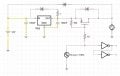
In that case, is this next circuit correct as drawn?
If so, then there is something wrong with the CMOS inverter gate or it's power connections. etc.
Note there is no inverter in this new circuit.
 

Attachments

Thread Starter

dhinesh.ganesan

Joined Oct 19, 2017
48
1) Why would you use a 4.7V zener if you want 5V?

2) Why do you need a zener at all if your voltage divider is creating the 5V pulse you need?

3) Zeners have a soft knee. The voltage maintained across the zener varies as a function of current and also varies from one unit to the next.

I'm guessing the zener is the cause of the voltage drop. I'd eliminate it entirely. If you just want to keep the inverter input protected against over-voltage inputs, you could use a clamping diode from the input to the 5V regulated supply.
1. 5V Zener is not available can I use 5.1v to get a 5V pulse?
2. I thought of any voltage spikes
3. Could you please explain more about this clamping diode (from where to where), if I use clamping diodes then what happens to the voltage divider? don't need that one?

4) Do you get a good 5V on the output of the '7805?

The 1N4732A will generate the correct voltage at 53mA but your circuit drives it with less than 2 mA (( 12V-5V) / 4.7k) so I would expect a voltage lower than specification.
1. I am getting 4.9V
2.Yes, you are right current consumption is less. Do you recommend any Zener diode which works for low current?

As for the inverter not responding to input, it's possible that the zener is dropping your voltage too low. The Schmitt threshold at 5V VCC could be up to 3.5V and be within tolerances. According to your voltage readings, I wouldn't expect this to be the problem, but you're close enough to the danger zone that I wouldn't rule it out.

Again, I think simply eliminating the zener will solve your problems.
1. if the threshold is 5V to 3.5V then I've tried connecting Schmitt trigger directly to the voltage divider eliminating zener diode it is not seeing any pulse.
 
Last edited by a moderator:

Thread Starter

dhinesh.ganesan

Joined Oct 19, 2017
48
Hi,

Your diagram shows 3.8v at the top of the zener, then nothing when it gets to the input of the inverter. That means that the line that connects the two is broken unless of course your illustration is not correct. Check for an open wire or connection or else correct the diagram.
What I've done after that is connected 5V Vcc to the Schmitt trigger and connected output pulse from the zener diode into the inverter input. Is that what you are looking for?

From TS voltage disappears when the inverter is also connected:
Sorry what do you mean by TS? Is that Thread starter?
 
Last edited by a moderator:

ebeowulf17

Joined Aug 12, 2014
3,307
1. if the threshold is 5V to 3.5V then I've tried connecting Schmitt trigger directly to the voltage divider eliminating zener diode it is not seeing any pulse.
When you have it connected that way, does the input pin on the inverter (which should be electrically equivalent to the voltage divider output) still show the expected voltage?

If the inverter input is correct and you get no output response, that's one issue.

If the voltage divider output drops to 0V as soon as you connect it to the inverter input, that's a very different problem.
 

Thread Starter

dhinesh.ganesan

Joined Oct 19, 2017
48
I'd like an explanation of that as well. Judging from the text, I think the TS has assembled the circuit bit by bit, testing with each component addition, such that:
  • 5V at voltage divider was measured before zener or inverter were added to circuit
  • 3.8V was measured after zener was added, possibly before inverter was added
  • 0V at inverter might not be a measurement at all, but might just be an assumption based on not getting the desired output from inverter
Of course, I may be misinterpreting all of those things. Hopefully the thread starter can clarify when, where, and how each measurement was made, because it's not entirely clear to me right now.
Yes you are right. I have measured bit by bit. As soon as I pass high pulse from the microcontroller that gets converted into 5v inverted pulse at the voltage divider side in transmission. Then I am using a inverter to make high pulse to run the stepper motor.
 

ebeowulf17

Joined Aug 12, 2014
3,307
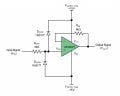
Here's an example from the internet of clamping diodes. This one includes two, one for preventing too high of input, the other for too low.

IMG_3579.JPG
 
Top