I have used coulumb counting for tracking SOC on my wheelchair for over 10y, initially with 40Ah then 80Ah SLA and, more recently, 200Ah LiFe batteries. The thing with LiFe is I can safely discharge to 10% SOC and use the full 90% capacity whereas with SLA, 50% SOC means the on-load voltage has dropped low enough (or internal resistance has increased) to the point where the chair no longer functions reliably making a 80Ah SLA effectively only 40Ah usefully.
Initially up & down, but up was always > down. With the LiFe batteries I fully charge until balancing complete, then only count down from a nominal 198Ah as that's what 100% SOC is now calibrated as. The way my LiFe charger works makes counting up a bit tricky as it variably pulse charges which screws up the calculation (I use an older TI BQ chip and a 100A ACS hall effect sensor on one chair and a custom ESP32 pcb and 100A/75mV current shunt on the other).
This describes Coulomb counting pretty well. For Li-Ion cells (a fairly linear battery chemistry) with a good estimation algorithm for Coulomb counting corrections you can be pretty accurate within a charge/discharge slope.. For LA, all bets are off the table. https://www.renesas.com/us/en/docum...e-estimation-featuring-raa489206isl94216a-bfe
Coulomb counting is a common method to estimate the SOC in industrial applications. It offers low implementation complexity and acceptable accuracy by relying on the estimation of the initial capacity and the measurement of the current. If the capacity at a given moment is known, the remaining capacity can be estimated by adding the integrated charge current and subtracting the integrated discharging current. This method works well if charge and discharge coulombic efficiencies are 1 and the estimation of the initial capacity is accurate. These conditions are rarely met due to the complex interrelationships among factors such as usage profile, temperature, and irregular variations of cell capacities, resistances, and aging effects during the lifetime of the battery. In addition, measurement errors due to current sensors, noise, bias, leakage, and nonlinearity, accumulate and affect SOC estimation. Even if the Battery Font End (BFE) features dedicated and specialized coulomb counting hardware, it is necessary the estimation algorithm perform correction of its SOC estimations to ensure accuracy.
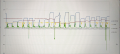
Here's a three week energy tracking chart (the bank energy is in 10's of Wh) for my LiFePO4 solar energy bank. This time of year, without a external utility charger, those batteries are always in a partial SoC. Not good for LA but this type handles that just fine.
The green line shows energy gains from solar panels and energy losses from loads.
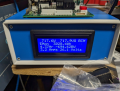
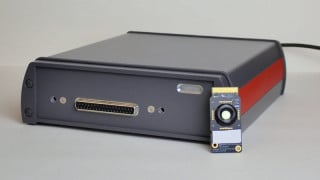
Remote info display monitor with run-time at current power load using CAN-FD for networking.

 Facebook
 Google
 GitHub
 Linkedin