Xenon flash issues?

Sensacell

Joined Jun 19, 2012
3,785
I suspect that either the tube has not extinguished (is still conductive) or the thyristor is still conducting after the first half second.
Try a thyristor which is not as sensitive. It will also have a higher latching current, therefore is more likely to commutate when it should.
Does the 230V version have a full wave rectifier and the 115V version a double half-wave?
Can you place a high bandwidth current probe on the return lead and compare the waveform good-to-bad tubes?
 

Thread Starter

seanstevens

Joined Sep 22, 2009
323
@nsaspook Thanks, thats exactly what I suspect as well as the electrode material.

@MrChips, Voltage across the cap is fixed at about 280-300VDC max, as is the trigger - remember this circuit has been working for 25+ years. The same tube works perfectly at 115VAC

@schmitt trigger, yes, this is beginning to look similar.

@BobTPH, yes have noticed that - never seen a xenon tube with such a low flash rate, so yes its possible however, put the same tube in a 115VAC and not only will it flash 1 Hz, but also happily 2Hz!

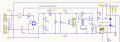
@Ian0, testing more tubes based on delivery batches yesterday, out of 5 batches of the same tube, one batch worked about 90-95% as opposed to other batches of 20%, also found 3 tubes that flashed once and then stopped. The circuit has been in use for 25 years, will attach part of the circuit. the same tube in a 115VAC and not only will it flash 1 Hz, but also happily 2Hz!

@Danko, We sell about 2k per month of these devices for the last 20 years, the tube has to be cost-effective.

@Sensacell, I am afraid not, the construction does not allow it.

I am NOT looking to change the circuit or change the component values, I am asking for possible reasons why it does not flash regularly at 1Hz.
 

Attachments

Thread Starter

seanstevens

Joined Sep 22, 2009
323
@nsaspook Thanks, thats exactly what I suspect as well as the electrode material.

@MrChips, Voltage across the cap is fixed at about 280-300VDC max, as is the trigger - remember this circuit has been working for 25+ years. The same tube works perfectly at 115VAC

@schmitt trigger, yes, this is beginning to look similar.

@BobTPH, yes have noticed that - never seen a xenon tube with such a low flash rate, so yes its possible. However, put the same tube in a 115VAC and not only will it flash 1 Hz, but also happily 2Hz!

@Ian0, testing more tubes based on delivery batches yesterday, out of 5 batches of the same tube, one batch worked about 90-95% as opposed to other batches of 20%, also found 3 tubes that flashed once and then stopped. The circuit has been in use for 25 years, will attach part of the circuit. the same tube in a 115VAC and not only will it flash 1 Hz, but also happily 2Hz!

@Danko, We sell about 2k per month of these devices for the last 20 years, the tube has to be cost-effective.

I am NOT looking to change the circuit or change the component values, I am asking for possible reasons why it does not flash regularly at 1Hz. Also, the really bad tubes work perfectly in a DC 24V version. The DC version has a PWM step up to 300VDC on the charge cap and uses a Thyristor to trigger the HT coil. So this is an AC issue only with this particular tube.
 

Thread Starter

seanstevens

Joined Sep 22, 2009
323
Update, looks like the 47nF cap for the HT is too large a value for it, even though it calls for it in the specs. Putting 2 47nF in series instead gets it to flash 1Hz with no issues. Just doing more tests, once its conclusive, I will update and close this thread.
 

Thread Starter

seanstevens

Joined Sep 22, 2009
323
Update: Tests are currently running on the 115VAC & 230VAC using 2 x 47nF in series and both are working as it should.
So is something out of phase, as all the individual functioning blocks work on the 115VAC, on the 230 also all work but could the phase of the HT strike out?
 

Ian0

Joined Aug 7, 2020
13,132
Update: Tests are currently running on the 115VAC & 230VAC using 2 x 47nF in series and both are working as it should.
So is something out of phase, as all the individual functioning blocks work on the 115VAC, on the 230 also all work but could the phase of the HT strike out?
That is a bit marginal. 6.8M and 47nF give a time constant of 320ms.
It will need 3τ to get charged up enough to fire the tube.
I also think that a 350V electrolytic is marginal for European mains (230V±10%) as it give a peak voltage of 358V, but that’s not the problem we’re discussing.
 

Thread Starter

seanstevens

Joined Sep 22, 2009
323
Thanks @Ian0, yes I see that, but this circuit/configuration has been through UL and a handful of other really strict third-party approval bodies and works at extreme high and low temperatures. But for now, it is running, may have to go to 33nF and put them in the environmental chamber at -25c and +70c to see how they do. I can now see the odd missing flash on the 115VAC after a while, 33nF next.
 

MisterBill2

Joined Jan 23, 2018
27,524
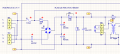
Since you are having inconsistent performance from a batch of xenon flash tubes, I would make a test jig to test and characterize each tube. The circuit looks something like this:

View attachment 362729

I would put a Variac on the AC input in order to adjust the input voltage.
Adjust the flash rate in order to give the storage capacitor C1 time to recharge.
What about the circuit for 120 volts 60 Hz?? I have a couple thoughts about the differences. Mostly the charging rate of the C1 ! I am guessing that as the fnewer flash tube ages it discharges C1 to a greater extent, so that the C1 does not charge quite fast enough with the 50 Hz power. (Only 25 charging pulses. So it it takes 26 or ore current pulses for an adequate trigger it waits another half second.
 
Last edited:

Thread Starter

seanstevens

Joined Sep 22, 2009
323
@MisterBill2, 115V 60Hz works fine no missing flashes, neither at 50Hz or 60Hz. C1 & R2 are a part of the power supply to the low voltage logic, nothing to do with flash as such. Did you mean C8?
The issue is manifested on brand new PCBAs just made and brand new Xenon tubes, so no ageing at this point, unless you mean ageing in the few minutes being under test.
 

MisterBill2

Joined Jan 23, 2018
27,524
I was hoping to compare the two circuits to see what was different, since the circuit shown for 220 volts will not provide the same voltage with only 120 volts. So I was suspecting a small difference in the recharging times.

BUT it appears that you have decided where the problem is and so decided that I have no need to compare the circuit with no problems against the circuit that does have problems, to see what is different.
In my long engineering career, looking for the cause of some malfunction, frequently the ultimate cause of the problem is not right at the point where things go wrong, and so it is useful to look at a slightly bigger picture. In this case, compare the design that is OK with the one that is not OK. AND, if the problem had been obvious immediately you would not be asking for other assistance.
Comparing what works with what does not work is a secret trick that I sometimes use. It allows spotting very small differences that do not often stand out.
 
Last edited:

Thread Starter

seanstevens

Joined Sep 22, 2009
323
@MisterBill2, Having gone through a few batches of dated tube delivery test on the same PCBA, one batch worked perfectly and every batch after that date went wrong. Commercially, it was decided to go back to the manufacturer and ask a few questions in Chinese!
I fully agree with the idea of comparing/checking a working vs non-working, a method that I use often (secretly):) Thanks for everyone's help.
 

MisterBill2

Joined Jan 23, 2018
27,524
My guess is that the flash tubes that exhibit the problem conduct differently!They may either conduct until the capacitor voltage drops to a lower value then with the "OK" flash tubes, or else they might stop conducting at a higher voltage than the others. THAT would allow the trigger capacitor to charge faster and so increase the flash rate.
BOTH types of difference can be compensated for by changing the resistor values a bit. I understand that doing that would be a major production change, but it should not have a cost impact, unless you buy resistors by the train-car load .
 

Ian0

Joined Aug 7, 2020
13,132
Thanks @Ian0, yes I see that, but this circuit/configuration has been through UL and a handful of other really strict third-party approval bodies and works at extreme high and low temperatures. But for now, it is running, may have to go to 33nF and put them in the environmental chamber at -25c and +70c to see how they do. I can now see the odd missing flash on the 115VAC after a while, 33nF next.
It's doesn't say a lot for the approval bodies if they can't spot that a 350V capacitor on a potentially 358V supply isn't a problem!
 

MisterBill2

Joined Jan 23, 2018
27,524
And I now have seen both versions, I think. In both versions the trigger happens when the voltage rises to the level at which that NE1 device conducts. So using a reasonably fast scope you can observe the voltage wave form across each of the capacitors and observe the difference between satisfactory function and faults. My guess is that the problem is related to the voltage at which the flash tube ceases to conduct, and that is changing the timing relative to the voltage at which the flash tube trigger pulse is delivered.
 

Thread Starter

seanstevens

Joined Sep 22, 2009
323
It's doesn't say a lot for the approval bodies if they can't spot that a 350V capacitor on a potentially 358V supply isn't a problem!
I measure across the charge cap with a Fluke scope, and the peak voltage is never over 300VDC.
 

Thread Starter

seanstevens

Joined Sep 22, 2009
323
I use a digital BK Precision mains supply that I can set to any voltage in the range as well as the frequency. I set it to 230VAC & 240VAC 50Hz, I dont get anything over 300V. C3 is populated for 230V, for 115V, C3 is not populated, but C4 & C5 are populated. Its a combination PCBA populated as required.

1770635750860.png
 

MisterBill2

Joined Jan 23, 2018
27,524
Certainly the flash rate will be mostly determined by the time it takes the main flash capacitor to recharge And with nothing else in the circuit changing,the charge time will depend on the depth of discharge after a flash. AND, the depth of discharge will depend on the voltage at which the flash tube stops conducting. I am not sure howclosely the flash tube data sheet defines that voltage, or if it even specifies it. BUT, since nothing else is changed, THAT is a logical guess.
 
Top