Wondering where the power went.....

What generally happens, since the current in an inductor can;t change instantaneously, the power supply has to be able to suppy current BRIEFLY to the winding resistance. An SMPS has to be severely overrated to overcome this. The units are VA (Volt-Amps) and not Watts even though W=V*A.
 

Thread Starter

Dodgy Geezer

Joined Nov 30, 2009
181
If a transformer/rectifier is the way ahead, I daresay I can find a cap of 1000μF or so. Alternatively, a 10A SMPS might still be quite cheap...
 

Thread Starter

Dodgy Geezer

Joined Nov 30, 2009
181
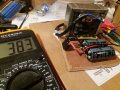
Well....here is a bench lash-up I put together with what I have. The RS transformer is taking nominal 230v on the primary, with the secondaries paired at 15 + 15 = 30V. That's connected to an FL406 bridge, whose output has a couple of 680μF electrolytics in parallel across it. The output wires just go to a voltmeter - nothing else.

I gave it some power, and got 39V DC at the output. But before I could put a scope on that I noticed that the kit was getting very hot, and killed the power. It should not have been heating at all, surely? Unless something was wrong with one of the components from my bit box....

All the components were hot - the caps were warm but the transformer and bridge were too hot to touch. There was no short at the output that I could see - just two wires going to a voltmeter.

If there was some kind of short in the secondary, then the bridge would not have got hot. If there was something wrong in the bridge, then the caps would not have got warm? If there was a short in the voltmeter then surely that would not have worked - it wasn't set to amps or anything like that. In fact, it's sitting quietly measuring the voltage decay from the caps as I type.

So, am I doing something wrong? Has one of the components failed? The only explantion I can think of which matches the data is that there was some kind of output short, though there is no evidence of one. And I checked the output wires for shorts, powered it up a second time, and got the same runaway heating.....

Has anyone got any further ideas?

power1.jpg
 

Ylli

Joined Nov 13, 2015
1,092
The caps got hot?? What are the voltage ratings on those caps, I think I see a "2" after the "680uF". If they are 25 volt caps that would explain it.
 

Thread Starter

Dodgy Geezer

Joined Nov 30, 2009
181
I thought that they said 200V as well. Looking at them more closely, I see that they say '200WV' - which is something I have not seen before....

Took the caps off - still got considerable heating, and a voltage reading of 8.9V (on a digital meter set to DC. Which seemed low to me, but I'm not surprised to find that I get odd readings without smoothing.

Took the meter off the output line, still got heating.

Am now waiting for the transformer to cool down, so that I can just trial the transformer on its own. I suspect that something must be blown, but I can't think what. Primary resistance around 40ohm - secondary around 1ohm, so perhaps the secondary is unhappy? But if so, how come it was providing 30-40V smoothed output...?
 

Thread Starter

Dodgy Geezer

Joined Nov 30, 2009
181
Just tried the transformer on its own. Runs cold and outputs 31V AC at the secondary, as it is rated so to do. Wonder what to test next. The bridge was connected correctly, but seems a bit suspicious....
 

Ylli

Joined Nov 13, 2015
1,092
Just tried the transformer on its own. Runs cold and outputs 31V AC at the secondary, as it is rated so to do. Wonder what to test next. The bridge was connected correctly, but seems a bit suspicious....
Yeah, that leaves only the bridge. You can test the diodes in the bridge with your DMM set to the 'diode' range. Ask if you need specific instructions.
 

Thread Starter

Dodgy Geezer

Joined Nov 30, 2009
181
43.3V at the output with the GBU406 and caps in circuit, and running cool with no load. It's something funny with this FL406. I have a cheap multi with no 'diode' feature, but this sounds like I won't be using this FL406 again...
 
Last edited:

Thread Starter

Dodgy Geezer

Joined Nov 30, 2009
181
I've now tried it with the motor - much more sensible amp values - about 0.4 under no load at 30V, running up to around 4A with heavy load on the motor. Could probably do with a bridge with more poke, but this one looks workable, and much more robust than a SMPS. Hope the transformer has not been too damaged... I wonder what was wrong with the FL406...

Perhaps I should add a bleeder resistor? The PWM seems to act as one, but a 1k across the lines might be good practice?
 

Thread Starter

Dodgy Geezer

Joined Nov 30, 2009
181
The test for diode drop shows one side open circuit, the other side shorted in one diresction....

Thanks to everyone for all the help - this had me stumped.....
 

shortbus

Joined Sep 30, 2009
10,049
How much do you have in the proper linear power supply you just made, in comparison to a similar rated SMPS that is the wrong thing for powering a motor? I know that people do the SMPS and motor thing on Youtube all of the time, but they never tell you how well they work or for how long. Or show one running a motor under load.
 

Thread Starter

Dodgy Geezer

Joined Nov 30, 2009
181
How much do you have in the proper linear power supply...

I would be happy to answer your question if I could understand it. Do you mean "How much did it cost?"? Perhaps you mean "How effective is it?"? Or do you mean something else? I shall try to answer the two questions above.

The components for the simple supply I built cost me nothing - they were in my bits box. I took about 3 hours finding the components and assembling them. I did this because the laptop power supply I was using very successfully with a smaller motor failed to work with this larger one, so this supply is more effective for the new motor. However, for the original smaller motor the laptop SMPS worked quite well and enabled me to cut wood on a CNC machine.

I now wish to cut aluminium, so I am going to need a bit more power, and it appears that laptop power supplies are not commonly made for the levels of power I need. Which is why I needed to make a suitable supply. I could show you a video of my CNC machine cutting light wood perfectly effectively with a small motor and a laptop power supply - you will need to wait a while if you want to see this supply driving a 775 motor through aluminium....
 
Top