Wiring Up Transformer Primaries

Thread Starter

lsllll

Joined May 31, 2017
5
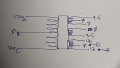
Hi folks. I'm trying to wire the primaries of the attached transformer. My mains are 120V. Currently I've only connected A and B to my mains and don't think I'm getting enough juice out of D and E, which is what I'm using for my output. Can I connect A and C together to, say, hot and B to neutral? Would that double the output of my transformer?

I saw the thread at https://forum.allaboutcircuits.com/threads/wiring-primary-of-this-transformer.56180/ and I don't think it quite answers my question, since that transformer appears to have two separate primaries, although in practice, once the two are connected in parallel it would resemble my setup.

Thanks,
Doobster.
 

Attachments

Ramussons

Joined May 3, 2013
1,568
Hi folks. I'm trying to wire the primaries of the attached transformer. My mains are 120V. Currently I've only connected A and B to my mains and don't think I'm getting enough juice out of D and E, which is what I'm using for my output. Can I connect A and C together to, say, hot and B to neutral? Would that double the output of my transformer?

I saw the thread at https://forum.allaboutcircuits.com/threads/wiring-primary-of-this-transformer.56180/ and I don't think it quite answers my question, since that transformer appears to have two separate primaries, although in practice, once the two are connected in parallel it would resemble my setup.

Thanks,
Doobster.
DON'T do this. If you connect A and C together, you are actually creating a virtual short across the power supply. If you are lucky you will get away with a power trip, else with a burnt out transformer.

What are the transformer ratings? What Voltage and Currents do you need?
 

Thread Starter

lsllll

Joined May 31, 2017
5
DON'T do this. If you connect A and C together, you are actually creating a virtual short across the power supply. If you are lucky you will get away with a power trip, else with a burnt out transformer.

What are the transformer ratings? What Voltage and Currents do you need?
I'm actually running the 9.5 V through a bridge rectifier/filtering cap/voltage regulator to get 5V. There are no ratings written on the transformer and I need 3 amps.

I don't understand why connecting A+C would be shorting the power supply. Obviously each one (A-B and B-C) is rated for 120V. Connecting them together (B on one wire, A+C on one wire) would halve the resistance between my mains and thus draw twice as much current. Technically that should translate to a magnetic field twice the size, which would translate into a larger wattage on the output. The only thing I'm not sure about is that because the center tap is in the middle of the whole wire, the same phase would feed both section. Both sections are wound in the same direction, so it seems that the magnetic fields would cancel each other and I'd get 0 on the output.

So I guess that's my main question here. Is this transformer completely different than a transformer with two primary coils? And, let's suppose it is. Then technically I should be able to take off the wrapping and break the primary at the center tap and end up with two coils, which I can then wire the proper way to double the wattage.
 

Dodgydave

Joined Jun 22, 2012
11,395
Because the polarity of the output will be "out of phase" as it's a centre tap primary, if it was two separate windings then it would work.
 

ebp

Joined Feb 8, 2018
2,332
You are correct that the magnetic fields would cancel. This would leave only the resistance of the paralleled halves of the winding across the AC line. That resistance will be small and the current very high, resulting in destroying the winding unless a fuse or circuit breaker protects it. A transformer primary must be designed so that the inductive reactance is sufficiently high to limit the "magnetizing current", usually to some quite small fraction of the current that would flow due to actual full loading of the secondary(s). For there to be inductance there must be the ability to store energy as a magnetic field. If the fields cancel, that is lost. Transformers aren't intended to store energy, but that inductance is crucial.

If the transformer winding was split into two parts where the centre tap is, the "bottoms" of each winding would connect together and the "tops" would connect together to usefully parallel the windings. It is very probable that the centre tap is buried in the windings and would not be accessible. Even if it were accessible, it might put parts of the windings at very different voltage immediately adjacent to each other. Magnet wire insulation is not adequate for more than a few tens of volts where safety is concerned.

A centre tap on a primary winding is pretty much useless for conventional application of a transformer. It is very useful for some applications such as certain topologies of switch mode power supply, but for that the core is usually ferrite.

With proper care in recognition of potentially lethal shock hazard, you can measure the primary current with no load on the secondary and then measure the resistance of the primary and calculate what the current would be if the resistance were the only thing limiting the current. A transformer can be left with residual magnetism in the core when the power is turned off and this can result in a very high transient current when power is reapplied, depending on whether the applied power first opposes or reinforces the magnetism. If it reinforces, the core can "saturate" and behave more or less as if it weren't there at all. This means that in measuring the primary current with a meter that is connected in series, it is best to short-circuit the meter when power is first applied, then remove the short so current can flow through the meter. A fuse must be used somewhere in the circuit to protect the meter from excessive current. Most reasonable quality meters will have an internal fuse, but the fuses in good meters can be quite expensive, so you don't want to blow them through carelessness.
 

Thread Starter

lsllll

Joined May 31, 2017
5
Thanks ebp. That explains everything. The transformer is toroidal if that may make a difference in reaching the center tap, and it is for an audio application, but for the price a transformer of this kind costs, I think I'll just upgrade to a beefier transformer, probably an R-core.
 

Audioguru

Joined Dec 20, 2007
11,248
The wiring in your home is 120VAC, 0V and another 120VAC that has the opposite phase from the first 120VAC. Then you have 220VAC between the two 120VAC wires to feed your stove and clothes dryer.

The primary on your transformer does not have two windings, it has one 220VAC center-tapped winding. Two separate windings can be wired to make 220VAC or 120VAC with double the current to make the same power as the 220VAC power.

Your transformer is designed to feed 120VAC to A and B or between B and C or feed 220VAC between A and C.
If you feed 120VAC between A and C then an opposite phase 120VAC will occur between B and C.
 
Top