Transformer wiring 208v to 24v (single phase)

Thread Starter

jeromio

Joined Dec 21, 2023
2
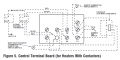
I have a 208v shop heater, wired single phase, so the 2 hots go to lugs and an equipment ground to the case. Then there's a transformer wired white to one hot lug and red to the other hot lug. The black goes to a post labeled "TR" for some reason. The 2 24v leads go to C and R. I should see 24v when the breaker is on, but I don't. The input (red & white, each attached to the hot lugs that go back to the panel) are showing 208v. But I get 0.000V on the output (24v) side. I replaced the transformer and sadly I'm seeing the same problem with the new one. The new one also does 240 via orange wire, but I capped that off.

I feel like I'm missing something obvious, but I dunno. Any ideas?
 

Attachments

michael8

Joined Jan 11, 2015
472
I'd suggest figuring out the transformer with it disconnected from everything else. Measure the resistance of each
wire to each of the others as a start.
 

Thread Starter

jeromio

Joined Dec 21, 2023
2
I'd suggest figuring out the transformer with it disconnected from everything else. Measure the resistance of each
wire to each of the others as a start.
On the old transformer:
Betw output (24v) wires: 0ohms
Betw red (208v) & black (240v) input: 0ohms
No continuity betw any other combo of wires.
 

michael8

Joined Jan 11, 2015
472
I would expect the 208 volt winding to be a higher resistance than the 24 volt winding but both might be close to 0 or 1 ohm or so.

What happened to the black wire?

Are there any manufacturer names or model numbers on the transformer and/or the heater controller?
 

jiggermole

Joined Jul 29, 2016
185
You are measuring the secondary on ac voltage not dc voltage right? I know I've messed it up before and confused my own indications. If you apply you're 208v to the primary you aren't blowing any fuses are you? And if possible are you measuring any current on the primary?
 

MisterBill2

Joined Jan 23, 2018
27,159
Is this a used transformer? Is it a used heater? If the transformer as connected backward for even a secod it has a problem. And that drawing does not even show a transformer. What sort of meter are you using??
 

Tonyr1084

Joined Sep 24, 2015
9,744
If you have a good 208VAC source and a good transformer that is 208:24 (26:3 ratio) then with 208VAC source you should see 24VAC on the secondary side. It's physics. If you're not getting that result then question whether you are using your meter correctly. How many ports for the test leads are there? What scale are you using? (AC or DC). Ohms? Is your meter auto-ranging or do you have to select a range? If you have to select a range what range are you checking on? You should be checking on the 20Ω scale, not the 20KΩ scale.

You said you have ZERO ohms on both sets of windings. At the worst that means there could be a short, at best it means there's nothing wrong with the transformer. It wouldn't be the first time anyone has made that mistake. For Christmas (about 10 years ago) I bought a cheap meter for my neighbor who always had a dead car battery. Always bugging me to come check his voltage. So I gave him a simple analog meter and told him how to use it. Now this guy is very mechanically inclined; there's NOTHING he can't screw up. He had it in his mind that "current" meant voltage. I made sure he understood the difference, but there was no getting through to him.

One morning he called me and said the meter I gave him didn't work. So I checked his battery, gave him a jump start and got him on his way. I took his meter home and checked it out. Sure enough, the 130mA fuse was blown. He set the meter to check for current and put the leads across the battery posts. Sharp as a fuzzy tennis ball. But I love him. He's a darn good friend for sure. I can always call him and ask for a hand and he's there with the muscle. I don't ask him for technical help - it's beyond him.
 

Tonyr1084

Joined Sep 24, 2015
9,744
My elderly neighbor had a sprinkler system that wasn't fully working. One zone would not come on. I checked for voltage at the solenoid and found 24VAC. So I replaced the solenoid. No luck! So I swapped wires between solenoids and now the non-functional solenoid worked and the formerly working solenoid wasn't. It turned out to be a corroded connection underground, wrapped in black tape. Moisture had been getting in there and degrading the connection.

IF you have 208VAC but it has a poor connection somewhere then the transformer could be too much load for the bad connection to carry the current needed. So in post #7 I asked if you have a good 208VAC source. Just because 208V is there doesn't mean it can carry the necessary current.
 

ThePanMan

Joined Mar 13, 2020
862
If you have a good 208VAC source and a good transformer that is 208:24 (26:3 ratio) then with 208VAC source you should see 24VAC on the secondary side. It's physics. If you're not getting that result then question whether you are using your meter correctly. How many ports for the test leads are there? What scale are you using? (AC or DC). Ohms? Is your meter auto-ranging or do you have to select a range? If you have to select a range what range are you checking on? You should be checking on the 20Ω scale, not the 20KΩ scale.
Was just thinking the same thing.
 

MisterBill2

Joined Jan 23, 2018
27,159
I studied that wiring diagram and it did not show where to connect the transformer. I saw the R and the C terminals and usually that is where the transformer would connect. But certainly the drawing was not very useful. And when a single range ohm meter is 20K ohms full scale then 200 ohms is going to be close to zero.
 
Top