Wiring LEDs with two different voltages

Audioguru again

Joined Oct 21, 2019
6,826
You said the red LEDs have a forward Voltage 1.9V to 2.3V. You did not measure them.
You said the three D batteries produce 4.5V. You did not measure the loaded voltage.
Then your math correctly shows 1.9V x 2= 3.8V. (4.5V - 3.8V)/1 ohm= 0.7A.
If the battery voltage drops to 4.2V which happens soon at 0.7A then the current will be a little less than (4.2V - 3.8V)/1 ohm= 0.4A, almost half.

But if the LEDs are 2.3V and need 4.6V plus more voltage for the resistor then the current and brightness will be low.
If the LEDs are 2.3V and the battery has dropped to 4.2V then the LEDs will produce no light.

You show five sets of "700mA" which is a total current of 3.5A. How much does the battery voltage drop at such a high current and does the battery holder contacts drop even more voltage?
 

SamR

Joined Mar 19, 2019
5,491
I have repeatedly questioned the 700mA current draw figure and still waiting for a definitive answer. Just what kind of LEDs are these? Picture plz!
 

Tonyr1084

Joined Sep 24, 2015
9,744
I have repeatedly questioned the 700mA current draw figure and still waiting for a definitive answer. Just what kind of LEDs are these? Picture plz!
Been wondering the same thing. 700mA ? ? ? Maybe I'm stuck thinking of the little 5mm LED's that typically run on a max of 30mA. But with these super duper bright LED's - - - Maybe I don't know something. Likely the case. But I too question the 700mA thing. Until I know better - - - I can add nothing more.
 

Thread Starter

gattu_marrudu

Joined May 20, 2021
20
Components bought in the "Open Market" without any provenance may be anything including scrap that did not pass quality control. Do you have any other components on hand to compare against? Why do you think they are rated for 700mA? Can you post a picture of the LEDs and any documentation you may have on them?
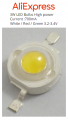
https://www.allelectronics.com/item/led-250/3w-red-led-with-star-heat-sink/1.html

This is all the documentation I have about these components.

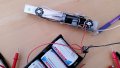
However, I started questioning the 1.9-2.3V value based on what I saw and decided to chance it. I connected a spare red LED from the same package to my battery pack and a 1.8 Ohm resistor strapped to a heat sink. It ran bright for 2 minutes. Then I reassembled my system with the two reds in parallel with the same resistance values as the green and blue ones and set it off. It's been running for over 10 minutes without any burnout, and I might let it run for another while to test the battery life.

I know that's not a scientific method, but that's what it takes sometimes when it's a holiday weekend and your source documentation is unreliable...
 

Thread Starter

gattu_marrudu

Joined May 20, 2021
20
Been wondering the same thing. 700mA ? ? ? Maybe I'm stuck thinking of the little 5mm LED's that typically run on a max of 30mA. But with these super duper bright LED's - - - Maybe I don't know something. Likely the case. But I too question the 700mA thing. Until I know better - - - I can add nothing more.
https://www.mouser.com/datasheet/2/810/NewEnergy_StarBoard_Cree_XHP35_2_DataSheet-2326266.pdf

This is just to confirm that current ratings in that range (and well above my samples) do exist and are actually common in this class of LEDs.
 

SamR

Joined Mar 19, 2019
5,491
· 1.9-2.3V 700 ma. OK, what this is telling you is that each LED has a voltage drop of 1.9 to 2.3 volts across each one and each has a maximum current limit of 700mA. Also that each LED is mounted on its own heatsink to attempt to avoid burnout from over temp. Quite a hefty LED. It doesn't appear to have an integral resistor to limit current draw so a series resistor must be added. Using a 5V power supply the series resistor = 5V/700mA which is ~7Ω @ 3.5W in series. So a 10Ω 5W resistor.
 

Thread Starter

gattu_marrudu

Joined May 20, 2021
20
Thank you. Is that what you have?
No, I was simply confirming that a 700 mA value is not outrageous for LEDs. Of course I can still question my supplier's web page as well as the life of the LED, but the PDF I linked to seems to come from a reputable supplier who wouldn't want its customers replace the products they sell every day.
 

Thread Starter

gattu_marrudu

Joined May 20, 2021
20
You said the red LEDs have a forward Voltage 1.9V to 2.3V. You did not measure them.
You said the three D batteries produce 4.5V. You did not measure the loaded voltage.
Then your math correctly shows 1.9V x 2= 3.8V. (4.5V - 3.8V)/1 ohm= 0.7A.
If the battery voltage drops to 4.2V which happens soon at 0.7A then the current will be a little less than (4.2V - 3.8V)/1 ohm= 0.4A, almost half.

But if the LEDs are 2.3V and need 4.6V plus more voltage for the resistor then the current and brightness will be low.
If the LEDs are 2.3V and the battery has dropped to 4.2V then the LEDs will produce no light.
I may not be getting the logic right but I was looking at the document that @SamR linked to earlier: http://www.gizmology.net/LEDs.htm

Look what happens when the voltage, supplied to a 150 ohm resistor in series with an LED ( , varies from 4.5v to 5.5v.

VoltageVeIVseriesVled
4.502.600.0172.521.98
4.602.700.0172.621.98
4.702.800.0182.721.98
4.802.900.0192.811.99
4.903.000.0192.911.99
5.003.100.0203.011.99
5.103.200.0213.111.99
5.103.200.0213.202.00
5.303.400.0223.302.00
5.403.500.0233.402.00
5.503.600.0233.492.01
I guess that this example would be valid for voltage drops as well. Proof is the fact that I just measured my battery pack voltage, which has been lighting the LEDs all this time, and it's at 3.9V. I haven't measured the LEDs' brightness but they still look mighty bright to me!
 

ElectricSpidey

Joined Dec 2, 2017
3,335
All Electronics is a reputable supplier.

If you run a high power LED in its maximum current range then the forward voltage will also be in its maximum range.

Therefore to run those LEDs at 700mA the forward voltage will be closer to 2.3 than 1.9.
 

ElectricSpidey

Joined Dec 2, 2017
3,335
And, I wish everyone and that includes suppliers would stop referring to the starboards as "heatsinks" those boards are just special printed circuit boards that "spread" the heat to a proper heatsink.
 

SamR

Joined Mar 19, 2019
5,491
Actually, some I've had were aluminum heat sinks and not PCB material. Based on those specs you can probably go 2 in series @ 5V and have a little bit of overhead left. You do not want to run them @ 700mA, that is the current max limit that will burn them up if exceeded. Same with the Voltage and Wattage. Leave a bit of overhead. The voltage drop is across a range, so use the high value for calculations.
 

Thread Starter

gattu_marrudu

Joined May 20, 2021
20
I attached them to a square aluminum pipe. Nylon screws were a bit too complicated so I just used two points of JB Weld and thermal compound underneath. The rod is moderately hot to the touch after 1 hour continuous operation. led_square_mount.jpg
 

Audioguru again

Joined Oct 21, 2019
6,826
Using a 5V power supply the series resistor = 5V/700mA which is ~7Ω @ 3.5W in series. So a 10Ω 5W resistor.
Sam, your math is heating the resistor red hot without the LED forward voltage in your calculations.
The 2.3V (?) LED is in series with the resistor so the resistor has 5V - 2.3V= 2.7V across it resulting in a current of only 2.7V/7 ohms= 386mA but using a standard 10 ohms the current is only 270mA.

Now Gattu admits that his "4.5V" battery measured 3.9V when powering the LEDs. That is why the two red LEDs in series that might need 4.0V look dim.

The LEDs at Allelectronics are No-Name-Brand junk. The LEDs made by Cree and sold at Mouser are much more trustworthy.
 

SamR

Joined Mar 19, 2019
5,491
Bottom line is that is a lot of load on a small battery!

"Now Gattu admits that his "4.5V" battery measured 3.9V when powering the LEDs. That is why the two red LEDs in series that might need 4.0V look dim."

Yes, no overhead left! My onboard calculator is a bit fogged up this morn, sry...
 

Thread Starter

gattu_marrudu

Joined May 20, 2021
20
Now Gattu admits that his "4.5V" battery measured 3.9V when powering the LEDs. That is why the two red LEDs in series that might need 4.0V look dim.
By that same logic I would see all the LEDs get dimmer together. In my first setup only the red ones were much, much dimmer than the others. In my current setup, they may be dimmer than they should be, but they are all still outputting a great deal of light. So much that I can't look at them directly.
 

Audioguru again

Joined Oct 21, 2019
6,826
The voltage for two red LEDs in series is past or close to their total forward voltage so the brightness varies a lot when the voltage varies a little.
The Tenergy batteries are made in China. Some reviews say they are no good. Eneloop Japanese Hi-MH batteries made by Sanyo/Panasonic are excellent and maybe the Energizer made in Japan batteries are the same.
 
Top