The Vf value is not related to an LED's ability to operate outside its maximum ratings. For circuits such as yours, LEDs die because of overcurrent. You must have some mechanism for limiting the instantaneous peak current (electronics can die very quickly).
Side note: In a series circuit with differing Vf values, the LED with the lowest Vf will dissipate the least heat. All things never are equal, but if all other things were equal, this would *increase* its reliability relative to other LEDs with higher Vf.
2. I can safely group series of LEDs with the same FV.
By itself, mixing LEDs of different colors, brightness ratings, and Vf values has zero effect on reliability. In a series string, the current through any element is the current through all elements. The LED with the lowest current rating sets the design point for the entire string. Protect that part, and the rest will be fine.
While my video shows you can parallel LED's with the same Vf, it's never a good idea. As was pointed out, if one fails the rest could cascade in quick succession. Best practice is to have a resistor for each LED. If you're putting a string of LED's in series, two things you need to know and understand: Best to stay with the same color and Vf. The total Vf of the series LED's MUST be less than the source voltage. If you have 10 LED's with a Vf of 2.9 then you need at a minimum, 29 volts. Best to give yourself a little head room. With 10 LED's I would recommend at least two Vf's (in other words, 5.8 volts) higher than the total Vf. Decide on a current. Many LED's are plenty bright at 10mA, so divide the voltage by the amperage and select the closest possible resistor. But wait - it's not that simple; well, actually it is:
Start with the supply voltage. Subtract the total Vf. You now have a new number. Divide that by the desired current and you will determine the proper resistance.
Example:
30V power supply
22Vf (the total of 10 LED's each with a Vf of 2.2)
Subtract 22 from 30, you get 8
Divide 8 by the current. (Lets assume 10mA)
8 ÷ 0.01 = 800Ω
Choose the closest standard resistor or use multiple resistors to achieve the desired total resistance
Using a 470Ω and a 330Ω resistor in series gives me 800Ω
Next - and this is important too - calculate the wattage. When choosing resistors you need to have resistors that can handle the wattage. At 800Ω you will have 10mA flowing through the entire circuit. Multiply 0.01 times total voltage (30V) and you have 300mW. Using a quarter watt resistor (250mW) will fail. The resistor will overheat and burn out. This case you would need half watt resistors.
Simple enough when you understand the total package. Guessing at "what if" usually leads to one of three things: First, your circuit could fail due to under-engineering the circuit (something burns out). Second, everything works but you've over-engineered the circuit (it could withstand 10 times what you need). While that's not a problem it's also not good practice. The third thing can be you've accidentally come up with the best design; and that's often not the case.
Follow the advice you've been given. If you need clarity then ask specifically about the parts you don't understand. It seems like you're already asking questions but it also seems like you're not fully getting the picture.
Different FV in series is fine if the total FV is less than the supply V. Would want some extra overhead after FV is subtracted. And don't forget to limit the current!
What I am inferring from the conversation so far (please let me know if I'm off the mark):
1. If I put LEDs with different forward voltages values in series, the ones with lowest value will die (that's probably what happened to the red LED in my original circuit).
When I first read this, I thought you wanted to group a series (number) of LEDs in parallel. Connecting in series is okay, parallel not so much.
3. If I parallel connect series of LEDs with different individual FV, but consistent within each serial chain, either each chain should have a total voltage drop equal to the others, or I shall adjust that by using resistors of different values to balance.
The resistor is to limit the maximum current to the LED.
However, since efficiency is a concern here, I would want to use a source voltage as close as possible to the voltage drop of the LEDs (and hence a small Ohm value).
When trained professionals design circuits, we design with the nominal component values. If we needed tighter tolerances, we used components with tighter tolerances. I was never taught to cherry pick parts. A large manufacturer I worked for did that with some parts, but it wasn't a common practice.
When I was an R&D technician working on some fairly complex designs, I can count on the fingers of one hand the number of times I had to cherry pick a component value. That usually involved some low value inductors or capacitors I needed to tweak the frequency response of a circuit. But this was R&D, not a production environment.
LED brightness differences of less than 50% aren't easily discerned by the human eye, so you may be splitting hairs for nothing. For cases where brightness matching mattered, you'd use a current source.
I don't know how you get this "cherry picking" concept from what I said, i simply measure the forward voltage of my high power LEDs to determine the other values used in driving them...no "cherry picking" involved.
Usually, I’m driving LEDs, so realize the comment also applies to other devices, such as a motor, H-Bridge, BJT/MOSFETs, etc... Each branch must be current controlled. Any given branch (of LEDs) must be current controlled. The value of a resistor needed for each branch of series components is calculated as follows.
Vc = Vs - sum(Vf)
R = Vs / min(If)
I try to make Vc close to Vled... But usually, using the number of leds (n) and the specified forward voltage for the LEDs used and replacing sum(Vf) with n*Vf is sufficient.
I don't know how you get this "cherry picking" concept from what I said, i simply measure the forward voltage of my high power LEDs to determine the other values used in driving them...no "cherry picking" involved.
I consider the act of measuring something to pick the value of something else to be cherry picking.
I can't recall ever measuring the forward voltage of an LED for the purposes of selecting "other values used in driving them". When I built an LED cube, I never measured the forward voltage of any of them. I didn't even test them to make sure there weren't any dead ones before assembling each plane (I did make sure none were dead before I connected the planes because replacing an LED in the assembled cube could be difficult and it would certainly mess up the alignment). I used the nominal forward voltage and designed for a nominal current. I didn't care what the exact value was.
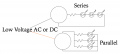
Not sure why, but I feel compelled to show this illustration: Notice in Parallel, each LED has its own resistor. This is Best Practice. In my video I've shown that it IS possible to use a single resistor and have multiple parallel LED's, but it's NOT "Best Practice". The illustration is what should be the case by way of making a circuit that will be more robust and more reliable. The video was just to settle an argument. The argument against what I've shown IS a good argument. But it's not an all inclusive argument. Just because something CAN be done doesn't mean it should be done.
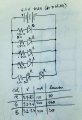
I Used Ohm's Law calculator to get the resistor values based on the LEDs' lowest ratings (1.9 x 2 for the red, 3.2 for the others). Contrarily to what I expected, the red LEDs are much dimmer than the others. Can anybody explain why?
Manufacturing variance? Many makers of LED of varying properties. Old Red LEDs that I have from the 70s are very dim compared to today's offerings. A lot of market LEDs have no provenance much less a maker's PDF. At first glance, 100 and 700 mA seem excessive depending on the LEDs design.
You show a current of only 100mA in the red LEDs but the brighter LEDs have a current 7 times more at 700mA.
Doesn't the current and brightness drop A LOT as the battery voltage runs down?
I got all my LEDs from the same supplier and seem to be of the same type. They are all rated at 700mA. The red brightness, by eyeball, looks like half or less, and it's similar for both. It could always be that the manufacturer's specs are WAY off for the reds and they actually want 3.2-3.4V as the others, but I wouldn't want to find that out by applying more voltage. The best thing seems to ask the supplier at this point. (By the way, I cheated a bit and bypassed the 1Ohm resistor for a fraction of second. The light got visibly brighter, but not nearly as bright as the blue and green ones.)
From this conversation I thought that that is what the resistors are for, to kind of smooth out voltage variations—both peaks and drops, no? In any case, I would expect the drop to be equal for all, unless I'm missing something.
Components bought in the "Open Market" without any provenance may be anything including scrap that did not pass quality control. Do you have any other components on hand to compare against? Why do you think they are rated for 700mA? Can you post a picture of the LEDs and any documentation you may have on them?
No, the resistor is to limit the current to below the Max listed in the PDF! Remember, LEDs are CURRENT devices that drop voltage across them due to their PN junction barrier losses.

 Facebook
 Google
 GitHub
 Linkedin