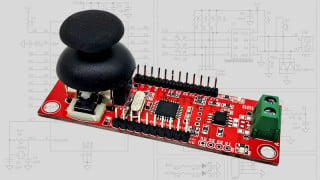
wiring and control method to connect an arduino to a PWM dc controller

Thread Starter

Owen Nieuwenhuyse

Joined Jun 20, 2017
42
https://www.aliexpress.com/item/NEW...11237.html?spm=2114.10010108.1000023.1.jILm8k
$us 46.39
$nz 63.44 free ship.
This looks like an appropriate unit to use. The motor is 12V, 700W rated, potential start current - massive?
free speed = 1500 rpm.
1) Can I monitor and limit current demand? Above 80A, controllers get expensive.
The load requirement is only 42 J (150 N x 0.28 m at steady speed)
I possibly want x 3 times the current to get adequate acceleration torque.
if this takes 2.3 secs at 750 rpm, this is 18 watts - for 42 J very small;*** x 3 = 54 W***
Such a big motor would run at a higher rev point, so we could easily double
the output power-to say 108 W ??? less time, more power.
This is 3x the base power to get the correct current estimate.

What is the current needed to get the correct torque? Permanent magnet brushed motor:

If this was a standard motor, at 60% efficiency, this would need 15 amps. This probably doesn't
need to use vastly more, but doesn't run as fast at maximum load- maybe 750 rpm at full power (half speed)?
as torque is directly related to amps.
The maximum power current of 50A would do me as a starting current as well
The driveline would probably work OK with a lot less than 50 A.

Can anyone identify the type of controller they are using? is it digital? can I directly input
a PWM signal? I have found a nice digital tacho unit. How would I set a control strategy to
limit output current? would I need extra electronics?
Does my reasoning re output sound correct?

700 W would need 120A at 50% efficiency, so potential starting current is very likely
x 2 or more - over 240A potential!. Definitely fryup material!
Torque and current is generally linear through the maximum power point at 50% speed, for
permanent magnet motors.
Does running at 50% of no-load speed mean 50% efficiency?

Do I need bridging flyback diodes and capacitors? How do I work out the correct
ratings?
Can I get a lower rated motor that would do the job?
It would be lighter- this one is about 3 kgs.,
price is fairly cheap: $150 nz delivered.
I need about 1 N-m at maximum power, free speed 1500 rpm, 12V
I will check Aliexpress.

cross-check : 10mm lead at 450N = 4.5 J
T = J/2pi = 0.72 N-m, 78 rad/s, w x T = P = 56 W - does this sound about right?
 

Thread Starter

Owen Nieuwenhuyse

Joined Jun 20, 2017
42
That link is for an analog input PWM controller. The pot controlls the speed as far as I can see.
That pot seems to have lots of wires to it. I was wondering if it were a digital rotation/position sender?
You really need input instructions. They don't seem to give specs, instructions etc on those ads.
 

shortbus

Joined Sep 30, 2009
10,049
What happened to the resistors to control speed of the motor? Didn't you tell me that PWM wasn't going to work? Or for that matter not necessary?
 

Thread Starter

Owen Nieuwenhuyse

Joined Jun 20, 2017
42
What happened to the resistors to control speed of the motor? Didn't you tell me that PWM wasn't going to work? Or for that matter not necessary?
That was an old question, before I decided to drop the up/down speed a lot, making simple torque and time control feasible.
If it is an actuator, and only runs 1-5 percent of the time, efficiency is not important.
 

shortbus

Joined Sep 30, 2009
10,049
Are you really an engineer as your 'blog' suggests? If so why are you not using normal established engineering terms in any of your rantings?

Why would you need a PWM controller if you already have or are planing on having a micro computer for this? The micro would create the PWM and all that is needed then is a Hbridge or even a 'motor shield' that is something off the shelf.

Why are you using such a high wattage motor and trying to slow it down electrically and not just using gearing to get the required speed? Doing this would allow a smaller cheaper motor to be used.

Your whole take on this has been so disoriented and bungling that I can't believe you are really serious about ever doing this project. Your questions just beg for asking you more questions before getting answers.
 

Thread Starter

Owen Nieuwenhuyse

Joined Jun 20, 2017
42
Are you really an engineer as your 'blog' suggests? If so why are you not using normal established engineering terms in any of your rantings?

Why would you need a PWM controller if you already have or are planing on having a micro computer for this? The micro would create the PWM and all that is needed then is a Hbridge or even a 'motor shield' that is something off the shelf.

Why are you using such a high wattage motor and trying to slow it down electrically and not just using gearing to get the required speed? Doing this would allow a smaller cheaper motor to be used.

Your whole take on this has been so disoriented and bungling that I can't believe you are really serious about ever doing this project. Your questions just beg for asking you more questions before getting answers.
 

Thread Starter

Owen Nieuwenhuyse

Joined Jun 20, 2017
42
1) My only "real-life" engineering experience was with whiteware, and DC motors and
motor controllers never came up. I am better with sheet metal and injection-moulded
plastic parts. I will file your Hbridge and Motor Shield suggestions for any future applications.
-ie power-assisted tadpole tilter-not that I could afford to build it.

I have spent the last 15 years doing computer programming, which was a bit of a career change.

2) I think I was getting into too high a speed/power zone, with the stabiliser wheel idea, and it was getting complicated.
Specifying a different type of linear actuator and a slower lift speed has given me more,
lower cost options.
I also had to find out about the RobotShop to get motors and gearboxes.
Normal commercial units are not in the right ranges. I haven't had anything to do with those
"Fighting Robots" before.
 

shortbus

Joined Sep 30, 2009
10,049
Specifying a different type of linear actuator and a slower lift speed has given me more,
lower cost options.
Your back to linear actuators again? How are you going to sense when the jockey wheel contacts the ground? To keep it from causing the bike to crash? I still think a 'swing down' type of jockey wheel is safer.
 

Thread Starter

Owen Nieuwenhuyse

Joined Jun 20, 2017
42
Your back to linear actuators again? How are you going to sense when the jockey wheel contacts the ground? To keep it from causing the bike to crash? I still think a 'swing down' type of jockey wheel is safer.
There is a swing arm. I think I posted a scale drawing for the chain drive actuator, and how it fitted in. I think I could use a polished pushrod and sliding seal on that, so that it can stick out into the weather. would that need to be chromed and ground? Does it need several stages of seal, like the ones on front forks?
Maybe tubular, 15mm diameter??
What catalog should I look for to find a seal system?
- Just google "weatherproof round sliding seals", I suppose.
The "push out" idea is just to avoid adding a clutch.
The time limit should stop any great "heave" against the ground if it is activated accidently.
The ground-level locking can be done with a substantial lever, which is unlikely to
be activated in sequence by accident. A car handbrake lever would do.
Refinements can be:
1) up-and-locked light.
2) down-and-unlocked light-larger lens.
3) down-and-locked light-warning to keep speed down-illuminated sign?
4) Counter logic/digital display for leg extension-case of jammed mechanism?
This can work off a sprocket or dedicated rotary counter.
A count-and-display unit may be available for less that a microcontroller, and be
easier to set up and install.
5) full-blown microcontroller and independent speed detector for additional warnings/lockouts etc- not really required.
 

shortbus

Joined Sep 30, 2009
10,049
I'm really not trying to put you down, but again you seem to know very little about how things work and mechanical engineering. Not knowing even about seals seems to be something that even the starting out level mechanics would know.

Just like wanting to control the speed of the DC motor and overall drive. You gear the final drive to the top speed and then if a lower one is needed you drop that by PWM. You don't arbitrarily pick a motor (they all have a pretty much similar top speed), then limit them by PWM or resistors to get them to the speed and torque you need. You also need to know the weight and load on what your attempting to lift, then pick the appropriate size motor to do the job. You from the beginning have been 'engineering' backwards.

Why make things so complicated? Why have two motions to do what one can do? By this I mean swing down and then extend. Unless I'm loosing site of your final project. In the beginning you talked about this being to just keep your cyclecar from falling over when stopped or coming to a stop. Are you now also going to use it like a 'center stand'?

The same with your two way 'clutch drive'. A very expensive machined part if you are paying to have one made. And then there is the "wave spring" you designed for it, makes no sense. Designers or engineers don't make things up for no reason, they use existing, off the shelf things where ever possible. In your other thread about the drive you kept going on about the "zero position" in the drive. You never once gave the meaning of the phrase, can you please explain what 'zero position' means or is? On your blog you talk about a car winch and how it can 'freewheel' the cable out, then claim that is what your two way clutch does. Have you ever seen the insides of the freewheeling winch? They don't use your so called 'friction pucks' I can guarantee you.

I want to help you with this, I really do and will. But you need to come to grips with the way you're going at it is going to end two ways. 1. you are going to spend a lot of time and money doing it your way and still not have a working project. 2. you will wreck the bike when you finally try it out. Learn from people who have done what your trying to do, look on the company websites to see how they did it and try to understand why they did what they did.
 

Thread Starter

Owen Nieuwenhuyse

Joined Jun 20, 2017
42
I'm really not trying to put you down, but again you seem to know very little about how things work and mechanical engineering. Not knowing even about seals seems to be something that even the starting out level mechanics would know.

Just like wanting to control the speed of the DC motor and overall drive. You gear the final drive to the top speed and then if a lower one is needed you drop that by PWM. You don't arbitrarily pick a motor (they all have a pretty much similar top speed), then limit them by PWM or resistors to get them to the speed and torque you need. You also need to know the weight and load on what your attempting to lift, then pick the appropriate size motor to do the job. You from the beginning have been 'engineering' backwards.

Why make things so complicated? Why have two motions to do what one can do? By this I mean swing down and then extend. Unless I'm loosing site of your final project. In the beginning you talked about this being to just keep your cyclecar from falling over when stopped or coming to a stop. Are you now also going to use it like a 'center stand'?

The same with your two way 'clutch drive'. A very expensive machined part if you are paying to have one made. And then there is the "wave spring" you designed for it, makes no sense. Designers or engineers don't make things up for no reason, they use existing, off the shelf things where ever possible. In your other thread about the drive you kept going on about the "zero position" in the drive. You never once gave the meaning of the phrase, can you please explain what 'zero position' means or is? On your blog you talk about a car winch and how it can 'freewheel' the cable out, then claim that is what your two way clutch does. Have you ever seen the insides of the freewheeling winch? They don't use your so called 'friction pucks' I can guarantee you.

I want to help you with this, I really do and will. But you need to come to grips with the way you're going at it is going to end two ways. 1. you are going to spend a lot of time and money doing it your way and still not have a working project. 2. you will wreck the bike when you finally try it out. Learn from people who have done what your trying to do, look on the company websites to see how they did it and try to understand why they did what they did.
1) weather seals are different from plain oil seals. A set suitable for a Macpherson strut may do the job.
Any kind of wiping seal is not going to cope with stuck-on dried road grime. It needs some kind of hard-ish scraper, and a very hard ground surface.
I need to research that. Even motorbike fork seals wear out quickly in poor conditions.
2) winch clutches. I haven't been able to find a drawing on line for the innards of a winch clutch, and I am not gong to buy one to
to pull it apart. Maybe I could look in old patent drawings? There are probably very many different types.
3) Getting two different torque levels from one motor: The reverse drive torque limiting is just to overcome inertia and drag in the lift
mechanism. It still functions mainly as a gravity drop device. A standard momentary push-button, like a motorbike starter button,
plus a relay,
would probably do, without the expensive timer.
This totally eliminates the need to manufacture a clutch.

A simple tubular face-dog clutch with a swinging yoke and solenoid would be the preferred option if a clutch was needed.
That could be assembled with hand tools and brazing, without any lathe work.
A lathe is possibly needed to custom-bore the sprockets. You can also order them pre-bored, if you want to pay top dollar.
Lathe work is also desirable to make aluminium bearing blocks, to get the bore square on to a face. That requires a bit of custom tooling
and careful setup to do in a drill press.

The only time a power down of the stabilizer wheel would cause a problem is in
the middle of a corner, while leaned over. If the torque is absolutely minimal at stall, any cornering destabilising will be small.
I can try that out in a large, empty carpark at slow speed, to improve testing safety. Other safety provisions could be to use
"limiting skids", to absolutely prevent tipover, again to be used at low speeds for testing only.

4) Generally for safety issues I intend to have a full testing program.
The whole thing is also submitted to the "Low Volume Vehicle Testing Authority" at several stages during design and construction.
They can veto anything they consider unsafe,or mandate any safety-related changes.
For instance, in steering-related parts, I am pretty sure I have to use standard car-type steering ball joints with a taper fitting.
Rose joints and bolts would not be allowed. An exception to that would be a pre-certified application, like the Caterham lower
suspension outer joint, or a specially machined center adapter for the rose joint.
(The current motorcycle design involves a secondary steering head with a push/pull rod and ball joints)
 

Thread Starter

Owen Nieuwenhuyse

Joined Jun 20, 2017
42
I have finally come to the conclusion that you are an internet troll, not some one doing a serious project.
No, I am a POOR PERSON. Different thing altogether. Are all people who talk and dream, but do not immediately build
something, to be considered as trolls? It seems to be a prevalent attitude amongst some "professional" motorcycle builders! :(
 

shortbus

Joined Sep 30, 2009
10,049
No, I am a POOR PERSON. Different thing altogether. Are all people who talk and dream, but do not immediately build
something, to be considered as trolls? It seems to be a prevalent attitude amongst some "professional" motorcycle builders! :(
If, as you say your a 'poor person', why do you resist learning how to do things an easier and cheaper way? I to am poor, I live on US$ 800.00 a month, so don't talk about poor to me. If you are 'poor' as you say, why do you start a project with buying a motor, that may or may not be the one you need? Before you even know how much power will be needed to do the job? There's no problem being 'poor', there is a problem in doing 'stupid' things with your lack of money. That will just make you poorer. Looking as I've said at how others have done things doesn't take money, especially now with the web, looking at catalogs and patents doesn't take money, looking at how things work doesn't take money. It's having an interest in how things mechanical work that and applying them to your problem/needs that makes the little money you have get results.

You through our whole conversations have had an idea and aren't willing to change. I spent my working lifetime doing this stuff. As both my job and one of my hobbies, have designed dies, molds and specialized machines, as well as vehicles for myself, all successfully, not all in the first go but in the end they were after so redesign of minor items. Looking as I've said at how others have done thin

I ask questions and you ramble on and refuse to answer them, acting incoherent, that is the reason I called you an internet troll. If your talking about "professional" motorcycle builders in your area that you are interacting with or even on the web, they have a business to run. They don't interact with people that don't have a real clue of what they're talking about in the first place. Like I've said before I really like helping people solve mechanical problems and have done it freely, but you have to get out of your own way and be open minded. Dreams are great, but if you want to realize the dreams with little money, you need to get smart in how you think.
 

Thread Starter

Owen Nieuwenhuyse

Joined Jun 20, 2017
42
If, as you say your a 'poor person', why do you resist learning how to do things an easier and cheaper way? I to am poor, I live on US$ 800.00 a month, so don't talk about poor to me. If you are 'poor' as you say, why do you start a project with buying a motor, that may or may not be the one you need? Before you even know how much power will be needed to do the job? There's no problem being 'poor', there is a problem in doing 'stupid' things with your lack of money. That will just make you poorer. Looking as I've said at how others have done things doesn't take money, especially now with the web, looking at catalogs and patents doesn't take money, looking at how things work doesn't take money. It's having an interest in how things mechanical work that and applying them to your problem/needs that makes the little money you have get results.

You through our whole conversations have had an idea and aren't willing to change. I spent my working lifetime doing this stuff. As both my job and one of my hobbies, have designed dies, molds and specialized machines, as well as vehicles for myself, all successfully, not all in the first go but in the end they were after so redesign of minor items. Looking as I've said at how others have done thin

I ask questions and you ramble on and refuse to answer them, acting incoherent, that is the reason I called you an internet troll. If your talking about "professional" motorcycle builders in your area that you are interacting with or even on the web, they have a business to run. They don't interact with people that don't have a real clue of what they're talking about in the first place. Like I've said before I really like helping people solve mechanical problems and have done it freely, but you have to get out of your own way and be open minded. Dreams are great, but if you want to realize the dreams with little money, you need to get smart in how you think.
 

Thread Starter

Owen Nieuwenhuyse

Joined Jun 20, 2017
42
If, as you say your a 'poor person', why do you resist learning how to do things an easier and cheaper way? I to am poor, I live on US$ 800.00 a month, so don't talk about poor to me. If you are 'poor' as you say, why do you start a project with buying a motor, that may or may not be the one you need? Before you even know how much power will be needed to do the job? There's no problem being 'poor', there is a problem in doing 'stupid' things with your lack of money. That will just make you poorer. Looking as I've said at how others have done things doesn't take money, especially now with the web, looking at catalogs and patents doesn't take money, looking at how things work doesn't take money. It's having an interest in how things mechanical work that and applying them to your problem/needs that makes the little money you have get results.

You through our whole conversations have had an idea and aren't willing to change. I spent my working lifetime doing this stuff. As both my job and one of my hobbies, have designed dies, molds and specialized machines, as well as vehicles for myself, all successfully, not all in the first go but in the end they were after so redesign of minor items. Looking as I've said at how others have done thin

I ask questions and you ramble on and refuse to answer them, acting incoherent, that is the reason I called you an internet troll. If your talking about "professional" motorcycle builders in your area that you are interacting with or even on the web, they have a business to run. They don't interact with people that don't have a real clue of what they're talking about in the first place. Like I've said before I really like helping people solve mechanical problems and have done it freely, but you have to get out of your own way and be open minded. Dreams are great, but if you want to realize the dreams with little money, you need to get smart in how you think.
You seem to be rather argumentative and aggressive about this discussion. If you have a specific question, I will try to answer it.
I am starting with speed and load and geometry requirements. Possibly my initial speed was too high.
Using the 200 watt range, and adjust speed to suit, seems to be a better target. this gives me a traverse time
estimate around 1 - 2 seconds, which seems bearable.
This whole design is just an initial feasibility study, for working in the overall weight range of 250 to 300 kgs.

I have a new option for a project that I can afford now, using a Honda Ct110 or similar. That will not need
any stabilizer wheels, and be in the 100 - 150 kg range. The motor is not that exciting, but It allows a low seating position and can use the original frame, with just some alterations in the seat and fuel tank area,
and put the front footrests even with the front axle. I have posted photos of an already-done example,
if you want to look.-on Flickr or Wordpress? There are some little problems to solve with gearshift
and footbrake. I am looking for a running example in the 300-600 dollar NZ price range.
That should be able to cruise at 70 mph, with some extra streamlined bodywork.
This is rated at 7.6 hp. A water-cooled 250 would be nice, but I want a gearbox-chain drive setup,
and the horizontal cylinder. Mostly those are vario belt drive scooter motors.
I can get Chinese Lifan motors of 140-150ccs based on the Honda motor, but the 110 would do me, I think.

My gripe with the motorbike builders is mainly to do with the Yahoo etc email groups, which seem to be dominated by professional builders. I have stopped posting there, and joined up with
a UK forum/bulletin board, which should be more tolerant of amateurs like myself.

They have a group on Projects/Restorations/Old motorcycles which sounds appropriate, tho the posting rate
for that board is rather low.

I am quite keen on Google searches and on-line catalogs, and am getting better at finding what I want.
The RobotShop was a good find.
 

shortbus

Joined Sep 30, 2009
10,049
You seem to be rather argumentative and aggressive about this discussion. If you have a specific question, I will try to answer it.
I am starting with speed and load and geometry requirements. Possibly my initial speed was too high.
Using the 200 watt range, and adjust speed to suit, seems to be a better target. this gives me a traverse time
estimate around 1 - 2 seconds, which seems bearable.
This whole design is just an initial feasibility study, for working in the overall weight range of 250 to 300 kgs.
I am being 'argumentative' with you, you are very "flighty and evasive" with your answers . So getting 'argumentative' was trying to shame you into better answers. But it hasn't worked. You use weird, unknown values and formulas that make no sense in engineering terms. Just like in this post that I'm quoting. How is your outrigger going to ever weigh even 200kgs? That would be closer to the weight of the whole bike, not the outrigger it's self. You only need to lift the outrigger and it doesn't need to weigh very much. A tubing weldment will work for it. And your specifying a motor again before you even have an outrigger design and actual weight. That's not how things are designed successfully.

As far as other motorcycle related sites treating you badly, if you act the same there as you do with me, no wonder they give you a hard time. You come of as someone that knows it all already and you don't know anything about what your talking about, and it is very obvious to others. Anyone can start a blog claiming to be an engineer, but you better have something to back it up, besides dreams. Have you noticed at all that I'm the only one to keep up a conversation with you? There's a reason that others aren't joining in. And it's in this paragraph. If you don't want my help just say so, won't hurt my feelings a bit.
 

Thread Starter

Owen Nieuwenhuyse

Joined Jun 20, 2017
42
I am being 'argumentative' with you, you are very "flighty and evasive" with your answers . So getting 'argumentative' was trying to shame you into better answers. But it hasn't worked. You use weird, unknown values and formulas that make no sense in engineering terms. Just like in this post that I'm quoting. How is your outrigger going to ever weigh even 200kgs? That would be closer to the weight of the whole bike, not the outrigger it's self. You only need to lift the outrigger and it doesn't need to weigh very much. A tubing weldment will work for it. And your specifying a motor again before you even have an outrigger design and actual weight. That's not how things are designed successfully.

As far as other motorcycle related sites treating you badly, if you act the same there as you do with me, no wonder they give you a hard time. You come of as someone that knows it all already and you don't know anything about what your talking about, and it is very obvious to others. Anyone can start a blog claiming to be an engineer, but you better have something to back it up, besides dreams. Have you noticed at all that I'm the only one to keep up a conversation with you? There's a reason that others aren't joining in. And it's in this paragraph. If you don't want my help just say so, won't hurt my feelings a bit.
250-300 kgs was mentioned as the target motorcycle weight.
200 Watts was the motor power. I didn't go into load or ratio.

I don't consider that I was being flighty or evasive. Maybe I didn't get your point, or understand your question,
or maybe you were asking a question in a roundabout way?

My meaning may possibly not be fully explained
in my text or diagrams. Weird descriptors probably are part of an analogy I was using, like a zero motion reference. That is analogous to a signal zero or ground value, possibly??

Frames of reference are not normally part of an engineering discussion. They come up a lot in physics.
I was trying to establish that the initial mechanism had no external measure of rotation, only an internal
one. Sometimes external measurements or attachments can be important.

The rough rotation diagrams
were about that also. I suspect that an engineer would not normally use such diagrams, but an inventor or a
physicist would.

Anyhow, the stabilizer wheel mechanism is now on hold while I check out the Honda CT110 idea.
That would not need any extra support- legs and prop stand are enough.

I would be interested in ideas to combine a 250cc scooter motor with a proper clutch and gearbox.
-Possibly sourced from a pre-unit motorcycle?? .
I have seen a gearbox casing cut from a set of motor cases, with extra plates welded in, and driven
from another motor via the original primary gear drive.
This setup has been used to run a snowmobile motor through a motorcycle gearbox.
It sounds like a bit too much work and "fiddling" for me, though, as well as my not having easy access to a motorcycle wreckers yard.

It looks like the CT110 would make a good project donor, but I am not sure on prices and availability
of second-hand ones.
Another good option for cheap and available is the Suzuki 200 AG bike. This can be road-registered
in NZ, and there are a lot of them coming up for sale. That is rated around 18 hp, more than twice
the Honda rating. Unfortunately it is not easily modified into the form that I want.
The suspension would also need shortening/stiffening, or swapped with another model/make of bike.
-It would be ok for use as a general knockabout/local backroads bike, though. They have a "peppy" feel,
according to reviews.

engine parts are cheaply available from china/Hong Kong, for an engine rebuild.
I could replace most of the barrel/top end/cam gear and clutch for a couple of hundred dollars.
Crank/bigends should be OK.

Yet another one I am currently putting in auction bids for is a 250 Suzuki Bandit 4 cylinder.
It needs a little fixing up, but I will try to get it for under $600. I think it is worth $1500, though,
so I will see. I will try bidding close to auction close time. It seemed to have one other
follower when I bid on it last, at $110...
Interesting bike-competitive with an old Yamaha RD350 on performance.
 

Thread Starter

Owen Nieuwenhuyse

Joined Jun 20, 2017
42
As far as other motorcycle related sites treating you badly, if you act the same there as you do with me, no wonder they give you a hard time. You come of as someone that knows it all already and you don't know anything about what your talking about, and it is very obvious to others. Anyone can start a blog claiming to be an engineer, but you better have something to back it up, besides dreams. Have you noticed at all that I'm the only one to keep up a conversation with you? There's a reason that others aren't joining in. And it's in this paragraph. If you don't want my help just say so, won't hurt my feelings a bit.
It is not illegal to "spout shit" a bit. On some boards, it is quite expected. I know that some people do find me irritating in my manner,
but it is not as simple as "backing it up". It is more of "brash newcomer" vs "old boys network" . People just don't like anyone who doesn't
behave or talk like they expect. I am sure I am not explicitly offensive, and I don't engage if "flaming" - ie insulting peoples intelligence,
ancestry, or parentage.
These people who may be offended need to come out and discuss any problems with me, not simply
shit on me from a great height!
Really, they just can't be bothered trying to appreciate some other person's point of view.

I make no claims to be a good engineer, or to be experienced in all relevant fields, just that I have done the coursework, got the
certificates, and have worked in somewhat relevant fields. Designing and building whiteware may not seem to be very glamorous, but it was good experience. I am not totally "green" or "wet behind the ears".

I have also gained practical experience in engineering "trades" informally over many years, and am as qualified as anyone to
build "good stuff" in my garage. This is all you need to build motorbikes and motorbike frames: It is not a "rocket science"-type occupation...
 
Top