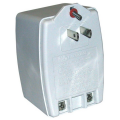
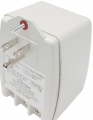
Wiring 3 terminal AC Transformer to two terminal control board

Thread Starter

Smucoy

Joined May 19, 2024
13
If any additional "ground" connection was not needed with the previous transformer, why wold it suddenly be needed now,with the replacement transformer??
There has been no mention about anything else changing.
Would generally agree. Just making sure it makes safety sense and previous installer didn't hack it. The EGND terminal was not wired on the previous system and there was a POTS line connected. Went 20 years without an issue, but since I am replacing thought I would make sure everything makes sense.
 

Thread Starter

Smucoy

Joined May 19, 2024
13
I'm coming to conclusion that EGND terminal protection is likely for one or any of the following situations:
1. protection from input surge from POTS connection (which doesn't apply in my config).
2. protection of PC board from static or arcs.
3. Resilient protection from event where security system wiring could become energized due to some cross with a class 1 circuit where anyone coming in contact with any part of the system would be in danger.
4. No code requiring the ground that I am aware of since the system is low voltage and airlocked behind grounded transformer. The manufacturer is probably instructing ground to protect the PC board circuitry.

So ground or not is the question. Assume if do connect, then wiring the PC board EGND terminal to the EGC in the outlet box which supplies the 16.5VAC power transformer would suffice?
 

Thread Starter

Smucoy

Joined May 19, 2024
13
So silly me, think I am connecting the dots… IF… following my post above, want to connect to the EGC of the AC power supply service outlet, presume I would simply wire power supply GND terminal to a ground screw on the control board metal enclosure and then wire the pc board EGND terminal to the ground screw? I suspect this is what Max has been implying as obvious.
 

MaxHeadRoom

Joined Jul 18, 2013
30,772
If the supply/secondary is insulated from the primary, then it possesses galvanic isolation, Under the code, 60v or less is not considered to be dangerous, in this case it is optional whether the secondary be connected to earth GND or not.
 

thurtado

Joined Jun 6, 2017
12
Just googled this device - it is a wall wart with a screw mounted in proximity to the AC mains prongs that is obviously meant to screw into the wall in place of the screw that holds the plate on the wall. It's not an electrical connection at all. On the output side there are 2 terminals - From your description I think you know what to do with those.
1716579686107.png
 

MisterBill2

Joined Jan 23, 2018
27,997
I have actually seen a similar wall-wart with an actual ground pin. So those exist also. It did make it stay in the outlet better, but for the isolated application, providing the "green wire ground" was totally a waste of time and wire.
 

du00000001

Joined Nov 10, 2020
194
Yep, but a different part number, right?
Different part number: yes - - - the PN given (MGT-1640P). Whilst your image shows an MGT-2440 (without the 'P' that might indicate the "Protective Earth" connection(s)).
I still don't know whether there is continuity between the earth pin on the primary side and the "Ground" terminal on the secondary (TL;DR), but it seems you all missed one thing:
Most "universal" transformers have a tap in the middle of the secondary winding: this way you are able to derive +/- supplies (by means of one-way rectification) or single supplies (via a full-bridge rectifier). In the former case the ground connection is a must, in the latter it is not mandatory to connect (although it might come handy to limit static voltage difference between primary and secondary of the transformer).
 

MisterBill2

Joined Jan 23, 2018
27,997
Certainly tying the center tap of a transformer to earth ground would greatly reduce the universal part of the applications by elimating all isolated applications. And certainly many applications are isolated.
 

MisterBill2

Joined Jan 23, 2018
27,997
One more question relative to adding a "ground" connection located on a replacement transformer, to a system that did not have a ground connection in that location previously.

Are you familiar enough with the circuit of the system module to know that there is no portion of the segment powered by that transformer that would not be short-circuited by adding a connection to ground to another point in the circuit?? It seems from the original question that the TS is not that intimately familiar with the internal circuit of the package.
So my suggestion is to duplicate the connections of the previous transformer and not make a change without a better reason that "because it is possible".
 
Top