Wire Shielding Resources and Do I Need It

Thread Starter

jlawley97

Joined Oct 5, 2019
31
Hi,

In general I just want to know about shielding and how do I know when I need to use it. I have started to read a lot of articles and books but they are either too basic or too complicated. Like I know you use shielding to protect against EMI and it is important in "noisy" environments.
I have questions like
- How do I know if I need to shield a cable?
- Is there some type of measurement device for this?
- Could I just use a passive passive filter instead?
- Could cable routing be more effective just as effective?
- Where do I terminate the shielding? and do I do it on both ends?
- If the ground in a Coax cable is the shielding, can I always use the shielding as a ground?

I know a lot of this is "it depends" so if their is a resource that I have missed(or ignored) that will answer my questions if I just sit down and read it, please let me know

I am building a controller box for a maglev motor. Basically I have power supplies, sensor signal wires, and the controller(a national instruments cRIO) in one box. I have made one of these before and it worked but I am trying to make it better and more accurate. I do not know if I need to shield the cables inside the box and if so, the signal cables or the power cables or both? do I ground the shielding to the metal case and then to the earth on the AC plug?
For more context the motor is taking about 3A RMS and is rotating at about 3K RPM. The signals I am reading are on the 1-10kHz range.

I am a mechanical engineer so i do not have a formal education in electronics, but have evidently been put in charge of several electronics projects, so my knowledge base is spotty.

thank you for any help
 

meth

Joined May 21, 2016
298
Audio is mandatory, also low voltage data signals (like BUS, not 24V IO) is good practice to be shielded. - because in industrial environment almost always there is a motor nearby.

Very important - shield one end only. Thats what I have been taught. If you shield both ends and if there is a potential difference you will have current flowing through your shield and you will have the completely opposite effect.
 

JohnSan

Joined Sep 15, 2018
121
The motor power cables will be a major generator/ transmitter of noise.
The signal cables, whether they are analogue or digital, need shielding from noise.
So each set of cables need separating and shielding.
As to only earthing at one end is debatable.
It depends. :)
If a separate earth cable can be run between the controller and motor metalwork, then connect the screens at both ends. That reduces the effect of the cable screen inductance causing an increasing impedance to earth and reducing the screen effectiveness.
Noise can be a bit of suck it and see.
 

drjohsmith

Joined Dec 13, 2021
1,548
welcome @jlawley97 to the world of emi / world of pain !
first a good resource ,
https://www.learnemc.com/emc-resources
strong sugestion you at least skim read all these papers , even if some is not in your domain, its a good start.

rule 1 of emi , there is no "only" way , Ive seen many systemes over the decades that should not work and do , and unfortunatly, been called into fix many systems that should work , and dont.

audio is a clasic, some times double screened differential is needed, otheres, the simple twisted pair is all thats needed. i.e. the old phone cable, is just twisted pair, no screen and has been working for the last few hundred years !

So,

Radiated transmision, Genraly, the lower the impedane of the line / receiver, the lower the chance of EMI,
conversaly , high impedance systems , tend to pick up more noise.

Generaly, the fuirther away you cna get an aggressor from a receiver, the less the chanceof interferance.

Main cause of noise IMHO, is the ground,
If you have a circuit that has a wire to ground, and that wire is also carrying current form another circuit, then the grounds on the circuits bounce as the current on the ground changes. typical problem is a control circuit that takes say 100 mA, shares a ground cable of say 1 ohm with a motor, taking say 10 A in spikes. causing 10v spikes on the ground of the control cicruit !

Shielding, yes , can / does help radiated emisions, but can add to the ground loops, adding to the problem mentioned above.
 

MisterBill2

Joined Jan 23, 2018
27,159
During a long career of creating a lot of systems, I can offer some advice about shielding. First: Filtering is no substitute for shielding, in most situations. Second, cable routing can certainly be very helpful in reducing interference pickup or radiation.
AND, Certainly every bit provided by DrJohnsmith is valid, useful, and good!!

My addition to deciding the need for shielding to keep noise out is to understand both the impedance of the circuit and the voltage levels of the signals in that part of the circuit. In general, the lower the voltage or the higher the impedance, the greater the need for shielding. Besides that, using twisted pairs in addition can reduce the effects of noisy magnetic fields.
For grounding shields, certainly a shield must be grounded, at least at one end. The idea of not at both ends is to prevent any noise current from flowing in the shield, which would constitute a "ground loop". ( An actual ground loop is a section of conductor that has current from a different source than the signal voltage source passing thru the same segment of the conductor.)
What that means is that you may need to connect the shield at both ends, both to the signal source return side and to the destination point common side. This is not always obvious at first.

The other purpose of shielding can be to keep noise inside a cable. Prime examples are brush motors and chopper (PWM) powered motors. Also welding cables. So cable routing can also be very important. The reason is that noise is transferred mostly thru fields, either electrostatic or electromagnetic. All these fields reduce with the square of the distance away from the source. So separation, and avoiding parallel paths is always helpful.

Is there some sort of measuring device?? Good question, and a qualified YES! The most definitive tool is an oscilloscope fed by an amplifier suitable for the frequency spectrum of concern, with the amplifier having a differential input. A two conductor cable similar to the intended type is connected to the amplifier differential input and then the cable is temporarily located into the intended cable path. Then the assorted power sources are activated for the other conductor wiring in that area. Any coupled noise will be displayed on the oscilloscope screen. (This method is difficult, expensive, and tedious.)
The other approach is to see and understand the system surrounding the area that signal wires will pass thru, and learn what sort of wires and signals will be nearby, and know what voltages will be involved. This is often much simpler and much less expensive.
 

Thread Starter

jlawley97

Joined Oct 5, 2019
31
welcome @jlawley97 to the world of emi / world of pain !
first a good resource ,
https://www.learnemc.com/emc-resources
strong sugestion you at least skim read all these papers , even if some is not in your domain, its a good start.

rule 1 of emi , there is no "only" way , Ive seen many systemes over the decades that should not work and do , and unfortunatly, been called into fix many systems that should work , and dont.

audio is a clasic, some times double screened differential is needed, otheres, the simple twisted pair is all thats needed. i.e. the old phone cable, is just twisted pair, no screen and has been working for the last few hundred years !

So,

Radiated transmision, Genraly, the lower the impedane of the line / receiver, the lower the chance of EMI,
conversaly , high impedance systems , tend to pick up more noise.

Generaly, the fuirther away you cna get an aggressor from a receiver, the less the chanceof interferance.

Main cause of noise IMHO, is the ground,
If you have a circuit that has a wire to ground, and that wire is also carrying current form another circuit, then the grounds on the circuits bounce as the current on the ground changes. typical problem is a control circuit that takes say 100 mA, shares a ground cable of say 1 ohm with a motor, taking say 10 A in spikes. causing 10v spikes on the ground of the control cicruit !

Shielding, yes , can / does help radiated emisions, but can add to the ground loops, adding to the problem mentioned above.
first off thank you.

Apparently my sensor ADC input impedance is 1 MΩ resistive, and 5 pF capacitive, so I'd say that that is sufficiently high to require shielding haha.

On the topic of grounding in this case. I can basically avoid ground loop issue by ensuring that each ground wire is wired directly to the ground (plane, plate, whatever). That has been my understanding up to this point but just want to confirm.
 

MaxHeadRoom

Joined Jul 18, 2013
30,557
Most of my work involved motor control (PID) systems, which involved low level (5V) encoder systems, together with servo motors and other potential radiating sources.
When I started out, it was customary to earth one end of a cable shield, the reason was it was often necessary due to different potential being present at different earthed points.
But more recent practice involves equi-potential bonding of all metalic mounting structures of the system, which then allows both ends of the shield to be bonded to GND.
This is outlined in a publication by Siemens.
See sections 4 & 6.
 

Attachments

drjohsmith

Joined Dec 13, 2021
1,548
first off thank you.

Apparently my sensor ADC input impedance is 1 MΩ resistive, and 5 pF capacitive, so I'd say that that is sufficiently high to require shielding haha.

On the topic of grounding in this case. I can basically avoid ground loop issue by ensuring that each ground wire is wired directly to the ground (plane, plate, whatever). That has been my understanding up to this point but just want to confirm.
it might be 1Mohm, but are you not using a input buffer amp and filter ? part of the nyquest requirements !

your using the plate as your ground reference, so any high currents are flowing through there also ? see the comment about grounds bouncing .
and it does not stop a ground loop by tying everything to chasie, it might help, it might not .

maglev , by definition have high magnetic fields , unless these are controlled, the field crossing a wire induces a voltage and is hard to shield against, think u metal ,

are your sensors differential output by any chance , or available as such.

no quick way here , you need to read the link provided.
 

MisterBill2

Joined Jan 23, 2018
27,159
OK, I overlooked the part about it being "a control box for a maglev" system. There might be a need to electrically isolate the mechanical part of the load cell from the rest of the mechanism. Certainly all of the strain gage signal wires will need to be twisted pairs, since the magnetic field will be fairly strong. The shield grounding may need to be revised after assembly, depending on just where the magnetic field is, relative to the load sensing portion.
 

panic mode

Joined Oct 10, 2011
4,864
shielding is used to protect against some interference (electric field) but it is not effective against magnetic field. for that twisted pairs are useful. many cables combine both shield and twisted pairs.
one common application where shielding is a must is servos. servo drives generate simulated sine wave which is essentially a PWM of few hundred volts and tens of amps. that is a lot of power. and square waves have tons of harmonics. so shielding is used from drive to the motor and it is grounded at both ends to minimize any leakage that would interfere with other circuits. same servo drive will use feedback such as encoder or resolver that are low voltage, low current circuits. they are very sensitive to noise. so shielding is used to minimize effects of external influences. normally shielding is done on one side - by the drive. shield is tapend back at the remote end (encoder). making shield discontinued in this fashion prevents ground loops which would allow for more stronger coupled interference. but this is not one solution fits all. in some cases both sides need to be grounded. in that case external conductor with lower resistance is used as a path of lower resistance (so that ground loop currents are at least not close to sensitive conductors.).
as mentioned another method of combating interference is to use twisted pair and differential driver/receiver. this way interference is both reduced and then rejected (common mode).

shields are also not all equally effective. foil can provide 100% shielding but it is not mechanically strong - it easily rips and cracks, exposing gaps. braid is mechanically stronger but never 100% opaque. so cables of highest quality always use both - braid and foil (as well as twisted pairs).

another way to fight interference is to use low impedance circuits. everyone recalls childhood movies of cowboys,indians and outlaws that would shoot down "talking wires". those wires were not shielded and would run for miles and still managed to transfer information. it did not transfer much of information either (low data rate) and impedance of the circuit is low - important factors to keep in mind. enter modern times with amplifiers, high impedance inputs and wide frequency bands and you are on the other side of the spectrum - inputs that are very sensitive to interference. outputs? nobody cares. you can have speaker wires pretty long and not shielded. this is both low impedance circuit (4-8 Ohm) as well as signal is much stronger than any interference. (it is all about signal to noise ratio). input signals are very weak (which is why they need to be amplified) and impedance is high (hundreds of kOhms) and signal to noise ratio is NOT favorable. so everyone is looking for a way to prevent noise reaching amplifier input, but not output.

the same applies to cable TV etc. all of those are low impedance and shielded and grounded. i have yet to see transmission line cable or coax that has impedance of 10kOhm or 100kOhm - guess why.
 

MisterBill2

Joined Jan 23, 2018
27,159
So far the only information that we have is that the signal is from load cells, or a single load cell. One interesting choice would be to add a second, dummy, load cell equivalent resistor bridge, well shielded, at each load cell location, and run an identical cable right next to the load cell cable. OR, even, use a dual-quad cable. Then the noise induced signal could be subtracted from the actual load cell signal. This scheme would be neither simple nor cheap.
A second choice, much simpler, would be to excite the load cells with a higher frequency sine wave, several kilohertz, and use a bridge instrument amplifier only sensing the amplitude of that signal. I believe that such systems are available commercially. I think that "ECTRON" is one source.. That scheme is only marginally more expensive than a DC load cell system.
 

Thread Starter

jlawley97

Joined Oct 5, 2019
31
OK, I overlooked the part about it being "a control box for a maglev" system. There might be a need to electrically isolate the mechanical part of the load cell from the rest of the mechanism. Certainly all of the strain gage signal wires will need to be twisted pairs, since the magnetic field will be fairly strong. The shield grounding may need to be revised after assembly, depending on just where the magnetic field is, relative to the load sensing portion.
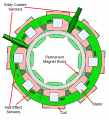
to clarify its a "bearingless slice motor" so no strain gauges/load cells. I have attached an image of the top down view of the motor and the sensors I am using
but basically the ECS (microepsilon) are for the rotor's radial position and the hall effect sensors (DRV5055) are for the rotor's angle. The motor is outside the box ~5ft away. TopDownSensors.PNG
 

Thread Starter

jlawley97

Joined Oct 5, 2019
31
it might be 1Mohm, but are you not using a input buffer amp and filter ? part of the nyquest requirements !

your using the plate as your ground reference, so any high currents are flowing through there also ? see the comment about grounds bouncing .
and it does not stop a ground loop by tying everything to chasie, it might help, it might not .

maglev , by definition have high magnetic fields , unless these are controlled, the field crossing a wire induces a voltage and is hard to shield against, think u metal ,

are your sensors differential output by any chance , or available as such.

no quick way here , you need to read the link provided.
Sorry but why would I want an input buffer? so I can match the impedance between the sensor and the ADC? also what do you mean "part of the nyquest requirements " are there things aside from the sampling rate that need to be accounted for?
 

meth

Joined May 21, 2016
298
audio is a clasic, some times double screened differential is needed, otheres, the simple twisted pair is all thats needed. i.e. the old phone cable, is just twisted pair, no screen and has been working for the last few hundred years !
This is true, but twisted pair has 4kHz of bandwidth anyway, enough to transmit voice message - it is listenable and understandable, but if you are blasting Judas Priest - Ram it down on 2x100W outputs you dont want to hear that with phone call quality :D.

The TS application is an industrial one, including a sensor, so..
 

drjohsmith

Joined Dec 13, 2021
1,548
Sorry but why would I want an input buffer? so I can match the impedance between the sensor and the ADC? also what do you mean "part of the nyquest requirements " are there things aside from the sampling rate that need to be accounted for?
Are there things apart from sample rate you ask ...
You bet is the easy answer .

Basics of adc , is a sampling system..
If you sample at say 100 khz , then a signal at 90 khz would look like a signal at 10 khz.
As would a signal at 110 khz , or 190 khz !

I guess you know a nyquest band is up to half of the sample rate.
So for 100 khz sample rate, that's 50 khz.
Assuming your going for 1st nyquest, that's DC to 50 khz.
Any signal coming in to the adc outside that band , is going to be reflected back into the 1,st Nyquist , and appear as noise . You need to ensure that you attenuate all signals above the 50 khz to less than one lsb of you adc.
As you need a filter , you can tailor it to let only your signal through.
Google the articles by analog devices on ADC , sample rate and nyquest
 

MisterBill2

Joined Jan 23, 2018
27,159
"Impedance matching" is primarily for maximum power transfer. For accurate sensor reading it is much more important to avoid loading the sensor. Consider that every bit of CURRENT flowing out of the sensor produces a voltage drop, not only in the connecting wires, but also in the sensor internal resistance. THAT is why the inputs for voltage output sensors normally try to be very high resistance.
 

Thread Starter

jlawley97

Joined Oct 5, 2019
31
So I am facing a new issue. I am using OPAMPs to drive my levitation and rotation (2 phase for each) and they are running on +/-24V. I have other sensors and controllers in the same box that have their own Power supplies that are not +/-. In this case would I terminate the levitation/rotation shielding to the floating 0V (which when referenced to the other power supplies ground is 24V)? I feel like that would cause an issue but I do not know.
 

MisterBill2

Joined Jan 23, 2018
27,159
Here we have an interesting problem indeed. One worthwhile choice is TO NOT HAVE THE SHIELD AS PART OF THE CIRCUIT!! That ties directly into the practice of only connecting the shield at one end, which only works when the shield is not part of the signal circuit!! (understand that an actual "ground loop" is a portion of a circuit that carries current from more than one circuit in a single conductor.) Thus using the shield as part of a signal circuit can certainly cause problems. So in this case it makes sense to use multi conductor shielded cables, with the shields tied to the same common as the conductive enclosure, and the signal return line being isolated from the shield circuit. In most low-level signal circuits, the use of the shield as the return is cost driven, and in many cases, with adequate planning, using the shield as the return conductor works.
For the application shown in post #12, I suggest that none of the signal paths include the shields, and only the motor power conductors shield be tied to the motor frame, and also be "grounded" at the drive system end. That is what I had to do a few years back, with a noisy brush motor and a bridge pressure transducer in close proximity. Four wires inside the shield, grounded at the IA end, and two power wires to the motor, with that shield tied to the motor housing and grounded at the motor drive package.
 

MaxHeadRoom

Joined Jul 18, 2013
30,557
but basically the ECS (microepsilon) are for the rotor's radial position and the hall effect sensors (DRV5055) are for the rotor's angle. The motor is outside the box ~5ft away.
That seems very unusual that linear sensors are used for rotor position (DRV5055) !!?
 

lichurbagan

Joined Jul 4, 2025
120
welcome @jlawley97 to the world of emi / world of pain !
first a good resource ,
https://www.learnemc.com/emc-resources
strong sugestion you at least skim read all these papers , even if some is not in your domain, its a good start.

rule 1 of emi , there is no "only" way , Ive seen many systemes over the decades that should not work and do , and unfortunatly, been called into fix many systems that should work , and dont.

audio is a clasic, some times double screened differential is needed, otheres, the simple twisted pair is all thats needed. i.e. the old phone cable, is just twisted pair, no screen and has been working for the last few hundred years !

So,

Radiated transmision, Genraly, the lower the impedane of the line / receiver, the lower the chance of EMI,
conversaly , high impedance systems , tend to pick up more noise.

Generaly, the fuirther away you cna get an aggressor from a receiver, the less the chanceof interferance.

Main cause of noise IMHO, is the ground,
If you have a circuit that has a wire to ground, and that wire is also carrying current form another circuit, then the grounds on the circuits bounce as the current on the ground changes. typical problem is a control circuit that takes say 100 mA, shares a ground cable of say 1 ohm with a motor, taking say 10 A in spikes. causing 10v spikes on the ground of the control cicruit !

Shielding, yes , can / does help radiated emisions, but can add to the ground loops, adding to the problem mentioned above.
A passive filter can partially replace shielding. Low-pass RC filters or ferrite beads can suppress high-frequency noise on signal lines. Filters only protect the cable from picking up noise at the point where they are installed. They don’t prevent the cable itself from acting as an antenna and picking up EMI along the route.
 
Top