Wire flyback transformer?

Thread Starter

kenw232

Joined May 18, 2009
57
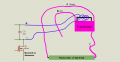
Hi, I'm new. And a novice. How do I wire in my flyback into my circuit?
This is my transformer: https://www.hv-experimental.com/image/cache/catalog/flyback_dc_wb-500x500.jpg

So I wrap 8 or 9 winds around the top of the core there. Then connect that primary wind to + and - from my circuit. 12V is pulsing through that.
now where does my high voltage come from? The black wire is the negative and the main red wire in front there is the +? So the other red (the one with the black) goes no where? There are no pins on the bottom of the transformer. So my high voltage sparkgap is between the main red and black wires.. correct?

Also, this transformer is a DC flyback? Can these be used to light up a fluorescent tube? Or do I require an AC flyback transformer?
 

Attachments

Last edited:

MrAl

Joined Jun 17, 2014
13,684
Hi, I'm new. And a novice. How do I wire in my flyback into my circuit?
This is my transformer: https://www.hv-experimental.com/image/cache/catalog/flyback_dc_wb-500x500.jpg

So I wrap 8 or 9 winds around the top of the core there. Then connect that primary wind to + and - from my circuit. 12V is pulsing through that.
now where does my high voltage come from? The black wire is the negative and the main red wire in front there is the +? So the other red (the one with the black) goes no where? There are no pins on the bottom of the transformer. So my high voltage sparkgap is between the main red and black wires.. correct?

Also, this transformer is a DC flyback? Can these be used to light up a fluorescent tube? Or do I require an AC flyback transformer?
Hi,

You would have to show exactly where you wound the turns on this thing. You can't just wind them anywhere they have to be wound in a certain way. Maybe an actual picture before and after would help a lot here. The drawing you created looks too simplistic for us to know exactly what you modified. We should be able to resolve this with a few photos as long as they are clear and show how the windings were added.
 

Thread Starter

kenw232

Joined May 18, 2009
57
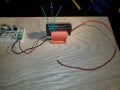
This setup here. I don't know how to hook it up. So I have the red and black wires primary wires coming from my circuit. I guess my high voltage spark is the large red wire. I have my own primary winding in green but I don't think I need it?

Otherwise where is the ground for the high voltage big red wire? I have no pins on the bottom of the transformer.
 

Attachments

MisterBill2

Joined Jan 23, 2018
27,323
What you have IS NOT A FLYBACK TRANSFORMER, unless there are additional connections that we do not see. A single coil in a molded plastic encasement, with a powdered iron core is not a transformer.
A transformer must, by definition, have at least three terminals so that one voltage can be transformed to another voltage.
Adding another winding can create a transformer, but since the molded plastic case hides the winding completely we have no means of knowing what any turns ratio would be.
So the question now is what information does the TS have relative to this item? AND I wonder what the source was.
 

MisterBill2

Joined Jan 23, 2018
27,323
Absolutely there will need to be a primary (input) winding and at that point it will be very useful to understand what level of magnetic flux will produce core saturation. That, along with knowing the number of turns in the encapsulated part, will allow you to create a circuit with some hope of working.
 
What you have IS NOT A FLYBACK TRANSFORMER, unless there are additional connections that we do not see. A single coil in a molded plastic encasement, with a powdered iron core is not a transformer.
A transformer must, by definition, have at least three terminals so that one voltage can be transformed to another voltage.
Adding another winding can create a transformer, but since the molded plastic case hides the winding completely we have no means of knowing what any turns ratio would be.
So the question now is what information does the TS have relative to this item? AND I wonder what the source was.
Please read the description:https://www.hv-experimental.com/product/flyback-transformer-dc
 
There will need to be a primary (input) winding and at that point it will be very useful to understand what level of magnetic flux will produce core saturation. That, along with knowing the number of turns in the encapsulated part, will allow you to create a circuit with some hope of working.
High-Voltage Output: The transformer is designed to produce high voltage (up to 30 kV DC), and typically, high-voltage outputs might only show a single high-voltage wire (in this case, red).
- Primary Winding Connection: The input voltage (12-24V) is connected via the primary winding, which is driven by the half-bridge amplifier. This is usually not directly visible in the high-voltage output description but should be part of his connection setup.
Addressing the Single High-Voltage Wire:
- Single High-Voltage Wire: The single red wire mentioned is for the high-voltage output. In flyback transformers, this is common; the high-voltage output is delivered through a single wire.
- Ground Connection for High Voltage:
- Return Path: In a flyback transformer, the return path for the high-voltage output is often connected through the core or through the circuit's ground that drives the primary winding.
- Connection to the Circuit: The transformer’s high-voltage output should reference the circuit's common ground. Even if there is no explicit separate ground wire for the high-voltage output, ensure that the high-voltage return path is properly connected to the system ground through the overall transformer setup and connections.

Practical Steps:
1. High-Voltage Output:
- Connect the red wire (high-voltage output) to the positive terminal of the high-voltage component or load you are driving.

2. Ground Connection:
- Ensure that the transformer is correctly grounded through its mounting or housing. This ground should be connected to your circuit's common ground.
- If your circuit design includes a high-voltage return path, ensure it is connected correctly to complete the circuit.

3. Transformer Core:
In many designs, the core or the casing of the transformer may also serve as a reference point for the high-voltage return. Ensure this is connected to the circuit’s common ground.

The absence of an explicit ground wire for high voltage is not unusual. The return path is typically managed through the transformer’s design or circuit connections.
Ensure Proper Grounding: Verify that the transformer is correctly mounted and grounded in your circuit setup to ensure safe and effective operation.

This is the reply from another expert that is specialized in it.
 

MisterBill2

Joined Jan 23, 2018
27,323
OK, I followed that link and read the description and the result is that I would never ever consider doing business with that vendor. Not nearly enough useful information is provided .
The item in this link is not the same as in the other photos. The link shows a few turns of wire and an external item with undisclosed components inside.
The description includes a lot of words and it smells to me like the results are rather optimistic.

I respectfully suggest that the TS describe to us what the ultimate purpose will be.
 

MrAl

Joined Jun 17, 2014
13,684
This setup here. I don't know how to hook it up. So I have the red and black wires primary wires coming from my circuit. I guess my high voltage spark is the large red wire. I have my own primary winding in green but I don't think I need it?

Otherwise where is the ground for the high voltage big red wire? I have no pins on the bottom of the transformer.
Hi,

I cannot tell what the smaller red and black wires are in relation to the longer red wire. The green wire is obviously a new winding so that part is clear. You would have to find the common for that long red wire, maybe that is the black wire?

You could test this with a sine wave generator if you have one, hopefully you do. That would give you an idea what the winding ratios are. In any case though, you have to find the common for the long red wire.
 

MisterBill2

Joined Jan 23, 2018
27,323
I read that description and it avoids giving any useful information. And absolutely no solid information, such as winding resistance or current rating or turns ratio or impedance or insulation rating. When a sales rep would not provide the basic information on a product I would invite them to leave. "Glittering Generalities" have no place in a technical description. That whole link provided no definite information aside from the size weight and cost.
There is no reason to trust a vendor that does not provide adequate information.
 
Top