Wierd Problem - Circuit only works if probed with voltmeter

Thread Starter

phillipsoasis

Joined Aug 22, 2022
170
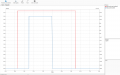
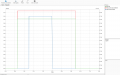
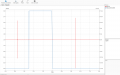
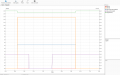
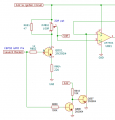
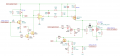
@sghioto I ran a simulation of your proposed circuit and it didn't perform as expected. The continuity current never turned on except for a spike when Launch Key Enabled changed state. As soon as Launch Key Enabled turned on, Q803 turned on at 3.6A, and did not turn off until Launch Key Enabled turned off. Launch Rocket had no effect regardless of the magnitude - 3.0V to 10.0V. It appears that Vjunction does not go low enough for Q101 to turn on, unless Launch rocket is larger than 12V to Igniter Circuit.

I have attached the Kicad v7 files in case you want to play with it. Please let me know if you find an error or solution that does not include the relay.
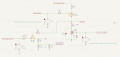
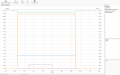
Screenshot from 2025-03-03 08-52-50.pngScreenshot from 2025-03-03 08-53-33.pngScreenshot from 2025-03-03 08-54-30.pngScreenshot from 2025-03-03 08-55-19.png
 

Attachments

Last edited:

sghioto

Joined Dec 31, 2017
8,634
I ran a simulation of your proposed circuit and it didn't perform as expected.
Which modification was this exactly, the 47uf cap on the base of Q801?
Is this new schematic for eliminating the relay and the current control feature?
What does V103 represent on Launch Rocket?
 
Last edited:

Thread Starter

phillipsoasis

Joined Aug 22, 2022
170
Which modification was this exactly, the 47uf cap on the base of Q801?
Is this new schematic for eliminating the relay and the current control feature?
What does V103 represent on Launch Rocket?
This is a simulation schematic of your circuit idea to remove the relay. I simplified the schematic for simulation purposes by removing Q801 and U801 and the associated passive components. These just provide level shifting of the Launch Rocket signal and feedback control for the voltage output of U801, and are not really necessary for this simulation. All the AO2401A needs in a simulation is a voltage source. V103 drives the gate of the AO3401A as the output of U801 would, and I am calling it Launch Rocket in the simulation. The purpose is to verify that removing the relay idea works, and both the continuity current and launch current turn on and off as needed based on activating the Launch Rocket and Launch Key Enabled signals.
 

sghioto

Joined Dec 31, 2017
8,634
As soon as Launch Key Enabled turned on, Q803 turned on at 3.6A,
I'm not up to speed on that current limit circuit but apparently the output of Q803 is fully on when the "+12 volts to igniter" is applied regardless if "Launch Rocket" is high. That explains without the relay why the igniter would fire.
Will continue the discussion on this new circuit a little later this morning.
 

sghioto

Joined Dec 31, 2017
8,634
All the AO2401A needs in a simulation is a voltage source.
If V103 is only 3 volts then Q801 will always be ON because there will be at least 8 volts measure across the Source -Gate junction.
To eliminate the relay Q801 needs to be completely OFF until a "Launch Rocket" signal is given.
 

Thread Starter

phillipsoasis

Joined Aug 22, 2022
170
If V103 is only 3 volts then Q801 will always be ON because there will be at least 8 volts measure across the Source -Gate junction.
To eliminate the relay Q801 needs to be completely OFF until a "Launch Rocket" signal is given.
I am not sure which component is Q801. Do you mean the 2N3904 attached to R801?

If I set V103 to 1V in the simulation, the AO3401A is on hard whenever Launch Key Enabled goes High. Same with V103 at 0V or -5V. Not that it matters, but there aren't any negative voltages on the board.

I am not sure how to turn off the AO3401A in your circuit with the continuity circuit attached to the drain of the AO3401A. Either I start again, or use a relay and two control signals.
Screenshot from 2025-03-03 15-57-22.pngI don't have any negative voltages on the board. Screenshot from 2025-03-03 15-53-25.png
 

Attachments

sghioto

Joined Dec 31, 2017
8,634
I am not sure which component is Q801. Do you mean the 2N3904 attached to R801?
Sorry, meant to say Q103 from your latest schematic.
If I set V103 to 1V in the simulation, the AO3401A is on hard whenever Launch Key Enabled goes High.
Actually Q103 (the AO3401) will be fully ON regardless of Launch Key Enable status.

I am not sure how to turn off the AO3401A in your circuit
Because of the design of the current limiter one way I see is to pull the negative input of the the LM7301 Low until the Launch Rocket signal is applied.
One version to do this:
1741045712232.png
 
Last edited:

Thread Starter

phillipsoasis

Joined Aug 22, 2022
170
Sorry, meant to say Q103 from your latest schematic.

Actually Q103 (the AO3401) will be fully ON regardless of Launch Key Enable status.


Because of the design of the current limiter one way I see is to pull the negative input of the the LM7301 Low until the Launch Rocket signal is applied.
One version to do this:
Did you mean to attach something?
 

sghioto

Joined Dec 31, 2017
8,634
This is my suggestion with a LED to indicate if it's safe to connect the igniter and a at the pad continuity checker.
For this to work a momentary switch could be configured to bypass the delayed "12V to Igniter Circuit" to provide 12 volts immediately. If LED 802 is lit there's a problem.
The momentary continuity switch Sw1 only passes appx 1ma through the igniter, so completely safe.
With Q807 inhibiting the LM7301, Q801 could be eliminated also.
Full Schematic:
1741048106699.png
 

Thread Starter

phillipsoasis

Joined Aug 22, 2022
170
This is my suggestion with a LED to indicate if it's safe to connect the igniter and a at the pad continuity checker.
For this to work a momentary switch could be configured to bypass the delayed "12V to Igniter Circuit" to provide 12 volts immediately. If LED 802 is lit there's a problem.
The momentary continuity switch Sw1 only passes appx 1ma through the igniter, so completely safe.
With Q807 inhibiting the LM7301, Q801 could be eliminated also.
Full Schematic:
View attachment 343702
Looks interesting. Thanks so much for the suggestions! I guess you really don't like relays...lol Neither do I, for that matter.
A couple of questions and comments, in no particular order:
1. Why the replacement of the Q802 2n3906 circuit with the BS250 circuit? What are the advantages?
2. What happens if Launch Rocket is ON and you hit the continuity button? How much current flows through the igniter?
3. My experience with MOSFETS driven by single sided rail to rail op-amps, is GND at a - input pin does not guarantee the MOSFET is off. There are always leakage and bias currents that can partially turn on the MOSFET. Not always, but a pain to get rid of. A +/- voltage supply to the op-amp works better in that scenario, because you can turn off the MOSFET hard. On reason to use the relay, as I can use a single rail supply and not worry about the MOSFET turning on a little bit because the relay isolates it from the igniter until I want it connected.

BTW, the 12V to Igniter Circuit varies from 15V to 8V from my external battery source and 12.6V to 9.6V from the internal batteries. Just full disclosure.

There is another page of my schematic that you have not seen, because it did not relate to the problem at hand, is that I already have the red LED for "Danger, Will Robinson, Danger". It was great that you added it in your schematic. Also a yellow power LED, the Master Arm Switch, and a timer to give the user 10 seconds to get away from the rocket when the Master Arm Switch is enabled. It also allows for a wireless signal from the controller box to overide the Master Arm Switch to shut the launcher down if, for example, a kid runs out onto the field during the count down. And yes, it uses a relay....lol.

Continuity tied to the Key interlock is a normal pattern for launchers based on an over abundance of caution, because it make the user stand away from the rocket when putting any current through an igniter. However, the NAR rules just require an interlock, and do not require a continuity check.

I am still struggling with the board I have. I replaced the relay and added the extra control signal and the code to run it, and still have the same problem with the magic DVM probes. Haven't had a lot of time to get into it yet.
 

sghioto

Joined Dec 31, 2017
8,634
Answers:
I don't have a problem with using relays but prefer they are configured to prevent arcing when possible as in this application.
#1) 2N3906 would work also with an additional resistor.
#2) appx 8 to 15ma max depending on the voltage level of "12V to Igniter"
R817 should be 1K not 100 ohms.
3) If speaking of the LM7301 then grounding the negative input pin sets the output high at the supply voltage because the plus input is also at the supply voltage. 12V to the gate of Q803 is a full shutoff, see no possible way the output of the LM7301 wouldb go low enough to turn on Q803.
The continuity check is for convenience.
Current passes through the igniter only when the button is pressed not when connecting the igniter.
Anyway let's focus on getting it fixed.
Need to get the meter out for some more test readings when you have time.
 
Last edited:

Thread Starter

phillipsoasis

Joined Aug 22, 2022
170
Answers:
#1) 2N3906 would work also with an additional resistor.
#2) appx 8 to 15ma max depending on the voltage level of "12V to Igniter"
R817 should be 1K not 100 ohms.
3) If speaking of the LM7301 then grounding the negative input pin sets the output high at the supply voltage because the plus input is also at the supply voltage. Plus 12V to the gate of Q803 is a full shutoff, see no possible way the output can go low enough to turn on Q803.
The continuity check is for convenience.
Current passes through the igniter only when the button is pressed not when connecting the igniter.
Anyway let's focus on getting it fixed.
Need to get the meter out for some more test readings.
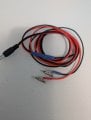
Its working now. I think the solder connectors I used to attach the igniter clips to the igniter leads did not melt all the way, and so there was an intermittent connection depending on how I bent the leads. PXL_20250304_024557840.jpg
 

Thread Starter

phillipsoasis

Joined Aug 22, 2022
170
Great, so how is the Launch Rocket code working?
It is working. I am going to setup a test loop tomorrow today for about 30 launches every 5 minutes as a stress test.

The code all of 20 lines or so and most of it came from refactoring some of the original code to put the new code in one place.

Oops - wrote this 12+ hours ago and forgot to hit send....
 

Thread Starter

phillipsoasis

Joined Aug 22, 2022
170
It is working. I am going to setup a test loop tomorrow today for about 30 launches every 5 minutes as a stress test.

The code all of 20 lines or so and most of it came from refactoring some of the original code to put the new code in one place.

Oops - wrote this 12+ hours ago and forgot to hit send....
@sghioto While working on a test loop for the launcher, I realized I might not need and extra control signal to protect the relay. I have two possible algorithms to protect the relay.

Option 1 No Additional Control Signals:
initial state: Launch Key Enable - high, Launch Rocket low
To launch rocket
1. Launch Key Enable low - turn off Q804
2. wait 10 msec
3. Launch Rocket high to both Q805 and Q801
4. wait 50 msec
5. Launch Key Enable high - turn on Q804 - launch rocket

Reverse the process
6. Launch Key Enable low
7. wait 10 msec
8. Launch Rocket low to both Q805 and Q801
9. wait 50 msec
10. Launch Key Enable high

Option 2 Extra Control Signal:
Launch Rocket Relay attached to base resistor R814
Launch Rocket attached to base resistor R802
initial state: Launch Key Enable - high, Launch Rocket - low, Launch Rocket Relay - low
To launch rocket
1. Launch Rocket Relay high - switch relay to launch mode
2. wait 50 msec
3. Launch Rocket high - launch rocket

Reverse the process
1. Launch Rocket low
2. wait 10 msec
3. Launch Rocket Relay low
4. wait 50 msec

I am leaning towards Option 1. However, I have implemented Option 2 and it appears to be working. At least no smoke from the relay, yet.

Maybe Option 3, a combination of the two options where I use the 2 control signals but also control the current with Launch Key Enable.

Your thoughts?
 

sghioto

Joined Dec 31, 2017
8,634
Not sure but is "Launch Rocket" a 3 second duration pulse in option #1?
Regardless I agree with option #1 but don't see the need for step 10.
In option #2, I believe even when Launch Rocket is low there is voltage on the output of Q803 when 12V to Igniter Circuit is applied but need to verify when you have time.
If this is true then the igniter will fire immediately after step 1.
 
Last edited:

Thread Starter

phillipsoasis

Joined Aug 22, 2022
170
Not sure but is "Launch Rocket" a 3 second duration pulse in option #1?
>>Yes, it is.

Regardless I agree with option #1 but don't see the need for step 10.
>>Launch Key Enable high - returns the system to the original state, which is measuring continuity

In option #2, I believe even when Launch Rocket is low there is voltage on the output of Q803 when 12V to Igniter Circuit is applied but need to verify when you have time.
If this is true then the igniter will fire immediately after step 1.
>>Launch Rocket is low in step 1 of Reverse the Process is after the rocket has launched. I need to think how to measure at the right time. Probably a second test in code.
Finished a 30 rocket launch test, 3 sec launch pulse, 3 seconds between launches. Battery dropped to only 81% from 98%. Nothing broke!
I was using Option 3 - a combination of Options 1 and 2. I already had split Launch Rocket into two control lines, and the board and batteries were already in place. I takes a bit of time to unbutton everything to solder/unsolder wires, so I just modified the code as shown below.

1. Launch Key Enable low
2. wait 10 msec
3. Launch Rocket Relay high
4. wait 50 msec
5. Launch Rocket high
6. wait 10 msec
7. Launch Key Enable high
8. wait 3 seconds
9. Launch Key Enable low
10. wait 10 msec
11. Launch Rocket low
12. wait 10 msec
13. Launch Rocket Relay low
14. delay 50 msec
15. Launch Key Enable high
16. wait 10 msec
 

Thread Starter

phillipsoasis

Joined Aug 22, 2022
170
And the pad box is wirelessly connected to your phone?
This is version 2, so no phone. There are 2 boxes, one at the launch pad and one at the launch table, 15 feet from the launch pad. The two boxes are connected wirelessly. The box at the launch pad has the energy needed to ignite the motors. The box at the launch table has a Key Switch, a Big Red Button, and an Abort button.

I have found using version 1, where my phone is the "box at the launch table", that it is a bit distracting/annoying to constantly switch my focus from the field and what is going on there to the screen on my phone. Especially with 30 fifth graders wandering about waiting for the launch.

I also wanted a box with a Big Red Button for a special event at our local elementary school, STEM Night. My son-in-law and I built a guy-wire launcher to launch a 3D printed rocket 18 feet or so on a guy wire using a B6-0 motor. We wanted to get the third, fourth, and fifth graders excited about STEM. You can see some pictures and movies at www.hopirockets.com, in the gallery tab.

I learned last year at STEM Night that for this age, it is all about the show and not that much about the details of the science in this venue. IMO, these kids need to get excited the possibilities of STEM first, then get hooked on the details. It is a tough competition with video games.

Version 2 is also my first foray into ESP32 land. Version 1 used a Raspberry Pi. It has taken some time to resurrect my C programming skills from the attic of my mind. I so prefer Python!
 
Top