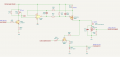
Wierd Problem - Circuit only works if probed with voltmeter

Thread Starter

phillipsoasis

Joined Aug 22, 2022
170
Is there a simple hardware delay circuit, or should I do it in code and use two GPIO lines?
Forgive the stupid question. A simple RC circuit on the base of Q801 should do the trick. Say, 47uF and 1.2K resistor should suffice. I prefer the hardware solution based on physics than lines of code that can change inadvertently when launching rockets.
 

Thread Starter

phillipsoasis

Joined Aug 22, 2022
170
Try a 47uf from ground to the base of Q801.
R802 can stay at 1K.
Do I need to worry about the reverse situation? Launch Rocket is a ~3 second pulse. I see the issue when the relay switches while Q803 is starting to deliver 3A. When Launch Rocket goes Low and the relay switches, the current from Q802 is only 10-20 mA. Is that an issue for the relay contacts as well, or do I need another delay? BTW, Launch Key Enabled is a manual change of a switch.
 

Thread Starter

phillipsoasis

Joined Aug 22, 2022
170
Do I need to worry about the reverse situation? Launch Rocket is a ~3 second pulse. I see the issue when the relay switches while Q803 is starting to deliver 3A. When Launch Rocket goes Low and the relay switches, the current from Q802 is only 10-20 mA. Is that an issue for the relay contacts as well, or do I need another delay? BTW, Launch Key Enabled is a manual change of a switch.
Another question. Won't the cap at the base of Q801 keep Q801 on while the relay is switching, so we have the same problem, but when the Launch Rocket goes low instead of high?
 

sghioto

Joined Dec 31, 2017
8,634
Another question. Won't the cap at the base of Q801 keep Q801 on while the relay is switching, so we have the same problem, but when the Launch Rocket goes low instead of high?
Correct Q801 will stay on for briefly when the Launch Rocket goes low but again the igniter should have burned open by this time
 

sghioto

Joined Dec 31, 2017
8,634
But they don't always break. Many times they do not break.
What you need is a modification to delay the relay deactivating also.
But it would be better to just eliminate the relay altogether since the current is already passing through two mosfets.
There are other ways to detect continuity. There shouldn't be any voltage on the drain of Q803 until Launch Rocket goes high.
1740967858965.png
 
Last edited:

Thread Starter

phillipsoasis

Joined Aug 22, 2022
170
What you need is a modification to delay the relay deactivating also.
But it would be better to just eliminate the relay altogether since the current is already passing through two mosfets.
There are other ways to detect continuity.
Would a solid state relay make a difference?
 

Thread Starter

phillipsoasis

Joined Aug 22, 2022
170
That would work too but you don't really need the relay.
Did you see the modified circuit in my previous post?
Oops...didn't see it. Using phone interface instead of computer. Have to think about what happens at junction of Q803 and R809 when Q803 and W804 are both on.
 

sghioto

Joined Dec 31, 2017
8,634
Oops...didn't see it. Using phone interface instead of computer. Have to think about what happens at junction of Q803 and R809 when Q803 and W804 are both on.
It shouldn't be an issue meaning nothing will be damaged.
What is the voltage at the drain of Q803 when set for a 3 amp limit?
 

Thread Starter

phillipsoasis

Joined Aug 22, 2022
170
Oops...didn't see it. Using phone interface instead of computer. Have to think about what happens at junction of Q803 and R809 when Q803 and W804 are both on.
It shouldn't be an issue meaning nothing will be damaged.
What is the voltage at the drain of Q803 when set for a 3 amp limit?
Not sure right now as it is not working. I liked the relay because if added a bit of safety. If Q801 fails on and you are attaching the igniter wires, you won't get hurt. Without the relay, if Q801 fails, you get a hot motor in your hands. One could argue, that if Q805 fails the same can happen. Your suggestion is a good one. I would just like it to be safer in some way. I am not in love with relays. I would love to reduce the parts count. I just want as much safety built in as possible. I have a physical master arm switch that turns on and off the 12V to Igniter Circuit with a 10 second delay, so no power goes to the igniter circuit when fiddling with the igniter. Perhaps that is enough. Once you throw that switch and walk away if the rocket cooks off it won't be that big of a deal. The Launch Key and Launch Rocket are back at the launch table (this is a wireless system). Apologies for the rambling, just thinking it through....
 

sghioto

Joined Dec 31, 2017
8,634
I have a physical master arm switch that turns on and off the 12V to Igniter Circuit with a 10 second delay, so no power goes to the igniter circuit when fiddling with the igniter.
Doesn't that mean you have to wait for 10 seconds to confirm continuity?
Wouldn't be better if the anode of D801 connected to 12 volts directly?
 

Thread Starter

phillipsoasis

Joined Aug 22, 2022
170
Not sure right now as it is not working. I liked the relay because if added a bit of safety. If Q801 fails on and you are attaching the igniter wires, you won't get hurt. Without the relay, if Q801 fails, you get a hot motor in your hands. One could argue, that if Q805 fails the same can happen. Your suggestion is a good one. I would just like it to be safer in some way. I am not in love with relays. I would love to reduce the parts count. I just want as much safety built in as possible. I have a physical master arm switch that turns on and off the 12V to Igniter Circuit with a 10 second delay, so no power goes to the igniter circuit when fiddling with the igniter. Perhaps that is enough. Once you throw that switch and walk away if the rocket cooks off it won't be that big of a deal. The Launch Key and Launch Rocket are back at the launch table (this is a wireless system). Apologies for the rambling, just thinking it through....
Regarding Q803/R809. Let's say 3A, so 300 mv below 12V to Igniter Circuit at the Q803 source plus Vds
Doesn't that mean you have to wait for 10 seconds to confirm continuity?
Wouldn't be better if the anode of D801 connected to 12 volts directly?
I don't think so. I don't want any current to flow in the igniter when I am hooking up the wires. I want to be a few steps away before that happens. The old style igniters had to have the key inserted and turned before reading continuity.
 

Thread Starter

phillipsoasis

Joined Aug 22, 2022
170
There is no current flow through the igniter until Launch Enable is high also.
Where is the Launch Enable Key located?
At the launch table, 15 feet away.
Something t think about - catastrophic failure meaning the igniter wires are ready to ignite the igniter with 3A and you bring a rocket to the launch stand to hook it up.

With relay - Q804 and Q805 and (Q801 or U801) have to fail.
Without relay - Q804 and (Q803 or Q801 or U801) have to fail.

BJTs and MOSFETS usually fail in the ON state. The relay does reduce the probability of a catastrophic failure.
 

sghioto

Joined Dec 31, 2017
8,634
The relay does reduce the probability of a catastrophic failure.
Not necessarily as I have seen contacts get welded closed.
A LED can be added that indicates whether it's safe to connect an igniter and continuity can be confirmed before leaving the launch pad is my suggestion.
If deciding to keep the relay I would go back to the suggestion of using two GPIO outputs for control to prevent arcing.
 
Last edited:

Thread Starter

phillipsoasis

Joined Aug 22, 2022
170
Not necessarily as I have seen contacts get welded closed.
A LED can be added that indicates whether it's safe to connect an igniter and continuity can be confirmed before leaving the launch pad is my suggestion.
If deciding to keep the relay I would go back to the suggestion of using two GPIO outputs for control to prevent arcing.
I agree. I only meant that with the relay, there is a longer chain of events that has to happen before a catastrophic failure.
 
Top