Facebook
 Google
 GitHub
 Linkedin
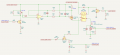
This circuit does two things - assume a 12V car light bulb is attached to J802.
1. Launch Key Enabled is 3.3V - the green LED glows to indicates continuity through J802 and Q804
2. and Launch Rocket is 3.3V - approximately 3 A flows through J802 and Q804 to actually light the light bulb.
It has been working so far - multiple tests over multiple days. A simulation of the continuity circuit (Q802/Q804) works and matches what I have measured when the circuit is working.
All of a sudden, it stopped working. The green LED does not light with Launch Key Enabled at 3.3V and the 3A current does not flow when Launch Rocket is 3.3V. The gate is at 3.3V and the other voltages are correct. The relay clicks when the the Launch Rocket goes high.
However, if I take a voltmeter probe and touch ground with the black lead and touch the base of Q802 with the other lead, the circuit operates as expected. It isn't a mechanical thing. Just pushing on the base of Q802 does not activate the circuit. One probe (red or black) has to be on ground and the other probe has to touch the base of Q802 (or the end of R809 attached to the base) to activate the circuit. The voltmeter can be on or off. One of the leads has to be to ground. Putting a lead on the +5V or 12V to Igniter Circuit does not work.
The circuit is not built on a push in proto-board, but with soldered wires on a breadboard. I have checked the wiring (and continuity) and it is good. There are no obvious solder bridges. The solder joints look nice and shiny.
What is the appropriate sacrifice to the EE gods - goats or chickens for a situation like this?
Should I try moving Q802, R810, D801, D803, R812, and R809 to another spot on the breadboard? Maybe there is a crack in the board around those parts causing an intermittent connection?
Any other suggestions on how to solve this mystery are greatly appreciated!
1. Launch Key Enabled is 3.3V - the green LED glows to indicates continuity through J802 and Q804
2. and Launch Rocket is 3.3V - approximately 3 A flows through J802 and Q804 to actually light the light bulb.
It has been working so far - multiple tests over multiple days. A simulation of the continuity circuit (Q802/Q804) works and matches what I have measured when the circuit is working.
All of a sudden, it stopped working. The green LED does not light with Launch Key Enabled at 3.3V and the 3A current does not flow when Launch Rocket is 3.3V. The gate is at 3.3V and the other voltages are correct. The relay clicks when the the Launch Rocket goes high.
However, if I take a voltmeter probe and touch ground with the black lead and touch the base of Q802 with the other lead, the circuit operates as expected. It isn't a mechanical thing. Just pushing on the base of Q802 does not activate the circuit. One probe (red or black) has to be on ground and the other probe has to touch the base of Q802 (or the end of R809 attached to the base) to activate the circuit. The voltmeter can be on or off. One of the leads has to be to ground. Putting a lead on the +5V or 12V to Igniter Circuit does not work.
The circuit is not built on a push in proto-board, but with soldered wires on a breadboard. I have checked the wiring (and continuity) and it is good. There are no obvious solder bridges. The solder joints look nice and shiny.
What is the appropriate sacrifice to the EE gods - goats or chickens for a situation like this?
Should I try moving Q802, R810, D801, D803, R812, and R809 to another spot on the breadboard? Maybe there is a crack in the board around those parts causing an intermittent connection?
Any other suggestions on how to solve this mystery are greatly appreciated!
Last edited: