Wide Range Current Measurement Circuits

Thread Starter

artmaster547

Joined Jan 6, 2016
409
Hi all
I am trying to design a system I guess, collection of circuits that allows for the measurement of current in the range of +/- 500A, however the tricky bit I am having at the moment if figuring out how to get a small precision with the readings using 10 bit ADCs on the microcontroller I have to use. I do however have access to multiple ADCs. I need a precision of around 10mA up to 10A, 0.1A up to 100A and 1A up to 500A, could anyone provide any suggestion for this or presiding LTSpice simulations for current measurement circuits that would meet these criteria ? Would appreciate input on this.

Kind Regards

Art
 

Thread Starter

artmaster547

Joined Jan 6, 2016
409
ok thanks for the suggestion I think the issue of measuring the precision I am after with a microcontroller with 10 bits ADCs is still the issue I am trying to solve and need assistance/suggestions with but thanks for suggesting this sensor :)
Hello,

You might want to have a look at the melexis website for the current sensors:
https://www.melexis.com/en/products/sense/current-sensors

They have sensors that use the hall effect with currents upto 2000 A.

Bertus
 

ebeowulf17

Joined Aug 12, 2014
3,307
Hi all
I am trying to design a system I guess, collection of circuits that allows for the measurement of current in the range of +/- 500A, however the tricky bit I am having at the moment if figuring out how to get a small precision with the readings using 10 bit ADCs on the microcontroller I have to use. I do however have access to multiple ADCs. I need a precision of around 10mA up to 10A, 0.1A up to 100A and 1A up to 500A, could anyone provide any suggestion for this or presiding LTSpice simulations for current measurement circuits that would meet these criteria ? Would appreciate input on this.

Kind Regards

Art
Are you sensing AC or DC current? If AC, what frequency ranges do you need to detect?

I recently made a circuit for AC current measurement with multiple ranges. The concepts might carry over if your project is AC too.

Be aware that accuracy and precision are different things. Your bottom two ranges are both asking for precision down to the LSB of your ADC (10 bits = 1024 steps, and you're wanting precision of 1/1000 the range for the first two ranges.) You can get readings down to the resolution you want, but they're likely to be noisy and have limited accuracy unless you use over sampling and careful circuit design. Even then, you're pushing the limits a bit.
 

dendad

Joined Feb 20, 2016
4,639
One way is to have a couple of Hall current sensors into different analog inputs.
The first placed so it just reads 10A full scale.
Then over 10A, use the second one. The first will be driven into saturation and be unuseable.
I doubt you will be able to use the internal conductor of the 10A sensor as it will not carry 500A. But you may be able to mount it against the main conductor to sense the current. Some experiments will be needed. Like extra magnetic circuit around it to help sensitivity.
To get +/- 500Amps in 10mA steps is a big ask.
 

danadak

Joined Mar 10, 2018
4,057
If the measurement wants to be 10 bits for error budget purposes I would start
with 12 bits or more.

Additionally I would use a diff in A/D to get rid of common mode errors.

Assuming you want to do high side sense you need something that will common mode outside the
supply rail.

Given that you are using a micro consider using a PSOC, it has a 12 bit SAR and/or a 20 bit DelSig.
The input on DelSig will CM 100 mV outside its supply rails, so a shunt in high side, coupled with
its 20 bit res will give you even greater dynamic range of measurement. Note Vref is also onchip,
good to +/- .1%. Coupled wirh ARM core, Digital Filter, lots of other analog and digital stuff, a good
choice. Note the DelSig will also CM below ground rail if that's preferred.

Here is example using DelSig (single ended mode, could have been diff) and post processing with dig filt. All on chip.


Attached a component list for the 5LP family. A component is an onchip resource
you can use.

Here is a lowend PSOC design using the SAR (12 bits), lowend only has SAR -

https://www.eevblog.com/forum/beginners/measuring-low-currents-with-cypress-psoc/


If you want to stay with current UP consider -

http://www.analog.com/en/analog-dialogue/articles/high-side-current-sensing-wide-dynamic-range.html

Regards, Dana.
 

Attachments

Last edited:

Thread Starter

artmaster547

Joined Jan 6, 2016
409
Are you sensing AC or DC current? If AC, what frequency ranges do you need to detect?

I recently made a circuit for AC current measurement with multiple ranges. The concepts might carry over if your project is AC too.

Be aware that accuracy and precision are different things. Your bottom two ranges are both asking for precision down to the LSB of your ADC (10 bits = 1024 steps, and you're wanting precision of 1/1000 the range for the first two ranges.) You can get readings down to the resolution you want, but they're likely to be noisy and have limited accuracy unless you use over sampling and careful circuit design. Even then, you're pushing the limits a bit.
Hi thanks for replying could I have look at the circuits you made that would be really useful for reference and good points about resolution.
 

Thread Starter

artmaster547

Joined Jan 6, 2016
409
If the measurement wants to be 10 bits for error budget purposes I would start
with 12 bits or more.

Additionally I would use a diff in A/D to get rid of common mode errors.

Assuming you want to do high side sense you need something that will common mode outside the
supply rail.

Given that you are using a micro consider using a PSOC, it has a 12 bit SAR and/or a 20 bit DelSig.
The input on DelSig will CM 100 mV outside its supply rails, so a shunt in high side, coupled with
its 20 bit res will give you even greater dynamic range of measurement. Note Vref is also onchip,
good to +/- .1%. Coupled wirh ARM core, Digital Filter, lots of other analog and digital stuff, a good
choice. Note the DelSig will also CM below ground rail if that's preferred.

Here is example using DelSig (single ended mode, could have been diff) and post processing with dig filt. All on chip.


Attached a component list for the 5LP family. A component is an onchip resource
you can use.

Here is a lowend PSOC design using the SAR (12 bits), lowend only has SAR -

https://www.eevblog.com/forum/beginners/measuring-low-currents-with-cypress-psoc/


If you want to stay with current UP consider -

http://www.analog.com/en/analog-dialogue/articles/high-side-current-sensing-wide-dynamic-range.html

Regards, Dana.
Thanks Dana for the suggestions much appreciated.
 

ebeowulf17

Joined Aug 12, 2014
3,307
Hi thanks for replying could I have look at the circuits you made that would be really useful for reference and good points about resolution.
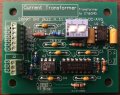
Ok, the project I did was dealing with 60Hz AC. It's based on a current transformer, so it will only work with AC, not DC. That's why I was asking for more detail. Also, in my case, I wanted very low overhead on my microcontroller, so I didn't want to be sampling the AC signal at high enough rates to capture the highs and lows and do my own RMS calculations... instead I created a circuit which rectifies the AC and provides a smooth(ish) DC output proportional to AC average current. It then assumes that the original AC was reasonably close to a pure sine wave and calculates RMS from that (so it's average reading, not TRUE RMS.) Depending upon the nature of the current being sensed, this could be pretty close to accurate, or it could be wildly inaccurate! Again, I was building a circuit for my very specific use-case, but it may not apply elsewhere. Finally, I was building for a two-stage system with up to 50A max capacity (although I ammended it with different sense resistors and built a 25A version first) so all of the values and part choices would need to change quite a bit in order to handle 500A! It's based on a transimpedance amp (which I forgot about in my first reply) and would require careful selection of current transformers so that you wouldn't be asking the amp for more current than it can deliver. Anyway, if none of those qualifiers have scared you off, here's some info:

The key concepts here are using a transimpedance amplifier to avoid offset and non-linearity in a simpler setup I tried early on, and switching an extra burden resistor in and out of the circuit, in parallel with the first one, to provide two different ranges.

The thread here where I got lots of help sorting through my ideas:
https://forum.allaboutcircuits.com/...surement-converting-to-dc-for-arduino.144283/

Simulation schematic and plot images:
current-xformer_crutschow_12_FINAL.png

I've also attached the LTspice .asc file and a PDF of the final schematic I built (intended for 0-2.5A and 0-25A range, although I later realized that power supply headroom at 5V limited me to about 2A and 20A.)
 

Attachments

ebp

Joined Feb 8, 2018
2,332
At 500 A, if you use a "shunt" (resistor) and accept 100 mV at full scale, you will have 50 W of dissipation in the shunt. 10 mA through the shunt will then produce only 2 µV, which is easily lost completely in thermoelectric (Seebeck, thermocouple) potentials and amplifier offset drift, even with very good amplifiers. You cannot put shunts in series - a shunt that will give you reasonable signal levels for resolving 10 mA will melt at 500 A.

If you use Hall effect sensors, you must be very concerned with magnetic remnance in the mag core used to "gather" the flux to the sensor, such as shown here:
https://www.allegromicro.com/en/Pro...-Package-Zero-To-Thousand-Amp-Sensor-ICs.aspx

There are complete high-current Hall effect sensors available. I suggest looking closely at specification for range and linearity to get some idea of what is possible. Nothing Allegro offers is a complete solution for the application.
 

Bordodynov

Joined May 20, 2015
3,431
ok great thanks do you have any suggestions for techniques that could be used to sense DC Current?
Current transformers can only be used for alternating current. In order to measure the current at direct current, sensors based on the Hall effect are needed. You are always offered them. For linearity and a stable conversion factor, a negative magnetic coupling is used. I think it's already done in industrial Hall sensors.
 

ebeowulf17

Joined Aug 12, 2014
3,307
artmaster547.
I've redesigned the circuit a little. A small change in the current transformer (more real values of inductances). This is version 0. A larger change in the following scheme. I think this scheme has less error.
Thanks, I'll have to take a closer look at what you've done. As you can probably tell, I had absolutely no idea how to model a current transformer - all I did was get the turns ratio right, neglecting all other factors.
 

Hymie

Joined Mar 30, 2018
1,347
Thanks, I'll have to take a closer look at what you've done. As you can probably tell, I had absolutely no idea how to model a current transformer - all I did was get the turns ratio right, neglecting all other factors.
How about something like this at the heart of your measurements.

The photo shows the output voltage switchable between 10mV/A - 1mV/A and a measurement range of 20mA to 650A.

https://www.ebay.co.uk/itm/Hantek-C...331611?hash=item41cf82d2db:g:AKEAAOSwQiBZu2U8

The only problem is that you need to manually switch between current ranges to cover 20mA to 650A. It might be possible to disassemble the unit and use a relay to automatically switch between ranges for your application.

I doubt you will find any practical solution that does not include some sort of range switching to cover 10mA to 500A – even my Fluke multimeter switches ranges at 4A (measuring using a shunt).
 

Thread Starter

artmaster547

Joined Jan 6, 2016
409
How about something like this at the heart of your measurements.

The photo shows the output voltage switchable between 10mV/A - 1mV/A and a measurement range of 20mA to 650A.

https://www.ebay.co.uk/itm/Hantek-C...331611?hash=item41cf82d2db:g:AKEAAOSwQiBZu2U8

The only problem is that you need to manually switch between current ranges to cover 20mA to 650A. It might be possible to disassemble the unit and use a relay to automatically switch between ranges for your application.

I doubt you will find any practical solution that does not include some sort of range switching to cover 10mA to 500A – even my Fluke multimeter switches ranges at 4A (measuring using a shunt).
Thanks really good suggestion I think you're right there will be a need for some sort of switching
 
Top