It’s not whether skin effect is present, it’s that the Litz wire doesn’t work well past about 1MHz because of parasitic capacitance (between strands). The mitigation of skin effect isn’t worth the increased capacitance.
It’s not whether skin effect is present, it’s that the Litz wire doesn’t work well past about 1MHz because of parasitic capacitance (between strands). The mitigation of skin effect isn’t worth the increased capacitance.
At risk of appearing pedantic, isn't it the capacitance between adjacent turns, not between strands of the same turn, because all parts of the same turn will be at the same potential, so capacitance won't matter because they would normally be connected?
I've normally seen it used in high current AC coils because the extra resistance at AC due to the skin effect results in greater heating.
At risk of appearing pedantic, isn't it the capacitance between adjacent turns, not between strands of the same turn, because all parts of the same turn will be at the same potential, so capacitance won't matter because they would normally be connected?
I've normally seen it used in high current AC coils because the extra resistance at AC due to the skin effect results in greater heating.
The different strands are not at the same potential -- that is why the strands have to be insulated from each other. The EM effects that give rise to the skin effect want to move current to the outer stands. The insulation prevents this motion, and so a lateral potential is established and current flows through the parasitic capacitance between the strands a consequence. At higher frequencies, the parasitic admittance goes down and the skin effect is able to re-assert itself more fully.
At risk of appearing pedantic, isn't it the capacitance between adjacent turns, not between strands of the same turn, because all parts of the same turn will be at the same potential, so capacitance won't matter because they would normally be connected?
I've normally seen it used in high current AC coils because the extra resistance at AC due to the skin effect results in greater heating.
Pedantic, but not in a bad way—I will say it falls under definition 2 in the Oxford Concise. Thanks for adding that, it’s an important point if you’re trying to apply Litz wire to a problem.
The different strands are not at the same potential -- that is why the strands have to be insulated from each other. The EM effects that give rise to the skin effect want to move current to the outer stands. The insulation prevents this motion, and so a lateral potential is established and current flows through the parasitic capacitance between the strands a consequence. At higher frequencies, the parasitic admittance goes down and the skin effect is able to re-assert itself more fully.
I'm still puzzling how two strands of wire can each have the same potential at the ends, but different potentials in the middle, even if the two strands have different effective resistances.
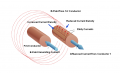
There are two different effects. One is between adjacent turns of the overall wire and the other is between strands within the wire itself. In the first case there is not only the effect of parasitic capacitance between turns (which is present whether Litz wire is used or not, although the details can be tailored by how the weaving of the strands repeats with Litz wire), but also proximity effect, which causes crowding similar to the skin effect. The other is the effects within the Litz wire itself between strands.
I'm still puzzling how two strands of wire can each have the same potential at the ends, but different potentials in the middle, even if the two strands have different effective resistances.
You can't look at it like a lumped model. You have to look at the local EM effects.
As an analogy, consider the Hall effect -- you have a current traveling down a solid wire in the presence of a magnetic field, yet you get a potential difference from one side of the wire to the other.
In Litz wire, the different strands are at different conditions. Some are near the outside of the overall wire, and some are near the inside.
Imagine if we were to try to make "Litz-Lite" wire by just running the strands parallel down a sheath, so that wires near the outside would stay at the outside and wires near the inside would stay at the inside for the entire length of the wire. We would have accomplished nothing, because the skin effect would result in most of the current traveling down the outer wires, even though they have the same potential at both ends as the inner wires. Why? because local EM effects matter.
By twisting/weaving them in a careful pattern, you make it so that each strand spends about the same amount of time at different distances from the center as any other strand. But this means that the local conditions of each strand are not the same, some are closer to the center at that point and some are further away, some have more pinching effect due to EM in the adjacent portion of that strand than others, and hence different current densities in that region than others, and hence difference potential drops in that region than others. On average, they average out, but it's the local conditions that matter.
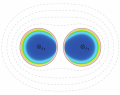
The figure “Internal Proximity effect” shows the non-homogeneous distribution of current between neighbouring single wires (current density increasing from blue to red color).
This effect demonstrates that there is an optimal range of frequency for litz wires, in which the losses are lower than for a solid conductor. Beyond this range the use of multiple single wires such as a litz wire can have negative effects.
You can't look at it like a lumped model. You have to look at the local EM effects.
As an analogy, consider the Hall effect -- you have a current traveling down a solid wire in the presence of a magnetic field, yet you get a potential difference from one side of the wire to the other.
In Litz wire, the different strands are at different conditions. Some are near the outside of the overall wire, and some are near the inside.
Imagine if we were to try to make "Litz-Lite" wire by just running the strands parallel down a sheath, so that wires near the outside would stay at the outside and wires near the inside would stay at the inside for the entire length of the wire. We would have accomplished nothing, because the skin effect would result in most of the current traveling down the outer wires, even though they have the same potential at both ends as the inner wires. Why? because local EM effects matter.
By twisting/weaving them in a careful pattern, you make it so that each strand spends about the same amount of time at different distances from the center as any other strand. But this means that the local conditions of each strand are not the same, some are closer to the center at that point and some are further away, some have more pinching effect due to EM in the adjacent portion of that strand than others, and hence different current densities in that region than others, and hence difference potential drops in that region than others. On average, they average out, but it's the local conditions that matter.
I see. It's the Litz weave that causes it. Each strand is effectively a whole load of different resistors in series as it varies in position in the bunch and the proximity effect varies depending on how far it is from the centre, and the next strand is a different load of resistors, so there are potential differences between points on different strands at the same distance from the end. Is that right?
It seems counter-intuitive that moving strands from inside to outside of the bunch at regular intervals should be any different from keeping them at the same distance from the centre.
I see. It's the Litz weave that causes it. Each strand is effectively a whole load of different resistors in series as it varies in position in the bunch and the proximity effect varies depending on how far it is from the centre, and the next strand is a different load of resistors, so there are potential differences between points on different strands at the same distance from the end. Is that right?
It seems counter-intuitive that moving strands from inside to outside of the bunch at regular intervals should be any different from keeping them at the same distance from the centre.
Again, consider just a big wire carrying a high frequency AC current. The current becomes increasingly confined to a thin skin of the conductor and none (well, very little) of it is flowing in the interior. So clearly there IS a difference related to how far you are from the center, otherwise there would be no skin effect to bother trying to deal with in the first place.
Again, consider just a big wire carrying a high frequency AC current. The current becomes increasingly confined to a thin skin of the conductor and none (well, very little) of it is flowing in the interior. So clearly there IS a difference related to how far you are from the center, otherwise there would be no skin effect to bother trying to deal with in the first place.
I'm well aware of skin effect and proximity effect. The thing that puzzles me about Litz is how swapping the positions of the wires are regular intervals makes a difference.
This is my crude analogy: Take three strands of wire, one in the centre of the bunch, one on the outside and one in between, and assume that they have resistances of 1Ω, 2Ω and 3Ω due to skin effect and proximity effect.
If each wire spends a third of its time in the centre and a third of its time on the outside then I'd expect each wire to have a resistance of 1/3+2/3+3/3 = 2Ω.
Put the three strands in parallel and the first arrangement gives 1/(1/1+1/2+1/3)=0.545Ω and the second gives 2/3Ω which is worse not better. (I had a horrible feeling that I was heading towards @dcbingaman 's parallel resistor problem).
I wonder whether my linear analogy is why its is wrong, as the problem is two-dimensional.
The people I get my Litz wire from advertise its use as antenna wire. I have never used it for antennas, I use brass pipes. In my RF days I used silver coated brass pipes to make 100mhz transformers.
I use Litz wire for power transformers. 100khz to 1mhz. The CU loss is reduced by Lita wire. The DC resistance is higher, but the transformer runs at a lower temperature.
I see the logic presented. I don't have another option as we head into the mhz regain. (I also use PCB copper for windings, people told me that would not work.)
Unless I retire soon, I will be making higher frequency mhz transforms. I want to see it work not just theory.
There is a different way of viewing the phenomenon too, as a diffusion mechanism. Recall the field is mostly on the outside of the wire.
As an analogy, it's something like heating a wire from the outside surface with a blow torch. The outer surface gets hotter due to imperfect thermal conduction of the material. The heat diffuses into the wire from the outside in.
I guess an acoustic analogy might work too. Sound waves striking a surface will penetrate to a certain depth. Lower frequencies penetrate deeper than higher frequencies. This gives the impression that high frequencies get dampened more than lower frequencies, assuming an overdamped construction which would be the case with acoustic insulation. If we had a construction in the shape of a wire, the audio would penetrate less with higher audio frequencies. I could imagine that some of the audio would reflect off of the surface also, so the audio would experience constructive and destructive interference when 'wires' are bundled together.
The main point though I think is that we are dealing with AC quantities not DC, therefore the analogies have to take that into account very seriously. This precludes the convenience of ignoring the dimensions of the construction versus the wave lengths involved.

 Facebook
 Google
 GitHub
 Linkedin