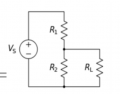
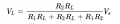
Even if \( \mathsf{R_L} \) is known and fixed, a voltage divider is not the equivalent of a buck converter. While they both drop the voltage, the voltage divider does it by converting the unwanted part of the current to heat, using the came power as if all of the current were being used productively but wasting the part that isn't needed.
The buck converter, on the other hand, only provides the desired power to the load by integrating over time making it far more efficient.
This is true, but the way I look at it is that the buck converter drops the voltage across an inductor rather than a resistor. An inductor drops voltage without dissipating any power, whereas a resistor does dissipate power.
A voltage divider will only work if it's made very stiff. The rule-of-thumb for dividers is that divider current should be at least 10 times the load current. Do the math and see how much power will be wasted by trying to use such a simplistic approach.

 Facebook
 Google
 GitHub
 Linkedin