Facebook
 Google
 GitHub
 Linkedin
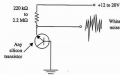
I designed this circuit to be an analog white noise generator, but when breadboarded, it exhibits strange behavior. Reverse-biased emitter-base junction of Q2, whose breakdown voltage is 5 volts, is the source of broadband noise, and its noise current is the signal input to the base of Q1, a common-emitter amplifier, and the noise output is taken from the top of R2.
The problem is, the voltage measured at the base of Q1 is 5 volts, at the emitter of Q1 is 10 volts, and at the collector of Q1 is 0 volts. It appears that 5 volts across the base-emitter junction of Q1, in the forward direction, is not enough to make it conduct! I thought I might be burning out the base-emitter junction of Q1 with the charging current for C1, so I added R3 to limit the inrush current to a few milliamperes, replaced both transistors, but the odd behavior persists. I tried increasing the value of R3 to 10k, again with new transistors, but the odd behavior still persists. Why does this circuit not work as expected?
The problem is, the voltage measured at the base of Q1 is 5 volts, at the emitter of Q1 is 10 volts, and at the collector of Q1 is 0 volts. It appears that 5 volts across the base-emitter junction of Q1, in the forward direction, is not enough to make it conduct! I thought I might be burning out the base-emitter junction of Q1 with the charging current for C1, so I added R3 to limit the inrush current to a few milliamperes, replaced both transistors, but the odd behavior persists. I tried increasing the value of R3 to 10k, again with new transistors, but the odd behavior still persists. Why does this circuit not work as expected?