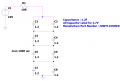
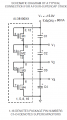
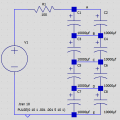
Why capacitor fails (bulge out) in below design

ronsimpson

Joined Oct 7, 2019
4,646
Do the capacitor fail during charge up or discharge? Probably you don't know.
What is the max charge current rating on the capacitors? I do not know.
What is the discharge circuit look like? What current?
The discharge current ( i ) is 0.01 × rated capacitance (F).
In simulation, set C3-C8 to 1.44F and C1-C2 to .96F (your capacitors are 1.2F+/-20%. See what happens to the capacitors voltage.
In simulation, set the caps all to 2.5V fully charged, and have the values like above (some at +20% and some at -20%) not discharge the caps with a load. I think the smaller caps will reverse charge. At the end you might have the small caps sitting at a negative voltage. Can the caps handle that?
Do the capacitors fail every time or has this happened only once?

Capacitors fail from heat, usually from too much current, too much voltage or from internal leakage. Some caps were made bad, but not often.
 
Last edited:

Alec_t

Joined Sep 17, 2013
15,101
Unless all the capacitors have exactly the same capacitance they will not share the voltage equally, so it's possible that the voltage across some will exceed their rated 2.7V.
 

KeithWalker

Joined Jul 10, 2017
3,603
The equivalent series resistances (ESR) of the capacitors may be significantly different. During charge, the one with the highest ESR will have the most voltage drop across it. This may exceed the maximum working voltage of 2.7V and that could cause damage to it.
 

BobaMosfet

Joined Jul 1, 2009
2,211

Attachments

Thread Starter

mishra87

Joined Jan 17, 2016
1,063
Unless all the capacitors have exactly the same capacitance they will not share the voltage equally, so it's possible that the voltage across some will exceed their rated 2.7V.
Hi...thanks for inputs.
Is it true if capacitor is charging with DC source ?
This is not clear to me.
 

Thread Starter

mishra87

Joined Jan 17, 2016
1,063
The equivalent series resistances (ESR) of the capacitors may be significantly different. During charge, the one with the highest ESR will have the most voltage drop across it. This may exceed the maximum working voltage of 2.7V and that could cause damage to it.
Incase of DC , does the ESR or DCR comes into the picture ?
 

MrChips

Joined Oct 2, 2009
34,628
Consider what happens when all the capacitors start off in a discharged state.
The voltage across each capacitor is zero.
When 10V is applied, C1 and C2 will be subjected to the full 10V across them.
 

Thread Starter

mishra87

Joined Jan 17, 2016
1,063
Do the capacitor fail during charge up or discharge? Probably you don't know.
What is the max charge current rating on the capacitors? I do not know.
What is the discharge circuit look like? What current?

In simulation, set C3-C8 to 1.44F and C1-C2 to .96F (your capacitors are 1.2F+/-20%. See what happens to the capacitors voltage.
In simulation, set the caps all to 2.5V fully charged, and have the values like above (some at +20% and some at -20%) not discharge the caps with a load. I think the smaller caps will reverse charge. At the end you might have the small caps sitting at a negative voltage. Can the caps handle that?
Do the capacitors fail every time or has this happened only once?

Capacitors fail from heat, usually from too much current, too much voltage or from internal leakage. Some caps were made bad, but not often.
The discharge current is around 250mA. The failure happens in The field after 6months..
Thanks.
 

ronsimpson

Joined Oct 7, 2019
4,646
The discharge current is around 250mA. The failure happens in The field after 6months..
Is it all the time the top capacitor that fail or can it be any cap?

There are 4 caps in series. (simple version, I know there are 8) You charge at the top of the stack of caps, and discharge from the top. Do you tap off power at the 3/4 point for something? (7.5V)
 

Thread Starter

mishra87

Joined Jan 17, 2016
1,063
Is it all the time the top capacitor that fail or can it be any cap?

There are 4 caps in series. (simple version, I know there are 8) You charge at the top of the stack of caps, and discharge from the top. Do you tap off power at the 3/4 point for something? (7.5V)
Hi Always...Top capacitors C1 and C2 fails...none other capacitor fails.
Thanks !
 

ronsimpson

Joined Oct 7, 2019
4,646
When 10V is applied, C1 and C2 will be subjected to the full 10V across them.
OK why? I do not see it.

I think there should be a balancing circuit! I do not understand why the top two cap and not any other caps. Maybe the placement of the caps is so the top caps are hotter or pressure is applied to the side of the caps. With out balancing some caps will have a hard life but why just the top two?
 

Thread Starter

mishra87

Joined Jan 17, 2016
1,063
OK why? I do not see it.

I think there should be a balancing circuit! I do not understand why the top two cap and not any other caps. Maybe the placement of the caps is so the top caps are hotter or pressure is applied to the side of the caps. With out balancing some caps will have a hard life but why just the top two?
Hi...Its kind of mystery and hard to find root cause of it.
All of above comments are just prediction and not indicating any possible root cause.
Regards,
 

Thread Starter

mishra87

Joined Jan 17, 2016
1,063
Surely a prediction is an indication of a possible root cause? Without making measurements, an actual cause won't be known for certain.
Hey Alec_t,
What would you like to measure ?
Voltage across C1 and C2 was 2.5V only.
What else would you like to suggest ?
Thanks.
 

ronsimpson

Joined Oct 7, 2019
4,646
What would you like to measure ?
Measuring may not find an answer. We need a unite that will fail next week. Measuring just before the failure will tell us something. It is very probably that the unite you have on your desk will never fail and measuring it tells nothing.

How far down do you discharge the caps? (2.5V x 4) is full, what is empty?

I have said before, when some caps in the stack are +20% value and some are -20% the charging will not be equal. Some caps will over charge.
I have said before, when (+20% & -20%) the discharging will not be equal. It is possible to discharge to a point where the -20% capacitors have a reverse charge. I have little experience with this capacitor, but reverse charge is not good.

Can you send pictures of the PCB with parts. Is the power supply or a power resistor near the top two caps?
 
Top