Why and how JFET acting as diode?

Thread Starter

Eartian

Joined Sep 16, 2021
58
Hi everyone,
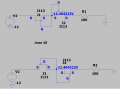
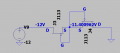
I’m simulating a bidirectional current limiter using two back-to-back N-channel JFETs. I came across this configuration in an op-amp protection circuit. The circuit seems to work fine—it limits the current regardless of the input voltage (see attached image). However, I noticed that one of the JFETs appears to behave like a diode, and I’m not fully sure why that happens. Could someone explain the reason behind this behavior?
Connetion: Used LT spice for simulation, J113 as njfet. Both sources are connected together and gates are tied together and shorted. (VGS is 0 for both).
Thanks!
1755879559164.png
 

WBahn

Joined Mar 31, 2012
32,703
Hi everyone,
I’m simulating a bidirectional current limiter using two back-to-back N-channel JFETs. I came across this configuration in an op-amp protection circuit. The circuit seems to work fine—it limits the current regardless of the input voltage (see attached image). However, I noticed that one of the JFETs appears to behave like a diode, and I’m not fully sure why that happens. Could someone explain the reason behind this behavior?
Connetion: Used LT spice for simulation, J113 as njfet. Both sources are connected together and gates are tied together and shorted. (VGS is 0 for both).
Thanks!
View attachment 354608
Start with the constitutive equation for the JFET and then apply the constraint imposed by shorting the gate to the source.
 

Thread Starter

Eartian

Joined Sep 16, 2021
58
Start with the constitutive equation for the JFET and then apply the constraint imposed by shorting the gate to the source.
Can you brief little more? what I believe the N channel is pinching off and Drain to Gate acts like a PN diode. If so how the pinching is happening when VGS is zero? or if I am wrong can you explain me about this little more? thanks
 

Papabravo

Joined Feb 24, 2006
22,058
A JFET will pass a current Idss when the gate to source voltage, Vgs is equal to 0. Reducing the gate to source voltage to a negative value will pinch off the channel. An increasingly positive Vgs will cause the drain current to rise until the device is destroyed.
 

Thread Starter

Eartian

Joined Sep 16, 2021
58
A JFET will pass a current Idss when the gate to source voltage, Vgs is equal to 0. Reducing the gate to source voltage to a negative value will pinch off the channel. An increasingly positive Vgs will cause the drain current to rise until the device is destroyed.
Yeah I get it, but here in this circuit the VGS will be always zero right? so it should act like a resistor limiting the current to IDSS as you said. But here one of the JFET is acting as diode and droping 0.6 to 0.7v. Which is what I am confused of. I believe VDS is controlling the channel width based on the polarity of the voltage and at some point the channel pinches off and Drain-Gate acts as diode. If I am correct here, how channel width is controlled? if I am wrong what makes the JFET to drop voltage exactly as a diode? Thanks
 

Thread Starter

Eartian

Joined Sep 16, 2021
58
I think, I was missing a simple concept of diode resistance when it is biased. Since Drain to Gate is forward biased it offeres less resistace than the Drain to Source channel resistance. That is why the voltage drop is similar to that of diode and almost no current is limited. I believe I missed a simple and basic concept. Thank you for the guidence provided.
 

Ian0

Joined Aug 7, 2020
13,097
JFETs can be used as low-leakage diodes, but it is usually done by joining source and drain together, not source and gate.
 

sparky 1

Joined Nov 3, 2018
1,218
Depending on which of the two regions of operation, Saturation or Triode region.
A (VCR) voltage controlled resistor in one region or in the triode region an N-Channel Jfet can exhibit positive gain.
it is applying a meaningful voltage correctly to the circuit that the substrate can exibit current direction or diode.
 
Last edited:

Thread Starter

Eartian

Joined Sep 16, 2021
58
Depending on which of the two regions of operation, Saturation or Triode region.
A (VCR) voltage controlled resistor in one region or in the triode region an N-Channel Jfet can exhibit positive gain.
it is applying a meaningful voltage correctly to the circuit that the substrate can exibit current direction or diode.
Hi Sparky,

Thanks for replying, that's a straightforward and perfect answer. Thanks!
 
Top