Facebook
 Google
 GitHub
 Linkedin

Hi,
I have designed and built an acoustic guitar preamp. It has a bunch of EQ and gain sections, focused on acoustic guitar.
(Previous thread of a previous version).
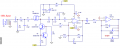
The first stage has a JFET and 2 BJT's (EasyEDA schematic below), that honestly I don't really understand. I stole this design from a Fishman Mini amp. This has worked in previous prototypes, but my most recent prototype, I've tracked it down to Q1 is not passing signal. Using a signal generator and scope, I get signal at pin 3 of Q1, but not at pin 2. So that makes me think the switch is not switching. Disclaimer, I'm a mechanical engineer and I don't really understand transistors that well. In the original Fishman circuit they used a 2N4392, but this is very hard to source, so the PN4392 is a good alternative that has worked previously. Also D1 and D2 were not in the original circuit, but someone suggested I add them.
I'd like to better understand what these 3 transistors do, and also how to troubleshoot why signal is not passing through Q1.
VCC and VEE are +/- 15VDC using a Traco 2W TEC2-0923 from 9v.
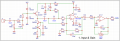
2nd picture is the original Fishman circuit as reference.
I have designed and built an acoustic guitar preamp. It has a bunch of EQ and gain sections, focused on acoustic guitar.
(Previous thread of a previous version).
The first stage has a JFET and 2 BJT's (EasyEDA schematic below), that honestly I don't really understand. I stole this design from a Fishman Mini amp. This has worked in previous prototypes, but my most recent prototype, I've tracked it down to Q1 is not passing signal. Using a signal generator and scope, I get signal at pin 3 of Q1, but not at pin 2. So that makes me think the switch is not switching. Disclaimer, I'm a mechanical engineer and I don't really understand transistors that well. In the original Fishman circuit they used a 2N4392, but this is very hard to source, so the PN4392 is a good alternative that has worked previously. Also D1 and D2 were not in the original circuit, but someone suggested I add them.
I'd like to better understand what these 3 transistors do, and also how to troubleshoot why signal is not passing through Q1.
VCC and VEE are +/- 15VDC using a Traco 2W TEC2-0923 from 9v.
2nd picture is the original Fishman circuit as reference.