Troubleshooting PCB, power issue

Thread Starter

rpschultz

Joined Nov 23, 2022
808
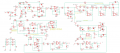
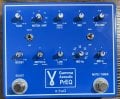
I have designed and built an acoustic guitar preamp. It has a bunch of EQ and gain sections, focused on acoustic guitar.

There are 4 op amps that run on +/-15 VDC: three TL074's and a single NE5532. 2 layer PCB with ground planes on top and bottom.

When I apply +/-15 (from a separate source), I don't get 15v at the rails, but instead get something <1V. Something is sucking current and I don't know how to troubleshoot this.

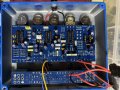
View attachment IMG_7247.jpg
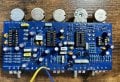
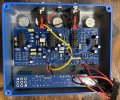
IMG_7246.jpg

1753827684549.png

+Vcc, GND, -Vcc are lower right of 2nd picture.

When I measure the resistance between +Vcc, GND and -VCC I get something in the 2-4 MOhm range without the op amps. I don't know that this measurement helps.

I'm not sure where to look.
 

dendad

Joined Feb 20, 2016
4,634
Does it only do this with the opamps plugged in?
That sounds like the supply polarity is reversed on something so there looks to be like a diode across the supplies. I have done that a number of times on mt PCB designs.
Double check the circuit. Then, try each opamp separately to see if it is only in one place.
 

MisterBill2

Joined Jan 23, 2018
27,159
Consider also bypass capacitors shown at each IC power connection. A backward connected electrolytic capacitor may have a high leakage current. So I also recommend first applying power without any of the ICs present in the sockets. Then you should be able to verify the correct supply voltages at the power connection pins.
I HAVE SEEN an instance where there was an error and all of the IC connections were flipped over. To use the PCB the ICs had to be installed on the solder side of the PCB.
 

ronsimpson

Joined Oct 7, 2019
4,645
Trouble shooting requires breaking the project into small pieces.
-what happens with no ICs on the board?
-add one IC at a time.
VCC and Vee reversed is a common problem.
Because the ohm meter = OK (low voltage measurement) there is not a board short in the supplies. Probably when VCC & VEE gets to 3V it pulls too much power, so it is a silicon problem.
 

MisterBill2

Joined Jan 23, 2018
27,159
You have done the ohm meter check and verified that it is not a dead short. That would have been simple the next steps suggested are exactly what I would recommend. AND, with no ICs installed, check for the correct voltage and polarity , with common as the reference, at each IC socket supply pin position. If those voltages are all correct, then make sure that the sockets all have pin one in the correct position.
BUT, if the voltages are still low, check for correct ploarity on all of the polarized capacitors.
 

Thread Starter

rpschultz

Joined Nov 23, 2022
808
Finally got back to this. @dendad may have been right. I scoured the PCB, found nothing. Hooked it back up, triple checking polarity on both boards and now I get 30v across the op amps pins, with or without ICs installed. I didn’t take any pictures beforehand to know if I crossed the wires or not.

IMG_7266.jpeg

IMG_7267.jpeg

IMG_7268.jpeg

But still no sound… onto the next phase of troubleshooting!
 
Last edited:

MisterBill2

Joined Jan 23, 2018
27,159
This stage of fault finding works much better when you have an understanding of what the circuit does and where the signal flows. I suggest providig an input signal and checking the opamp outputs for the signal being present.
 
Top