Whole house power measurments using a Current Transformer

Thread Starter

Jeffery Vahrenkamp

Joined Jun 16, 2016
53
I've been reading up on monitoring power usage using a current transformer. I feel like I have a pretty good grasp on the general ideas but there is one last thing that I have been unsure about and haven't found any good documentation on for the set up.

I live in America and have three lines coming into my house from the utility, two hot lines that are 180 degrees out of phase from each other (red and black) and a neutral wire. Everything I have read talks about putting a CT on a single wire and calculating the power by measured current * voltage using some formula. What I'm not sure about is, which wire and then what voltage. Looking at wiring diagrams for breaker boxes it appear that both hot wires are used for circuits, about half and half. So If I were to measure using either of the hot lines I would only be measuring about half the circuits in my house. In my mind that's a simple fix, just measure on the neutral line as all current used should egress out the neutral line. However, if I do that, what voltage do I measure? Will that be measured at 120V or 240V? I'm assuming that would be 120 as current drawn from either line would still always be 120V compared to the neutral, but I'm not sure how the two out of phase power supplies would affect measurements. Is there any reason not to measure on the neutral line? The only other configuration I can think of is to put the CT around both the hot lines coming in and measure assuming 240V, but I don't think there is enough space in the CT gap for that, and am certain I've never seen that suggested as a set up. Insight would be appreciated.
 

MaxHeadRoom

Joined Jul 18, 2013
30,654
For e.g. if you Were to measure the current in the neutral and you had two loads on each of the L1 and L2 lines, although they maybe 120v loads (L1-N & L2-N) the current in the neutral will be zer0.
Also you cannot measure the current with a single CT on L1 & L2.
Max.
 

tranzz4md

Joined Apr 10, 2015
315
You'll only measure the current in a single conductor with a single CT, and that'll be approximately 1/2 of your house.

Current is not power. Niether is current times voltage. That's why power meters are relatively complex assemblies.

Electrical current can be a useful characteristic to measure, and is related to electrical power, but won't help you find certain conditions that can increase your utility bill.
 

crutschow

Joined Mar 14, 2008
38,503
The measurement can be done with one current transformer I believe.
To measure the total house current you run the red lead through the transformer in one direction and the black lead through the transformer in the other direction
That will give the sum of the two currents.
If you were to run them in the same direction you will get the difference of the two currents (the neutral current).

You then multiply this instantaneous current by the instantaneous voltage from black to red and divide by 2 to get the real whole house power (an analog multiplier can be used for that multiplication with the output low-pass filtered to get the average RMS power).
(That technique will give an small error if the two voltages to neutral are slightly different but should be inconsequential for your purposes. The way to eliminate that error would be to use a current transformer on each leg and measure each voltage to neutral separately.)

The neutral current is the difference between the two hot currents, not the sum, and can be zero if the red side is drawing the same current as the black side, so it cannot be used to measure house current.
 

Thread Starter

Jeffery Vahrenkamp

Joined Jun 16, 2016
53
So it sounds to me that I'd be better off getting two CTs and measuring both hot lines independently. Looks like I could do the two direction approach in my outside box, but I'm not sure the core has enough space and I don't have an outlet out there (ah the irony of all that power and no outlet to access it through).

In terms of measuring instantaneous voltage, any ideas/links on how to measure that using a logic level ADC? The sources I have seen measure voltage by using an AC AC transformer to step it down, then a voltage divider to step it down further with a capacitor to float the AC above the ground value for the ADC. However, I don't see how that tells me what my true voltage is outside of knowing the exact number of turns in the transformer. Would I just measure the difference between the expected voltage and true voltage and assume my mains voltage is off by that same percentage? IE 9V transformer is 8.5V , so assume mains voltage is ~0.5% low as well?
 

MaxHeadRoom

Joined Jul 18, 2013
30,654
In terms of measuring instantaneous voltage, any ideas/links on how to measure that using a logic level ADC?
Many labs and instrument stations still use the old moving iron meters, which you may still get cheap, surplus etc.
Unless you need to log it with a processor or chart recorder etc.
Max.
 

Thread Starter

Jeffery Vahrenkamp

Joined Jun 16, 2016
53
Many labs and instrument stations still use the old moving iron meters, which you may still get cheap, surplus etc.
Unless you need to log it with a processor or chart recorder etc.
Max.
yeah, I was planning on building myself something like the Sense home monitor using an esp8266 and a dedicated ADC as an interesting side project (also trying to figure out how much power certain items are using while I'm at it).
 

crutschow

Joined Mar 14, 2008
38,503
n terms of measuring instantaneous voltage, any ideas/links on how to measure that using a logic level ADC? The sources I have seen measure voltage by using an AC AC transformer to step it down, then a voltage divider to step it down further with a capacitor to float the AC above the ground value for the ADC. However, I don't see how that tells me what my true voltage is outside of knowing the exact number of turns in the transformer. Would I just measure the difference between the expected voltage and true voltage and assume my mains voltage is off by that same percentage? IE 9V transformer is 8.5V , so assume mains voltage is ~0.5% low as well?
Yes, the easiest way to safely measure the mains voltage is to use a transformer and calibrate it.
You just measure the mains voltage and the transformer output voltage, and divide the two values to get the exact turns ratio (limited only by the accuracy of the meter you use).
No assumptions needed.
 

MaxHeadRoom

Joined Jul 18, 2013
30,654
If wishing to monitor current using a μP DigiKey sell Honeywell current sensors up to 1275A!
Such as the CSCA style and others.
Max.
 
Ac power measuring is never easy to do it right. Both analog devices and TI and probbaby others have IC;s designed for power measuring/

When i(t) and v(t) are sinusoidal and the load is resistive, the problem is easier.

Current becomes non-sinusoidal with switching power supplies that are not power factor corrected.

Voltage and current become out of phase with inductance or motors.

So, you might get the wrong answer when your furnace uses a variable speed drive for the fan motor.

Most homes don;t have a lot of non-sinusoidal loads.

You should in the US be able to get this info from the Utility's website if you have smart metering. it might be 10 minute increments or sol.

take a look at PDF page 18 here: http://ieee.rackoneup.net/rrvs/13/fundpwrmea.pdf

Start here: http://tmi.yokogawa.com/files/uploaded/Measuring_Power_Using_the_DL750.pdf It's not the best.

There's a good application note, but I can;t find it, so take a look here: http://www.ti.com/tool/TIDM-MSP430AFE253SUBMETEREVM#Technical Documents

it's true that when you look at any 240 V circuit. L1 L2 N and ground, Neutral carries the difference in current of L1 and L2 and may be negative which depends on how you define it.
 

crutschow

Joined Mar 14, 2008
38,503
If you multiply the instantaneous voltage by the instantaneous current, such as with an analog multiplier, the filtered output is the true (real) average power.
It does not register reactive power.
 

Reloadron

Joined Jan 15, 2015
7,886
Something to consider is using a current transformer the transformer primary becomes your L1 and L2 mains power into your breaker panel. This means threading those lines, while hot, through the the CT. Not always a user friendly task and just a bump the wrong way manipulating that cable and you will see a flash you will never forget. Projects like this always fare better when the utility company can come by and pull the meter allowing you a few hours of no power. When using a CT there is the matter of building or buying a circuit to signal condition what you have to what you want.
The merit to using a CT is they are inexpensive, the downside is the needed signal conditioning. There are meters designed to work with CTs which also provide analog outputs suitable for use with micro-controllers and data recorders but they are not quite inexpensive. Additionally there are turn key current transducer solutions where an AC Current Transducer will also afford outputs proportional to sensed current suitable for micro-controller or data logger inputs.
You can also build or buy AC voltage transducers where line voltage(s) are conditioned for inputs to a uC or data logger. If you plan to record the data (current and voltage) you need to place the recorded data somewhere where it can always be recalled and read. You can use any uC like an Arduino or invest a few bucks in a basic data logger.

Ron
 

ebeowulf17

Joined Aug 12, 2014
3,307
Something to consider is using a current transformer the transformer primary becomes your L1 and L2 mains power into your breaker panel. This means threading those lines, while hot, through the the CT.
I don't remember the terminology now, but I thought I remembered looking at CTs pretty recently that had a hinged or removable section so that they could be placed around a wire without interrupting the circuit. Might be a wise investment if the power there can't be completely shut off.
 

crutschow

Joined Mar 14, 2008
38,503
As Ron noted there can be some high voltages involved which can damage the transformer, so be sure you have the correct burden resistor connected to the transformer output when you close the core around the main's wire.
 

Thread Starter

Jeffery Vahrenkamp

Joined Jun 16, 2016
53
just in case anyone was wondering this is my hypothetical setup. I am going to have two 100A/1v split core transformers (burden resistor is already integrated). I have a third 30A/1V CT just in case I want to measure an individual circuit. I am going measure voltage using an ADC performing the calculations of instantaneous power on a micro controller, and send the information to my home RPI server using an esp8266. Unfortunately the esp8266 only has one ADC and it only reads up to 1.1V, so I am going to have to use another device to measure the voltage.

My thought was to simultaneously measure the voltage and amperage and calculate power by V*I. However, Yesterday as I was looking at the specs for my ADC it appears that it can only make 860 readings a second. That's surprisingly slow, especially since I was going to be measuring across 3 channels (2 current and 1 voltage). I think that comes out to only (860 hz/60 hz power/ 3 measurements) ~4 measurements per cycle, and probably will give me incorrect measurements for non-resistive loads. I think I'll just measure it with an arduino nano (I don't think I need the 16 bits of precision), which should be able to read at a 10 Khz sample rate. This should give 41 measurements per cycle, doing a little math on the arduino it will probably be more like 20 measurements a cycle if I'm measuring all three sources. I'll probably tweak the program and go back and forth between measuring the two hot lines so I can get more accurate measurements as I doubt my power demands are going to swing wildly in the 2-5 second range. I might be able to speed things up by off loading some of the calculations to my ESP8266, but I'll have to test if it would be faster to crunch some numbers on the arduino and send the results via serial, than it would be to try and transmit the raw data via the serial controller.

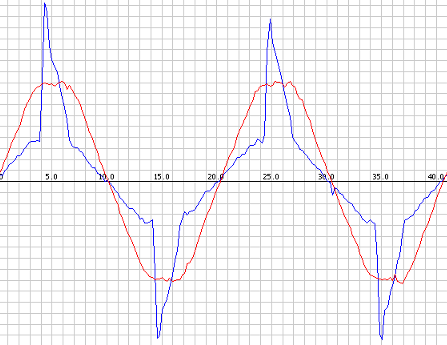
Is there any reason not to use an average of the instant power for my calculations, if I can have a high enough sample rate? 40-80 measurements a cycle should be enough to catch wonky behavior like this. :)
 

crutschow

Joined Mar 14, 2008
38,503
Is there any reason not to use an average of the instant power for my calculations, if I can have a high enough sample rate? 40-80 measurements a cycle should be enough to catch wonky behavior like this.
40 measurements per cycle will sample every 0.4ms.
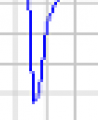
The peaks you show in you graph have an apparent width of about 0.2ms as shown below, so 40 measurements per second may not catch that.
To catch that peak you should likely sample at about a 0.1ms period or 160 samples per cycle.

Of course that short peak does not carry a lot of energy so it's a tradeoff between sample rate and accuracy.
At a 0.4ms sample rate, the minimum voltage you would catch looks to be about 2 divisions or 14% below the peak which should not be that significant in the total power measurement.
Edit: My (admittedly rough) estimate indicates that it would cause less than 1/2% error in the total power calculation.
The data in the plot you show appears to be sampled at about 12 samples/ms or an 83μs sample period.

upload_2017-8-31_10-25-37.png
1ms/division
 
Last edited:
Top