A fluorescent light tube is coated with phosphor... If ultraviolet LEDs were instead fitted in the tube, the emission would equally be white light, would it ?
I'm only guessing, but it sounds reasonable to me. There are two critical wavelengths, the one that excites the phosphor and the wavelength it emits at. As long as the LED wavelength is able to excite the phosphor, the emission will be the same.
I'm wondering about the significance of visible light that doesn't involve the fluorescence. The presence or lack of that might alter the appearance.
Thanks. I would guess too, that the light that does not involve fluorescence is blocked by the opaque phosphor itself. A test could be done by shining ultraviolet LEDs from outside the glass too, could it ?
Thanks. I would guess too, that the light that does not involve fluorescence is blocked by the opaque phosphor itself. A test could be done by shining ultraviolet LEDs from outside the glass too, could it ?
Most fluorescent lights work from the UV emission of mercury (254nm). LEDs at that wavelength are few and far between, expensive, short lived and not as efficient as a longer wavelength UV LED used in white LEDs.
Possibly, but I doubt it would reveal much. The glass envelope of the tube would let some of the longwave UV through to the phosphor, and that's probably what your UV LED emits; but glass blocks shortwave UV (which is where mercury vapor emits most, and your phosphor is most likely to respond to). So I doubt you'll see much response while trying to excite the phosphor from outside the envelope.
A fluorescent light tube is coated with phosphor... If ultraviolet LEDs were instead fitted in the tube, the emission would equally be white light, would it ?
Just guessing here but I'd expect that the amount of energy emitted in the form of light from the phosphor would be equivalent to the mount of energy expended exciting that phosphor. IF (big IF) UV LED can excite the phosphor then the amount of energy going into your LED SHOULD produce the same amount of light energy.
Your question is "Would that light be white?" If you can excite the phosphor then I'd imagine it would radiate in the color it naturally does. If white is the natural color then I'd assume it would be.
Just guessing here but I'd expect that the amount of energy emitted in the form of light from the phosphor would be equivalent to the mount of energy expended exciting that phosphor. IF (big IF) UV LED can excite the phosphor then the amount of energy going into your LED SHOULD produce the same amount of light energy.
Your question is "Would that light be white?" If you can excite the phosphor then I'd imagine it would radiate in the color it naturally does. If white is the natural color then I'd assume it would be.
The problems of this idea:
- LEDs are directional and the OP is trying to use directional light sources (LEDs) to replace the omnidirectional low-pressure Hg-discharge UV source. LEDs are, at best, point-sources with a hemispherical glow. Arrangement of the LEDs inside the tube will be critical if the designer is looking for a uniform glow of the tube.
- phosphors are actual a mixture of fluorescent pigments. Each pigment can absorb at one minimum wavelength (or a slightly-blue-shifted wavelength) and it will emit at one narrow wavelength (theoretically one). The fluorescent pigments are carefully mixed to emit the desired version of "white".
- The action of placing the LEDs into the tube will likely scratch the phosphor inside the fluorescent tube. The phosphor is very friable and barely adheres to the glass tube. It will easily crumble and leave a noticable flaw.
In essence, what I was saying is that you can't get 40 watts of light out without putting in at least 40 watts of energy. I think that would take a whole lot of UV LED's. But I believe the post is asking if " 'In Theory' this is the case - or is possible". I'd imagine it probably IS possible. Though the argument could be made that it might not be a very practical approach.
In essence, what I was saying is that you can't get 40 watts of light out without putting in at least 40 watts of energy. I think that would take a whole lot of UV LED's. But I believe the post is asking if " 'In Theory' this is the case - or is possible". I'd imagine it probably IS possible. Though the argument could be made that it might not be a very practical approach.
You would have to compare 40W of emitted UV photons from Hg-discharge lamp with its predictable wavelength distribution to 40W of UV emission - because 40 watts of electrical power into each type of UV-source will not give the same number of UV photons.
For clarification, 40W can be tuned by pushing more photons of a given energy or by picking LEDs that emit different longer or shorter wavelengths with the same total number of photons.
Phosphors emit one photon for every photon entering to excite. A higher energy photon (shorter wavelength) does not produce more emitted light, it just creates more heat losses on the phosphor surface). It is a very tedious process and a phosphor package must be tuned for a specific input energy (excitation) spectrum.
Possibly, but I doubt it would reveal much. The glass envelope of the tube would let some of the longwave UV through to the phosphor, and that's probably what your UV LED emits; but glass blocks shortwave UV (which is where mercury vapor emits most, and your phosphor is most likely to respond to). So I doubt you'll see much response while trying to excite the phosphor from outside the envelope.
Just for kicks I decided to put what I said to the test, and lo and behold, I was wrong-- sort of.
I used a Lumex LXT046UV1C UV LED (4 mW output at 385 nm, at If=20 mA) to illuminate a compact fluorescent lamp and it actually did produce some visible light. But it was very dim and could only be seen in a darkened room. Also, the light was quite blue so I suspect that some of the shorter wavelength Hg spectral lines are necessary to excite the components of the phosphor which make the light "white."
So I don't think fitting UV LEDs inside a fluorescent light tube to get white light is a practical idea.
Just for kicks I decided to put what I said to the test, and lo and behold, I was wrong-- sort of.
I used a Lumex LXT046UV1C UV LED (4 mW output at 385 nm, at If=20 mA) to illuminate a compact fluorescent lamp and it actually did produce some visible light. But it was very dim and could only be seen in a darkened room. Also, the light was quite blue so I suspect that some of the shorter wavelength Hg spectral lines are necessary to excite the components of the phosphor which make the light "white."
So I don't think fitting UV LEDs inside a fluorescent light tube to get white light is a practical idea.
385 is on the ragged edge of visible. An Hg emission is about 254nm so, about 50% more energy per photon than 385nm. In other words, the 385 nm cannot excite the electron to a band that, upon decay, creates a visible emission.
Additionally, If you are seeing blue/purple color of the LED, you are not even getting absorption. Without absorption, there can be no emission.
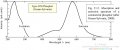
EDIT:Just for reference, here is a phosphor formulation sold by Osram. It shows absorption(excitation) wavelengths and emission wavelengths. It is turned for a Mercury discharge source at 254 nm and no excitation is expected from a 385 nm source.
Visually, the LED glows with a dim purple color which is quite different from the much brighter, somewhat milky blue color emitted by the CFL when excited by the LED. So it's clear there is some fluorescence happening, even though it's nothing to write home about.
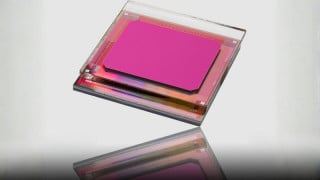
If the OP wants some nice, bright white light source, I'd say don't fool around putting UV LEDs inside fluorescent tubes: get one of these little monsters instead. I bought one just to play with, and even at 100 mA forward current (i.e., just under 3% of full power) the light output is astonishing.
Thanks, gentlemen.
GopherT plot/post explains a lot.
No intentions to insert UV LEDs in a tube. But collecting/scraping that phosphor from deceased tubes may bring some uses when mixed with clear paint or blown in suspension into a UV chamber.

 Facebook
 Google
 GitHub
 Linkedin