Which is the best simulator for testing circuits?

Audioguru

Joined Dec 20, 2007
11,248
I have never seen a "thermostabilized" 10V Zener diode. An ordinary Zener diode with a voltage from about 5.1V to about 6.2V is thermally stable which is why a 5.6V Zener diode was used in the original and improved circuits then amplified to 11.2V with an opamp.
 

Bordodynov

Joined May 20, 2015
3,431
I have never seen a "thermostabilized" 10V Zener diode. An ordinary Zener diode with a voltage from about 5.1V to about 6.2V is thermally stable which is why a 5.6V Zener diode was used in the original and improved circuits then amplified to 11.2V with an opamp.
Such diodes were made in the USSR (D818E, Vb=8.55V - 9.45V, +/- 0.001%/C). I forgot that the zener diodes in the range 5.1 ~ 6.2 have a small temperature coefficient. Such stabilitrons have two mechanisms of breakdown - tunnel and avalanche. The tunnel temperature has a negative temperature coefficient, while the avalanche coefficient is positive. Audioguru, thanks for reminding me. I was surprised why you used such a zener diode and for some reason did not apply my knowledge. On this occasion, there is a short, beautiful expression, but Google does not translate it correctly.
 

Bordodynov

Joined May 20, 2015
3,431
What is and where is U8 that has a peak current of 18A (!) and is heating with 6W?
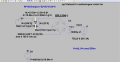
U8 - Bridgerectifier, GBJ2001 20A 100V.P = 2V * 3A = 6W.If we take four Schottky diodes with an allowable current of ~ 10A-20A, then we can reduce power by half.
Did you notice that the filter capacitor dissipates 1W?It is necessary to substitute a real ESR in the parameter Rser of the capacitor.The additional diode dissipates 2.7W power, but it allows you to do without negative voltage.By the way, LTspice has a search function on the schematic.The combination cntrl + F and the field in the upper right corner will appear.Type for example U8 and if there is an item, it will be highlighted.
 

ArakelTheDragon

Joined Nov 18, 2016
1,366
After the bridge rectifier, the fundamental harmonic is the double frequency. Simulate the bridge rectifier with a capacitive and resistive load and you will see that the output voltage period is half the period of the input voltage. The output of the bridge is a constant (rectified) voltage + ripple. One volt of pulsations is not enough. You can add a rectifier bridge, a capacitor and an AC voltage source (Transformer secondary voltage) to my circuit and see what happens.
In my example, the ripple voltage is 2 volts peak-peak, and the output is less than millivolts. I just wanted to show that this stabilizer quite well filters pulsations.
It should be 100Hz, only if the transformer is picked properly (with middle point)?
 

Bordodynov

Joined May 20, 2015
3,431
It should be 100Hz, only if the transformer is picked properly (with middle point)?
In any two-half-wave rectifier there will be a double frequency. One will give a positive half-wave, the second period will give a negative half-wave. Total; During one power supply period, two periods of the output voltage will be generated.
 

ArakelTheDragon

Joined Nov 18, 2016
1,366
In any two-half-wave rectifier there will be a double frequency. One will give a positive half-wave, the second period will give a negative half-wave. Total; During one power supply period, two periods of the output voltage will be generated.
Yes I know that theory, and I know the simulator gives it so, however on advice from colleagues, which I was unable to confirm, I need to pick the transformer properly or it will be 50Hz.
 

Bordodynov

Joined May 20, 2015
3,431
\
Yes I know that theory, and I know the simulator gives it so, however on advice from colleagues, which I was unable to confirm, I need to pick the transformer properly or it will be 50Hz.
Do you need to choose a ready-made transformer or are you going to make it? In any case, you need to know the power and output voltage.
 

Bordodynov

Joined May 20, 2015
3,431
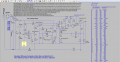
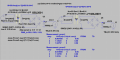
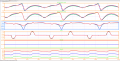
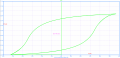
I uploaded two test circuits for the transformer. In the first scheme, the transformer is tested at the initial moment of input of the input voltage. The starting currents of the capacitor charge cause the transformer to become highly saturated. And only after a long period of time a stationary mode of operation is established. In the second file, I output a hysteresis loop after 99 seconds. We can already assume that the stationary regime is reached (almost). Each transformer has its own time constant, determined by the inductance and the winding resistance.
For example, the Inductance of the winding is 200 Henry, and the winding resistance is 10 Ohm. Then the time constant of the transformer is 200/10 = 20 sec. For a steady-state process, a time of at least 5 Tau is required.
 
Top