Which is the best simulator for testing circuits?

Audioguru

Joined Dec 20, 2007
11,248
Per piece of tle2141 costs more than $2 which is 141INR. On comparison to TL081 which here costs less than 20INR.
That's a huge amount of money.
Isn't there any alternative?
There is a HUGE difference between your India and my Western world. $2 is almost NOTHING here. Here, we have high paying jobs after schooling and university educations. If we want a good opamp then we buy a good opamp that costs the same or less than a cup of coffee..

Yes, the LM324 crossover distortion can be eliminated by operating the output in class-A that increases the current and heating of the output transistor. It has all four opamps in it that might cause it to get too hot in this project. Post a video of it smoking.

A simulator uses "typical" spec's for its ICs and transistors that you cannot buy. If you get parts that pass but have minimum or maximum spec's then the circuit probably will not work unless it is designed for minimum and maximum spec's.
 

Bordodynov

Joined May 20, 2015
3,431
.................................
Yes, the LM324 crossover distortion can be eliminated by operating the output in class-A that increases the current and heating of the output transistor. It has all four opamps in it that might cause it to get too hot in this project. Post a video of it smoking.
...............................
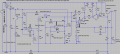
In my scheme, the total power of all opamp in LM324 is less than 250mW (Vcc = 40V). For the case PDIP-14 This will give an overheating of 30 degrees Celsius, which is quite acceptable and there will be no smoke. Unlike your circuit, I applied three transistors to the output, which unloaded the last amplifier in the circuit.
 

Audioguru

Joined Dec 20, 2007
11,248
Bordodynov, you are clever to operate the quad opamp that has a fairly low maximum allowed voltage at a low supply voltage, then use amplification for the output transistors. Then the maximum supply voltage for the quad opamp is not exceeded and its does not get too hot.

I am concerned that the maximum output current will not be controlled when the output is shorted because the current control opamp does not have a negative supply then your diode D2 cannot force the input of the voltage control opamp to zero volts. A circuit must be added to replace D2 with no voltage drop, or a small negative supply voltage for the opamps must be added.
 

Bordodynov

Joined May 20, 2015
3,431
Audioguru, thanks for the comment, I will make an additional offset of the opamp. One, two resistors is enough for this. I'll check it out in the final circuit.
And maybe I'll rewrite the protection scheme.
 

Bordodynov

Joined May 20, 2015
3,431
why to use 100Hz sine wave as an input when we have either 50 or 60Hz?
IDK is it right for me to point out the errors, but i saw output oscillates but within very small range almost negligible.
After the bridge rectifier, the fundamental harmonic is the double frequency. Simulate the bridge rectifier with a capacitive and resistive load and you will see that the output voltage period is half the period of the input voltage. The output of the bridge is a constant (rectified) voltage + ripple. One volt of pulsations is not enough. You can add a rectifier bridge, a capacitor and an AC voltage source (Transformer secondary voltage) to my circuit and see what happens.
In my example, the ripple voltage is 2 volts peak-peak, and the output is less than millivolts. I just wanted to show that this stabilizer quite well filters pulsations.
 

ericgibbs

Joined Jan 29, 2010
21,439
hi rahul,
It is possible to run a thermal response sim in LTS.
By bread board do you mean a solderless socket type BB, not the best choice for a high current project.
E
 

Bordodynov

Joined May 20, 2015
3,431
so what you say, should i test it on breadboard?
before that, what about the thermal stability of the circuit?
Thermostability is determined by the reference voltage source. I used this circuit (on an operational amplifier and a zener diode) for thermal stability. I applied a thermostabilized zener diode to 10 volts. There are thermally stabilized zener diodes at a voltage of about 10 volts. In reality, the structure consists of a zener diode (with a positive temperature coefficient) and several ordinary diodes (with a negative temperature coefficient) connected in series so that the total temperature coefficient is very small.
If you need increased stability, then use just such a zener diode.
 

Thread Starter

rahul411

Joined Feb 19, 2018
260
Thermostability is determined by the reference voltage source. I used this circuit (on an operational amplifier and a zener diode) for thermal stability. I applied a thermostabilized zener diode to 10 volts. There are thermally stabilized zener diodes at a voltage of about 10 volts. In reality, the structure consists of a zener diode (with a positive temperature coefficient) and several ordinary diodes (with a negative temperature coefficient) connected in series so that the total temperature coefficient is very small.
If you need increased stability, then use just such a zener diode.
Can only one LM324 can handle the torture, i mean it consists of 4 opamps in it and here we'll use 3 of them simultaneously, will it get overheat?
 

ericgibbs

Joined Jan 29, 2010
21,439
hi,
If you plan to design a PCB layout for the final build it would be wise to build test sections of the the design on strip PCB, before doing a final layout.

E
 

Thread Starter

rahul411

Joined Feb 19, 2018
260
hi,
If you plan to design a PCB layout for the final build it would be wise to build test sections of the the design on strip PCB, before doing a final layout.

E
Sounds like a plan.

But before that i need some confirmation regarding the components used. I saw the datasheet of BZX84C15L and BAT54 they both are available in SOT23 package. BZX84C15L is a 15V zener diode, can it be replaced with thru-hole package?
I think BAT54 don't have thru-hole package available.
 

Bordodynov

Joined May 20, 2015
3,431
Can only one LM324 can handle the torture, i mean it consists of 4 opamps in it and here we'll use 3 of them simultaneously, will it get overheat?
You should not be intimidated by overheating. Four opamps have a total current of 0.7 mA + an output current of 1.2 mA + 5 mA via a zener diode, but in this case an opamp is less than 4 V. You can see the power on each element. Start 4.asc and pointing the element on the element, press ALT, the thermometer will display the power on plot. You can put the Zener in any enclosure. Indeed, a low-power schottky diode similar to the BAT54 navryatli has an analog in the case with wire leads. Try BAT46
 

Thread Starter

rahul411

Joined Feb 19, 2018
260
You should not be intimidated by overheating. Four opamps have a total current of 0.7 mA + an output current of 1.2 mA + 5 mA via a zener diode, but in this case an opamp is less than 4 V. You can see the power on each element. Start 4.asc and pointing the element on the element, press ALT, the thermometer will display the power on plot. You can put the Zener in any enclosure. Indeed, a low-power schottky diode similar to the BAT54 navryatli has an analog in the case with wire leads. Try BAT46
Thanks
BTW can you recommend any site/book from where i can learn more about LTS, on YouTube they have tutorials on only basics which I know. I want to expand my knowledge on this. If you know any please share.
 

Thread Starter

rahul411

Joined Feb 19, 2018
260
You should not be intimidated by overheating. Four opamps have a total current of 0.7 mA + an output current of 1.2 mA + 5 mA via a zener diode, but in this case an opamp is less than 4 V. You can see the power on each element. Start 4.asc and pointing the element on the element, press ALT, the thermometer will display the power on plot. You can put the Zener in any enclosure. Indeed, a low-power schottky diode similar to the BAT54 navryatli has an analog in the case with wire leads. Try BAT46
Measured the wattage of each component. Found that R16 2.1W of power which is obvious.
R17 has 260mW and R190 170mW, does this require attention?
Rest all are under few mW.
 

Bordodynov

Joined May 20, 2015
3,431
Measured the wattage of each component. Found that R16 2.1W of power which is obvious.
R17 has 260mW and R190 170mW, does this require attention?
Rest all are under few mW.
Why do you take the impulse power during transients. It is necessary to take the average power in the steady state. Pulse power can be an order of magnitude and more than average power. You are frightened by the power of the current sense resistor. But in the prototype of the stabilizer the sensor had a resistance of 0.47 Ohm and the power dissipated by the resistor was twice as much! And did you watch the power of the output transistor (especially when the output shorted)?
 
Top