Which is the best simulator for testing circuits?

ramancini8

Joined Jul 18, 2012
473
Simulators don't test circuits; you test circuits. Simulators are nothing more than smart calculators. Start with a small piece of the circuit, one or two active devices, simulate it then test,and then examine the correlation of test and calculated results. Any and all non-correlations must be reconciled before proceeding. Do this for each piece of the circuit as they are designed, and then connect them together and repeat test and simulate. This technique takes longer, but it produces excellent results.
 

WBahn

Joined Mar 31, 2012
32,871
Built the circuit and later discovered that it doesn't work.
So consider this the tuition for a very valuable lesson. Build up circuits a little bit at a time and check for proper functionality as you go. Most mistakes (or bad parts) can be identified quickly and in such a way that there are only a few things that need to be focused on first to find the problem.

As for the present situation, if the supply is good other than it not working (meaning that you are satisfied with the assembly job you did), then try to test it from input to output and see where its behavior deviates significantly from what you would expect. When you find a spot that isn't what you would expect, see if you can't isolate it from the following circuitry. If it recovers, then the problem is further on but if it doesn't then the problem is probably in the last part of the circuit you checked. Start by checking the various power and ground rails every place they are used.
 

Thread Starter

rahul411

Joined Feb 19, 2018
260
So consider this the tuition for a very valuable lesson. Build up circuits a little bit at a time and check for proper functionality as you go. Most mistakes (or bad parts) can be identified quickly and in such a way that there are only a few things that need to be focused on first to find the problem.

As for the present situation, if the supply is good other than it not working (meaning that you are satisfied with the assembly job you did), then try to test it from input to output and see where its behavior deviates significantly from what you would expect. When you find a spot that isn't what you would expect, see if you can't isolate it from the following circuitry. If it recovers, then the problem is further on but if it doesn't then the problem is probably in the last part of the circuit you checked. Start by checking the various power and ground rails every place they are used.
Suppose for this case... How do I know that the opamp are giving the right output?
Which section of circuit needsto be executed first.
 

Audioguru

Joined Dec 20, 2007
11,248
I think the 10000uF main filter capacitor is missing or is defective. TP1 should be (28V x 1.414) - 1.4V= +38.2V when the supply has a 3A load and will be maybe +40V or +41V with no load.

R22 is a 1/4W resistor. It would dissipate 1/4W when it has 31.5V across it but it has a 10V zener diode reducing its power supply voltage.
TP1 is 27V so the 3.9k resistor has 17V across it and dissipates almost no heat.
See if the zener diode is backwards by measuring the voltage across it.

The PNP transistor is an on-off switch. It turns on (when regulating the current) with no voltage across it then no heating or it turns off with no current then no heating. It must be wrongly connected to something else.
 

Thread Starter

rahul411

Joined Feb 19, 2018
260
hi rahul,
I have marked 8 Test points, Tp1 thru Tp8
Power up the project and measure the Voltage on these Tps with respect to 0V/Gnd, post your marked up drawing.

E
View attachment 151308
Because of my exams I was unable to give you the feedback, sorry for that.
Now i measured the voltages across all the test points you mentioned. And the list is like this.
TP1- 27.8v
TP2- 17.8v
TP3- -1.4v(negative)
TP4- 26.7v
TP5- 26.3v
TP6- 0.3v
TP7- 11.1v
TP8-27.3
Here, instead of 28VAC I have used 21VAC transformer, will this cause any difference?
The LED connected to collector of Q3 is always ON which i think it shouldn't.
Also i have used TL081 opamp instead of MC34071. Other than that all the components are same.
 

Audioguru

Joined Dec 20, 2007
11,248
One fault in the original defective circuit was that it used the same TL081 opamps that you are using. TL081 opamps will not work in this circuit because their maximum supply is only 36V and they need a negative supply of -5.6V, not the 1.4V used for the newer opamps. With the negative supply too low for a TL081 and its input voltages are also low then the output on U3 will always be as high as it can go. The value for RV1 is much too low for a TL081 and it needs an additional series resistor for it as shown in its datasheet.

The output voltage TP8 of U2 is as high as it can go but you do not say if the voltage pot P1 setting can reduce it smoothly to zero.

It will work with the proper opamps and a 21V transformer but its max output voltage and current will be less.
The output voltage of U3 TP6 is low when the output current is higher than the current pot P2 setting so it turns on Q3 to light the LED. You did not say what is the setting for P2. The LED lights to warn you that U3 is reducing the input voltage to U2 through D9 but U2 is not responding to the voltage reduction.

Your circuit has an old fashioned transistor in a TO5 metal case which probably replaces the driver transistor Q1 which should be a BD139. Is it the very old 2N2219 used in the original defective circuit? It gets too hot.

Maybe the voltage setting pot P1 is defective or connected wrong. When it is adjusted to zero then it grounds the pin3 input of U2 then the pin6 output of U2 and the output of the circuit voltages also should go to ground. But in your circuit those voltages are as high as they can go.

Do you
 

Thread Starter

rahul411

Joined Feb 19, 2018
260
One fault in the original defective circuit was that it used the same TL081 opamps that you are using. TL081 opamps will not work in this circuit because their maximum supply is only 36V and they need a negative supply of -5.6V, not the 1.4V used for the newer opamps. With the negative supply too low for a TL081 and its input voltages are also low then the output on U3 will always be as high as it can go. The value for RV1 is much too low for a TL081 and it needs an additional series resistor for it as shown in its datasheet.

The output voltage TP8 of U2 is as high as it can go but you do not say if the voltage pot P1 setting can reduce it smoothly to zero.

It will work with the proper opamps and a 21V transformer but its max output voltage and current will be less.
The output voltage of U3 TP6 is low when the output current is higher than the current pot P2 setting so it turns on Q3 to light the LED. You did not say what is the setting for P2. The LED lights to warn you that U3 is reducing the input voltage to U2 through D9 but U2 is not responding to the voltage reduction.

Your circuit has an old fashioned transistor in a TO5 metal case which probably replaces the driver transistor Q1 which should be a BD139. Is it the very old 2N2219 used in the original defective circuit? It gets too hot.

Maybe the voltage setting pot P1 is defective or connected wrong. When it is adjusted to zero then it grounds the pin3 input of U2 then the pin6 output of U2 and the output of the circuit voltages also should go to ground. But in your circuit those voltages are as high as they can go.

Do you
Yes, read your replies on electronics-lab on the same topic, you there said TLE2141 can be a substitute for MC34071. Is there any extra adjustments needed to be done while using TLE2141?
also I'm getting some voltage on the output which can be altered by voltage pot, but the problem is when pot is at mex it shows 26.4V (which is because of low voltage input transformer, i guess) and as i turn(counterclockwise) pot to lower the voltage is does but after 2.3V it starts to increase while turning counterclockwise.

I have used BD139 as driver transistor. Also nothing gets heated up during operation, i think that's good.
 

Audioguru

Joined Dec 20, 2007
11,248
At pin2 0V and at pin3 1.4V, when P2 is at its maximum value.
Then the output voltage of U3 should be as high as it can go (+17.3V) but you said it is only 0.3V.

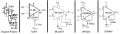
You must look at datasheets if you are substituting an MC34071 for a TLE2141. Here my sketch of how the input offset voltage adjustment parts should be for the different opamps:

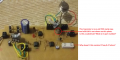
Your photo shows an old TO5 metal case on a transistor. What is it?
 

Attachments

Audioguru

Joined Dec 20, 2007
11,248
Here is the metal case transistor in your photo.
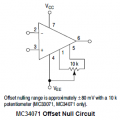
Here is the input offset adjustment pot for an MC34071. We don't talk about the old MC34071 anymore because it is no longer made in a through holes DIP case and is only a tiny surface mount part now that gets too hot in this circuit.
 

Attachments

Thread Starter

rahul411

Joined Feb 19, 2018
260
Here is the metal case transistor in your photo.
Here is the input offset adjustment pot for an MC34071. We don't talk about the old MC34071 anymore because it is no longer made in a through holes DIP case and is only a tiny surface mount part now that gets too hot in this circuit.
Transistor in TO5 metal case is 2N1513 and now it's been replaced with BD139. Also i can't find 0.47ohm 10W resistor so i have used 2 1ohm 5W resistors in parallel. Now I'm again doing the same circuit on a breadboard, that picture is of old built.
 

Audioguru

Joined Dec 20, 2007
11,248
The flimsy contacts on a solderless breadboard fail with the high currents in a power supply.
Was the opamp or your voltage measurement wrong to cause the output voltage of U3 to be low instead of high?
 

Thread Starter

rahul411

Joined Feb 19, 2018
260
The flimsy contacts on a solderless breadboard fail with the high currents in a power supply.
Was the opamp or your voltage measurement wrong to cause the output voltage of U3 to be low instead of high?
I don't know about that... All the connections are exactly same as in what shown in circuit diagram.
TBH i don't understand what you said about the offset adjustments of MC34071.
Please can you suggest any substitute for MC34071 ASAP, I'm going to the electronics market which is 2 hrs drive from my place.
 

ericgibbs

Joined Jan 29, 2010
21,445
hi rahul,
Rerun those TP tests when you have the correct components in the circuit.
If you have to use alternatives post a marked up circuit diagram.
E
 

ericgibbs

Joined Jan 29, 2010
21,445
hi rahul,
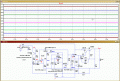
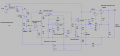
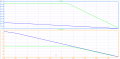
This is your circuit in LTSpice, it works reasonably well, could be improved.
Shows Vset pot being step changed, versus Vout.
The Over current LED, TP6 drive works OK at current limiting.
LTS 'asc' file attached if anyone else wants to run it.[E&O]
E
 

Attachments

Last edited:
Top