Where is all the leaded solder wire? Why is everything lead-free now?

schmitt trigger

Joined Jul 12, 2010
2,276
Welcome to the new, brave World of RoHS-compatible (Reduction of Hazardous Substances) electronics.

The European Union started legislation in the 20th-century waning years. China followed suit somewhat later.
The US hasn’t passed legislation in that respect, but the US automotive industry switched. The remaining US industries have to follow suit. The three US companies I have worked for since 2000, all had to completely convert to RoHS.
 

WBahn

Joined Mar 31, 2012
33,316
Hmmm.

Maybe there IS something to this RoHS campaign.

For decades, we've seen the apparent intelligence of people, particularly children, decline in direct relation (possibly exponentially) to their exposure to electronic devices.

Must be the lead -- can't think of any other factor that might account for it. ;)
 

nsaspook

Joined Aug 27, 2009
16,503
Hmmm.

Maybe there IS something to this RoHS campaign.

For decades, we've seen the apparent intelligence of people, particularly children, decline in direct relation (possibly exponentially) to their exposure to electronic devices.

Must be the lead -- can't think of any other factor that might account for it. ;)
The current boogeyman is PFAS 'forever chemicals'. This has lead to somewhat illogical things like trying to remove PFAS (with likely reductions in fire fighting capabilities) from fire-fighting foams and gear firefighters use. With a host of toxic chemicals in smoke, including cyanide, carbon monoxide, benzene, and acid gases they are routinely exposed to daily, this seems misguided.
 

Ian0

Joined Aug 7, 2020
13,310
Hmmm.

Maybe there IS something to this RoHS campaign.

For decades, we've seen the apparent intelligence of people, particularly children, decline in direct relation (possibly exponentially) to their exposure to electronic devices.

Must be the lead -- can't think of any other factor that might account for it. ;)
Maybe not. RoHS started in 2003, and smartphones about the same time, but in the last 20 years they still seem to be getting dimmer. Probably it was the lead that was keeping them intelligent.
 

nsaspook

Joined Aug 27, 2009
16,503
I must be behind the times with my conspiracy theories.
You didn't know that the reason they outlawed lead (paint was the real target, lead based solder was a false flag) is so the government could spy on us? Lead paint on our walls was stopping their radio signals.
 

Hymie

Joined Mar 30, 2018
1,347
This youtube video is well worth a watch (despite being 25 minutes long), mostly covering the subject of lead in gasoline/petrol and its effects on humanity.


Thread Starter

rambomhtri

Joined Nov 9, 2015
606
It makes very little difference, provided you don’t use the 99S, which is rubbish (and suffers with tin pest)
The only real difference I have noted is that soldering iron tips corrode more quickly.
Good old Weller TCP tips don’t last at all. The new Weller irons are better.
As for repairs, the best solder for a repair is the same solder that is already on the joint.
I chose a Sn99-Ag0.3-Cu0.7, is that wrong?
I chose it because it has Ag, Cu, and is the best seller, and they say it's a good quality solder in the comments.

I am probably buying a leaded wire from AliExpress too.

About this sentence "As for repairs, the best solder for a repair is the same solder that is already on the joint"...
I think that's wrong, because if there's lead-free solder and you add 63/37 solder (I think what I've been doing all my life TBH, as all the devices I have repaired are RoHS), you create a new alloy which has lead and a better composition in terms of performance.

Correct me if I am wrong.
 

Thread Starter

rambomhtri

Joined Nov 9, 2015
606
Okay... this has turned the wrong way. This thread has absolutely NOTHING to do with why lead is toxic to humans or why it was banned through RoHS. I am familiar with RoHS, I know heavy metals are poisonous, indeed I think that all the devices I have worked with have been RoHS certified, as I started to solder and repair things in 2010. This is not a thread about human health or the consequences of being exposed to heavy metal (Long Live Metallica and Megadeth WTH!).

I was assuming "the market" knows that the solder wire they sell in Amazon (EU) is used to repair electronics by techs, professionals and hobbyists. So, I was assuming no RoHS is applied to this, as it is nonsense to consider "dangerous" the amount of lead you put in a RoHS device after you switch one capacitor or whatever using 63/37 solder. Well, of course, an illiterate politician's opinion should be totally discarded, or an illiterate fake ecofanatic dumbo, or the opinion of an angry illiterate teenage girl really mad at people.

Hence, I was expecting companies to still provide the best wire to do these jobs, which contains lead of course. At least in Amazon EU I find it extremely difficult to buy one with lead, and if they do, it's really hidden, like typing "lead" equals to no sales at all or something.
 
Last edited:

MisterBill2

Joined Jan 23, 2018
28,508
Lead solder is much less available because if one is stupid enough to eat it or otherwise get it into their body, it is a bit toxic. I do not know anybody who eats scrapped electrical products, and I can't imagine eating a circuit board. But because somebody might eat one, all consumer electronic products are less reliable.
Maybe if a PCB were ground up quite fine, somebody could eat it, I suppose.
 

Ian0

Joined Aug 7, 2020
13,310
I chose a Sn99-Ag0.3-Cu0.7, is that wrong?
I chose it because it has Ag, Cu, and is the best seller, and they say it's a good quality solder in the comments.

I am probably buying a leaded wire from AliExpress too.

About this sentence "As for repairs, the best solder for a repair is the same solder that is already on the joint"...
I think that's wrong, because if there's lead-free solder and you add 63/37 solder (I think what I've been doing all my life TBH, as all the devices I have repaired are RoHS), you create a new alloy which has lead and a better composition in terms of performance.

Correct me if I am wrong.
Certainly, it creates a new alloy with lead in it, but the argument that more lead equals better solder is a non sequitur, otherwise we'd all be soldering with pure lead. Only alloys around the Sn/Pb eutectic are good solders. Alloys with small amounts of lead tend to be brittle.
I prefer TSC alloys of around 2.5% silver. I also think that most Sn99 alloys are prone to tin pest.

Another bizarre consequence of RoHS exemptions are audio connectors (and probably many other connectors using brass pins)
Look at the datasheet for XLR connectors
https://www.neutrik.co.uk/product/nc3mxx
Hidden down at the bottom is:
Contacts: Brass (CuZn39Pb3)
That is the composition of "free machining brass" and it contains 3% lead.
When it is turned on a lathe the swarf breaks into tiny pieces due to the lead in the alloy instead of all coming off in one long strand.
 

Thread Starter

rambomhtri

Joined Nov 9, 2015
606
Talking about solders... is there any advantage when using Sn60Pb38Cu2 over Sn63Pb37?

I've been using all my life Sn60Pb38Cu2, but now that the roll is about to get finished, I wonder if I should go for the good old eutectic alloy.

Never ever had a single problem with the Sn60Pb38Cu2, may be sometimes I get dull finishes, but I don't know if that's my alloy's fault or simply a consequence of mixing it with the lead-free solder that's in the board already "which very rarely remove completely".
 

Thread Starter

rambomhtri

Joined Nov 9, 2015
606
I just received my solder, been testing it a few times, to be honest, I don't notice that much of a difference, may be that the tip of the soldering iron melts it a tiny bit slower, but marginal, barely affects my way of working.

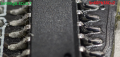
Here are some pics (ignore the little hairs, it's from a paper I used to clean the flux and didn't brush them off):
1712915817213.png

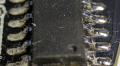
With flash ON:
1712915958845.png

It's with a macrolens, so this is very zoomed in. It looks fine to the average eye, but, TBH, in this picture I gotta say the left one looks worse than it looked like without zooming in. Are those joints on the left OK?

After testing it for a few minutes I was about to go lead-free for good because I barely felt any difference when doing solder joints, but this picture is really making me throw away the lead-free solder and buy again a leaded wire.
 
Last edited:
Top