Facebook
 Google
 GitHub
 Linkedin
Hi Sir,
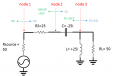
Please see the below figure.
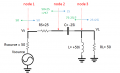
On left there is a voltage source with impedance(Rsource) 50 Ohm, and on right there is a load RL also with impedance 50 Ohm.
If RS/C/L are added between voltage source and RL, we can calculate the impedance toward RL (the blue arrows in figure) as
However, if we calculate impedance at the opposite direction (the green arrows in figure)
Also, it is obvious that Vs is 0.5*Vsource, without any signal reflection. But what I need is no signal reflection on load side (RL//L), what would be the best matching in this case ?
Thanks for clarifying the concept of impedance matching !
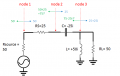
Please see the below figure.
On left there is a voltage source with impedance(Rsource) 50 Ohm, and on right there is a load RL also with impedance 50 Ohm.
If RS/C/L are added between voltage source and RL, we can calculate the impedance toward RL (the blue arrows in figure) as
- at node 3, L//RL = 25+25i
- at node 2, adding C(-25i) goes to 25 Ohm
- at node 1, adding RS(25) goes to 50 Ohm
However, if we calculate impedance at the opposite direction (the green arrows in figure)
- at node 2, does the impedance equal to Rsource+RS = 75 Ohm ? And in this case, does that mean impedance is NOT matched at node 2 since impedance toward RL side(25 Ohm) and toward source side(75 Ohm) is not equal ? Is there any signal reflection occurs on node 2 ?
- at node 3, similar to node 2, does impedance is NOT matched at this point ? and is there any signal reflection occurs on this point ?
Also, it is obvious that Vs is 0.5*Vsource, without any signal reflection. But what I need is no signal reflection on load side (RL//L), what would be the best matching in this case ?
Thanks for clarifying the concept of impedance matching !
Attachments
-
 26.9 KB Views: 2
 -
 26.8 KB Views: 2