What would be the reading before the xformer from this schematic ?

Thread Starter

Hextejas

Joined Sep 29, 2017
187
I know this is a"learning exercise" but why not use a chip that is made to do this from the start? One that is a well proven idea, you can still learn when using a known/working idea from the start. Many of the schematics found on the web are put on there by others seeking to learn, especially the older stuff.

http://tahmidmc.blogspot.com/2013/01/using-sg3525-pwm-controller-explanation.html

https://www.onsemi.com/pub/Collateral/SG3525A-D.PDF
Thank you shortbus I will do it as soon as I figure out what I am doing wrong with the 4047.
 

Thread Starter

Hextejas

Joined Sep 29, 2017
187
The CD4047 makes a very nice perfectly symmetrical squarewave because it uses a digital frequency divider. An SG3525 can do the same or make a pseudo-sine/squarewave with PWM if you need it.
Audio, I changed out my circuit to do as you suggested with the same results.
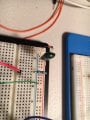
However, would you or anyone please take a look at my breadboard to see how I wired it. I wired, rewired, rerewired, with a lit of questions.
You cannot imagine what some of the kluges looked lime.
One thing that I struggled with was whether or not it made a difference which component the electrons hit first.
Please don't laugh.
Referring to your schematic, I saw the electrons 1st hitting the resistor, 2nd hitting the diode, 3rd the cap, etc.
Eventually I pulled everything out and have what you see in the photo. Nothing seemed to make a difference.
The differences that I have from your schematic are these: I don't have what you call out.
RC at 1-3 are 17k and 220nf
Zener is a BZX55C15
Volts at pin 10 is 12, 11 is 00.

IMG_0421.JPG
 

MrChips

Joined Oct 2, 2009
34,901
We appreciate that you are trying to learn how electronic circuits work. We are here to set things straight for you.

Electrons don't hit components in any specific order. The flow of electrons in a circuit affect all components simultaneously.
So stop thinking about electrons and let us see how you can understand circuit behavior from a different perspective.

If you want to study how the CD4047 IC works without the use of an oscilloscope you will have to slow down the clock frequency to a rate that is visible by eye.

Do you have a 100μF or 1000μF capacitor handy?
Do you have some LEDs and a handful of resistors of various values?

Post a photo of your entire breadboard showing how you have the CD4047 chip wired.
 

Thread Starter

Hextejas

Joined Sep 29, 2017
187
Electrons don't hit components in any specific order. The flow of electrons in a circuit affect all components simultaneously.
If you want to study how the CD4047 IC works without the use of an oscilloscope you will have to slow down the clock frequency to a rate that is visible by eye.

Do you have a 100μF or 1000μF capacitor handy?
Do you have some LEDs and a handful of resistors of various values?
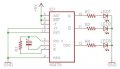
I really appreciate your help MrChips. Here is the 1st schematic that i wired and it was successful. At least I think it was as the LEDs blinked in a nice pattern. I was so proud of it that i left it running all day. And as I think of it, i used the RC pin1-3 values that Audio said would kill the chip. Maybe because it was only 5 volts.
Anyhow, I will wire it up again and see what happens. My confusion re current getting to a certain component 1st or 2nd stems from the discussions I see elsewhere and Audio talking about a "coupling" capacitor, and the RC at pins 1-3.
It sounds like they are protection for some of the components and certain parts of the circuit in that they let some things (electrons ?) through, and restrict harmful elements.
I think that I might try and come up with a more simple circuit like what Audio furnished only without the 4047. Something simpler like that and add some lights and buzzers.
Again, I am grateful for your help.
Lol, I was looking around Houston so as to hire an EE tutor for some spot tutoring as I was doing the breadboard.
astabledemo1.jpg
 

Audioguru

Joined Dec 20, 2007
11,248
A CD4047 is ordinary Cmos. A graph on its Texas Instruments datasheet shows that its shorted output high current with a 5V supply is about 4mA, with a 10V supply it is 10mA and with a 15V supply it is 15mA. Then with your 12V supply it was 12mA. The Mosfet output at pin 2 was shorted with your extremely low resistor value and with its voltage supplied at 12V and its shorted current at 12mA then it failed to oscillate but with a 5V supply its shorted current was so low that is did oscillate.
When the resistor and capacitor values are as I showed then it should produce an output of 60Hz.

The CD4047 circuit driving power transistors, not Mosfets and a center-tapped transformer was used in the Philippines so that people in villages without electricity could light their incandescent light bulbs at night. A guy there who asked on a forum why his circuit did not work (I fixed it like this one) made hundreds of them and rented them. He delivered fully charged car batteries and picked up the exhausted ones on his scooter.
 

MrChips

Joined Oct 2, 2009
34,901
For the moment, don't worry about electrons and where they go.

Firstly, make a note that resistors resist the flow of current. If you have a resistor of 0Ω, that is considered a short circuit. When you have a short circuit there is nothing to restrict the flow of current and nasty things happen.

If you put a short circuit between pin-2 and pin-3 of the CD4047 chip, nasty things will happen. This is what @Audioguru is referring to. We want to make sure that the resistor that has to go between pin-2 and pin-3 is not too low in resistance. A resistance of 1000Ω or higher would be preferred when the power supply voltage is 5V. If you are using a 12V supply, make the resistor no lower than 2200Ω.

How did I arrive at these values?

I just figured that the maximum current through a 1kΩ resistor powered by 5V is 5V/1kΩ = 5mA which is a safe current.

Maximum current through a 2.2kΩ resistor powered by 12V is 12V/2.2kΩ = 5.5mA which is also safe.

Quite simply, I used Ohm's Law to calculate the current I = V/R.

Therefore, start with R1 = 1kΩ and C = 100μF and watch the LEDs blink.
 

Thread Starter

Hextejas

Joined Sep 29, 2017
187
For the moment, don't worry about electrons and where they go.

Firstly, make a note that resistors resist the flow of current. If you have a resistor of 0Ω, that is considered a short circuit. When you have a short circuit there is nothing to restrict the flow of current and nasty things happen.

If you put a short circuit between pin-2 and pin-3 of the CD4047 chip, nasty things will happen. This is what @Audioguru is referring to. We want to make sure that the resistor that has to go between pin-2 and pin-3 is not too low in resistance. A resistance of 1000Ω or higher would be preferred when the power supply voltage is 5V. If you are using a 12V supply, make the resistor no lower than 2200Ω.

How did I arrive at these values?

I just figured that the maximum current through a 1kΩ resistor powered by 5V is 5V/1kΩ = 5mA which is a safe current.

Maximum current through a 2.2kΩ resistor powered by 12V is 12V/2.2kΩ = 5.5mA which is also safe.

Quite simply, I used Ohm's Law to calculate the current I = V/R.

Therefore, start with R1 = 1kΩ and C = 100μF and watch the LEDs blink.
Ok, will do tomorrow.
 
Top