What is a cheap type of epoxy I can use to insulate a high voltage transformer? I looked on amazon and saw a cheap silicon epoxy resin but I don't know if that would work well especially at high temperatures.
The time I had to varnish a high voltage transformer (to quiet it acoustically), no the secondary was about 800 volts,and I dipped the wound bobbin in Varathane (varnish) for several coats. No problems were observed either in the lab or in the field. I cannot comment on the type of epoxy used for potting but I found it helpful to put I a Bell jar under a mild vacuum while curing to “suck” out all of the bubbles.
How "high" is the high voltage?? and how much physical support of the connections does the epoxy need to provide??
"High Voltage Transformer" covers a very big spread of devices, ranging from a few grams to over a ton. From milliwatts to megawatts. So please provide more details about the transformer.
How "high" is the high voltage?? and how much physical support of the connections does the epoxy need to provide??
"High Voltage Transformer" covers a very big spread of devices, ranging from a few grams to over a ton. From milliwatts to megawatts. So please provide more details about the transformer.
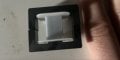
For the transformer below in attachments, it's going to be running at around 90KHz with output around 2500-3000V. The core is rated for 70W so I don't see myself pushing much past that. Not air gap, E Core, and my finger for a size comparison. I plan on epoxying the bobbin, plus windings, but not the ferrite core.
As for the future, I'm thinking about making one of those (Small HV Transformer) so ideally whatever epoxy I get now, would also be good for that. Let's say output of this transformer closer to 10-20kV.
I also am thinking about vacuuming to get rid of air bubbles.
I saw a video from Plasma Channel and in one of his videos use Clear Cast Plus but that stuff is too expensive (not the exact same). I saw in the product description that it can be used for Art, Craft, Casting, Wall Art, Table Top Coating. Nothing about high dielectric strength and yet he used it in a project that was outputting at over 200kV. I found this silicon based epoxy resin on amazon and was wondering if that would be worth giving a shot?
Certainly using a vacuum to purge air bubbles is a valuable addition, even repeated vacuum cycles, if the epoxy is slow setting. Adding a large proportion of fine silica improves heat transfer plus reducing the amount of expensive epoxy required.
When we were doing this with mostly motor windings the process was known as Impregnation. The way it was done was the parts are placed in a chamber with resin, then we pull a vacuum followed by pressure. This was done over and over. Next for simple applications I suggest you Google "corona dope". This will also help, Google "transformer impregnation resin" . That should give you several ideas.
Since I'm working with only a few kV (maybe 3kV max), if I mange to get air bubbles out before pouring the epoxy, should that be ok?
I dont have any type of pressure/ vacuum pot at the moment and was thinking of getting rid of bubbles with the heated water method I saw (place epoxy cup in warm water, and make sure no water gets into epoxy).
Also will normal epoxy resin be ok for that said amount of voltage?
Another option I have is to still put the epoxy in warm water to try and get air bubbles out, then pour it into my transformer bobbin, then place the bobbin in a heated area to try and get rid of more bubbles. Would that be the next best thing?
You need to avoid the types of epoxy that have fillers to thicken them, because the fillers could be conductive. Carbon filler is the one example.
Theepoxy producer should be able to supply information about the electrical insulating properties of their product. If they can't, or won't, they are the wrong supplier.
You need to avoid the types of epoxy that have fillers to thicken them, because the fillers could be conductive. Carbon filler is the one example.
Theepoxy producer should be able to supply information about the electrical insulating properties of their product. If they can't, or won't, they are the wrong supplier.
If there is a label that includes ingredients, check what is listed as "Fillers", which are added to alter the properties of the cured resin. Some include talc or silica, others might include chopped fiberglass strands for increased strength. But some materials, like metal particles or carbon, will greatly reduce the insulation breakdown voltage. That is the type to avoid. If both parts to be mixed appear to be clear, then probably there is not much additive.
since you are looking for low cost substitute, there is no way around trial and error. but for "domestic" use (less that 15-30kV), pretty much any clear epoxy without additives or colors should do. content should be listed on the label. what kind of volume you are thinking of? just one of the little transformers or it will be a big batch?
since you are looking for low cost substitute, there is no way around trial and error. but for "domestic" use (less that 15-30kV), pretty much any clear epoxy without additives or colors should do. content should be listed on the label. what kind of volume you are thinking of? just one of the little transformers or it will be a big batch?
I ended up getting this clear epoxy resin. For now it will be for that small transformer that I put in an attachment above. And if it works well then maybe for future projects. Thx for all the help from you and everyone else!
Insulate in what ways? Is it being potted, or just dipped? Is it just to prevent hands from getting zapped?
Buying some "epoxy" that does not have dielectric property specified, is perhaps not good practice when dealing with "high" voltage. 450v/mil is a basic (generally stated) number for just "epoxy resin".
Plastics are insulators, but are also conductors.
Beyond just the dielectric, need to worry about epoxy shrinking during curing, and even perhaps expansion of the xfrmer as it gets warm-hot which can break epoxy coating. If expansion is an issue then I usually coat with some form of silicone to allow expansion after coating or potting. In some applications it's best to warm the part close to an operating temp and hold it there until epoxy cures out 1-2days. Over-temp scenarios should be accounted for, which could burn the plastic, possibly in bad ways. Will the coating or potting allow the item to cool enough?
To avoid air bubbles, I use a warming plate to heat my mixes, it allows air bubbles to all move to the surface where you can break them with a thin stick (easy stirring the surface), then pour in slowly. Anything faster than ~8hr set is too fast, let the epoxy set up slowly. Should be usable within 24hrs. When coating a slow set, most of it is gonna flow off the part, so you might need to dip a few times to get the thickness desired.
Silicone and urethane mixes also yield fairly decent dielectric strengths and allows more expansion than epoxy resins. Really depends on what's needed from the coating or potting.
Like DCK just mentioned, there are a whole lot of other choices than epoxies, and some of them are much better. One important aspect is the viscosity. THAT is why, for many years, better quality transformers and motors were VARNISHED. They were dipped and a vacuum pulled while they were submerged, possibly repeated a few times to assure that all of the air was removed and replaced with the varnish. THAT assured that every bit of the wire was anchored and not able to vibrate and eventually break. Of course it also makes things a bit heavier, and certainly adds to the manufacturing time. So there is always the trade-off!
"Corona dope", "transformer impregnation resin" and alike are the means of choice:
Thema being 1-component there is no need for mixing
They guarantee low viscosity until the dilution has evaporated.
No mixing -> no "open time" to be considered.
The finalized coatings show some elasticity to be prepared for thermal expansion/contraction, vibrations etc.
Epoxies are "hobbyists tools" when it comes to insulation. Professional coatings ("conformal coatings", "protective varnishes" and alike) are usually 1-component: well-defined, lowest viscosity, easy to apply, ...
One other consideration is the insulating property of the material, what ever it may be. If the epoxy does not claim insulating properties they probably will not be adequate.
What I can vouch for is that SODIUM SILICATE (water glass) is not an insulator at all! It is a good conductor. I learned that MANY years ago, after trying to use it to insulate a home-made switch.
If the TS can locate some varnish that has sat on a shelf for too long and become thick, that would be a good choice. Not much shrinkage and probably very cheap.
One other consideration is the insulating property of the material, what ever it may be. If the epoxy does not claim insulating properties they probably will not be adequate.
(some text removed for clarity.

 Facebook
 Google
 GitHub
 Linkedin