What to use for IR detector/receiver ?

Thread Starter

usernamehere

Joined Nov 22, 2017
18
Hello,

I would like to find out what can someone use to detect IR radiation e.g. from a IR source such as an IR illuminator or any IR light nearby?
If I was to use an IR receiver diode with an advertised range of 45m, does that mean it can detect IR radiation 45m away? Would this also work if the source was at an angle to the receiver diode? Would this reduce the range?

Thank you.
 

ericgibbs

Joined Jan 29, 2010
21,439
hi,
Use your mobile phone camera, they respond very well to IR.
I use mine to check out remote control handsets and other IR projects I work on.

Why do you want to detect IR illuminators.?
E
 

Thread Starter

usernamehere

Joined Nov 22, 2017
18
hi,
Use your mobile phone camera, they respond very well to IR.
I use mine to check out remote control handsets and other IR projects I work on.

Why do you want to detect IR illuminators.?
E
I know the cameras with no IR filter will show IR being emitted but I want to create something e.g. arduino that will light up an led when it detects IR.

No particular reason, It is just something I want to do.
 

Thread Starter

usernamehere

Joined Nov 22, 2017
18
hi,
You can use a glass focussing lens at the IR detector.
Thank you.
Do you mean something like this?

https://www.ebay.co.uk/itm/405-G-2-...50nm-Blue-Laser-Diodes-w-Holder-/282321475526

So this will go over the diode I mentioned earlier and detect IR from IR light sources?

If you check the darasheet you will find that range is specified with a particular transmitter, drive current and test pattern. If you follow those conditions you should get the 45m range.
Okay I just thought that it would work without the transmitter. I am just after making an IR detector.

The TSOP34838 is not just an IR detector diode. It has a lot of built in circuitry to detect, amplify, demodulate and decode signals from an IR remote controller (like your TV remote). I will not detect un-modulated and un-decoded IR radiation.
So what can be used to detect undecoded and unmodulated IR?
 
Last edited by a moderator:

AlbertHall

Joined Jun 4, 2014
12,625
Okay I just thought that it would work without the transmitter. I am just after making an IR detector.
The range of detection depends on both the transmitted power and the sensitivity of the receiver.
A standard IR photo diode has no trouble detecting IR from a distance of 93 million miles when the source is the sun.
 

LesJones

Joined Jan 8, 2017
4,511
You also need to consider that the detector is sensitive to all the wavelengths of infra red that you want to detect. You will find this (And other usefull information.) on the data sheet for the device.

Les.
 

Thread Starter

usernamehere

Joined Nov 22, 2017
18
So this does not seem as simple as I thought. I need to revisit some concepts as I can't make sense of the figures on the characteristics page of the receiver I mentioned earlier. Is the relative sensitivity in figure 10 showing me how well the device reacts to that particular wavelength of infrared?

Don't confuse IR with blue or UV.

What is the IR source you want to detect? Is it modulated?
As an example I want to detect a TV remote and/or infrared illuminators.

There are many generic photodiodes available. Try looking for them online at your favourite electronics mail order suppliers. Just make sure they don't include additional circuitry.

https://www.aliexpress.com/af/IR-ph...02054614&origin=n&catId=0&isViewCP=y&jump=afs
That page you have posted above suggests that the devices are transmitters not receivers except for the CAN2 Si, is this true? As I understand, TSOP34838's datasheet shows a block diagram which includes things like "demodulator", so I should avoid such circuitry?

I looked at the Si photodiode's datasheet and there isn't any similar block diagram present.
 
Last edited by a moderator:

KeithWalker

Joined Jul 10, 2017
3,606
So this does not seem as simple as I thought. I need to revisit some concepts as I can't make sense of the figures on the characteristics page of the receiver I mentioned earlier. Is the relative sensitivity in figure 10 showing me how well the device reacts to that particular wavelength of infrared?
As an example I want to detect a TV remote and/or infrared illuminators.

Now we are getting somewhere. You finally gave enough information for us to help you. I suggest that you read the arduino tutorial at the url attached. It gives information on hardware and software that will enable you to detect and decode a TV remote..
https://learn.adafruit.com/using-an-infrared-library/hardware-needed#

To detect unmodulated IR you just need a simple IR photodiode as in the "Aliexpress" catalog item. Here is some information and a circuit diagram:
https://www.elprocus.com/infrared-ir-sensor-circuit-and-working/

That page you have posted above suggests that the devices are transmitters not receivers except for the CAN2 Si, is this true? As I understand, TSOP34838's datasheet shows a block diagram which includes things like "demodulator", so I should avoid such circuitry?

I looked at the Si photodiode's datasheet and there isn't any similar block diagram present.
 

MisterBill2

Joined Jan 23, 2018
27,501
Detecting an IR emitting device is not that complex, and an arduino would be a huge waste of resources. Use an IR sensitive photo-transistor and then a darlington transistor such as an MPSA13, and an LED (red) as the indicator of collector current.Just a one transistor amplifier with a gain of about a thousand.And run the whole thing off of a 9 volt battery. I am certain that some reader with schematic creating software can provide the circuit drawing. But do not substitute for the MPSA13 transistor, regular ones do not have enough gain.
 

Bernard

Joined Aug 7, 2008
5,784
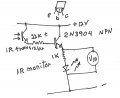
Crude but it helped measuring IR beam width at a range of about 10 ft. IR transistor had a daylight filter
maybe and aroundIR Monitor 00000.jpg 800 nm .
 

MisterBill2

Joined Jan 23, 2018
27,501
Use the same circuit as in post #17, but use the MPSA13 in place of the 2N3904 transistor. The gain of the darlington device is about a hundred times greater. (40 dB greater gain)
 

Thread Starter

usernamehere

Joined Nov 22, 2017
18
Crude but it helped measuring IR beam width at a range of about 10 ft. IR transistor had a daylight filter
maybe and aroundView attachment 162160 800 nm .
Hello, thank you very much for this.

Sorry if this sounds dumb but just to make sure I understand the circuit correctly.
1. The "EBC" is the infrared light source
2. There is an IR transistor before the 22k resistor
3. Then an LED after the 1k resistor, this LED then lights up when IR is detected?
4. You have called the whole thing an "IR Monitor" or am I missing another component?
 
Top