what kind of transistor for a low-side switch with inverted logic?

Thread Starter

mikewax

Joined Apr 11, 2016
230
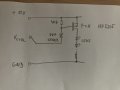
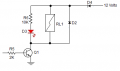
Here's the circuit. The load is a few LEDs in series with a 20mA CRD. Vcontrol is the output of a 12v CDS (photosensor) switch device i got on amazon, and the transistor has to be active low, that is, VL = LEDs on and VH = LEDs off. I'd prefer a FET to minimize Icontrol. Or maybe a BJT to reduce switch loss? Don't know, just tryin to be as energy efficient as i can.
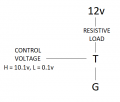
fetcircuit.png
 

dl324

Joined Mar 30, 2015
18,216
Whether you use a PNP transistor or P channel MOSFET to switch the load, you're still going to need an inverter because your control voltage won't be high enough to turn the device you use as a switch off.

What does "CRD" mean?
 

AnalogKid

Joined Aug 1, 2013
12,042
tryin to be as energy efficient as i can.
The total power dissipation in the circuit is 0.24 W, determined by the circuit voltage and current, both of which are fixed. Because 100% of the current in a series circuit goes through 100% of the components 100% of the time, different transistor structures will not change this.

ak
 

MrChips

Joined Oct 2, 2009
34,626
You could drive a mechanical relay with a transistor.
Double throw contacts will allow you to choose either logic on the load.
 
You didn’t mention what Vctrl impedance is, is it some open-collector output? Or push-pull output?

But generally you can remove the 10.1 to 12V offset with zener to fully close the P-ch transistor.


IMG_0934.jpeg
You can change 4k7 to 22k if low consumption is needed.
 

Thread Starter

mikewax

Joined Apr 11, 2016
230
Whether you use a PNP transistor or P channel MOSFET to switch the load, you're still going to need an inverter because your control voltage won't be high enough to turn the device you use as a switch off.
yeah so it seems, i could just get a 2nd transistor to control the 1st one. CRD = current regulating diode
 

Thread Starter

mikewax

Joined Apr 11, 2016
230
The total power dissipation in the circuit is 0.24 W, determined by the circuit voltage and current, both of which are fixed. Because 100% of the current in a series circuit goes through 100% of the components 100% of the time, different transistor structures will not change this.
yeah i see what you mean. Gotta think it through again
 

Thread Starter

mikewax

Joined Apr 11, 2016
230
You could drive a mechanical relay with a transistor. Double throw contacts will allow you to choose either logic on the load.
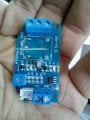
well for this circuit a relay is what i'm trying to avoid because of the current draw since it's a battery-powered circuit. this is the photo switch i'm using and i actually took the relay off so i could put a FET in it's place.
 

MrChips

Joined Oct 2, 2009
34,626
well for this circuit a relay is what i'm trying to avoid because of the current draw since it's a battery-powered circuit. this is the photo switch i'm using and i actually took the relay off so i could put a FET in it's place.
You had an actual working solution and you chose to defeat it.
Operating current draw is 5mA and 50mA.
 

Thread Starter

mikewax

Joined Apr 11, 2016
230
You didn’t mention what Vctrl impedance is, is it some open-collector output? Or push-pull output? But generally you can remove the 10.1 to 12V offset with zener to fully close the P-ch transistor.
You can change 4k7 to 22k if low consumption is needed.
THANX that will do the job without needing an extra transistor. This is the device i have. I removed the relay so i could use the Vcontrol, meant for the relay, to do this. I figure if Zcontrol is low enough for the relay than it'll work for this.
photoswitch.jpeg
 

Thread Starter

mikewax

Joined Apr 11, 2016
230
You had an actual working solution and you chose to defeat it.
Operating current draw is 5mA and 50mA.
yeah that's the whole point. To eliminate the 5(0)mA. The load that i'm trying to switch is only 20mA. It's a battery powered device.
 
Last edited:

sghioto

Joined Dec 31, 2017
8,633
You can use the transistor on board the module that was driving the relay to activate the LEDs.
Save more current by eliminating the two LEDs on the module as well.
 

Thread Starter

mikewax

Joined Apr 11, 2016
230
You can use the transistor on board the module that was driving the relay to activate the LEDs. Save more current by eliminating the two LEDs on the module as well.
that's a good point but i poked around with my meter and it turns out the transistor on the module is a low-side switch that grounds the relay coil. And it lites the LED at the same time. The coil and the LED are in series on the low side. so i can't take the LED outa the circuit. The coil is the limiting resistor for the LED. And try as i might i can't find the trace that goes from the LED to the transistor. Can't tell which is the drain/emitter. Damn thing's to small to solder to anyway.
 

Thread Starter

mikewax

Joined Apr 11, 2016
230
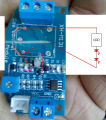
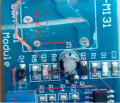
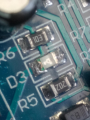
that's what i thought too but no, i probed around and here's what i found. There's diode D4 for polarity protection, R1 & D1 for ON indicator, C1 to stabilize, then through the coil, D3 is a trigger indicator, then it goes - where? i dunno, it's to damn small, but i'd say it goes to Q1. You can see why i measured 10.1 at D3. This is what my measurements seem to indicate. And according to the relay's data sheet, the coil resistance is 400 ohm. So it's a logical place to put D3.
pic3.png
 

sghioto

Joined Dec 31, 2017
8,633
No there's a path from the bottom coil to R6 which is in series with the LED D3 from my perspective.
But doesn't matter if the coil is removed.
Is there a problem with using low side switching the transistor on board provides?
 
Last edited:

Thread Starter

mikewax

Joined Apr 11, 2016
230
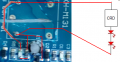
Holy #@!$ you're right. I had to sharpen my probes. The bottom end of R6 is connected to the the anode of D3, so that means.... WTF! The top end of the coil is connected to the cathode of D3? This makes no damn sense. I triple checked it, the top of R6 is directly connected to the cathode of D4, to 11.3v. So the bottom of the coil is 11.3v and the top of the coil is connected to the cathode of D3. R6 is 10k which means it's only there to pull up the anode of D3. ???o_O D3.png
 

sghioto

Joined Dec 31, 2017
8,633
I can't really tell from all those photos but if you activate the sensor the LED should come on. even with the relay removed.
R6 is the current limiter for the LED D3. I see the circuit as this:
1721418701372.png
 
Last edited:

Thread Starter

mikewax

Joined Apr 11, 2016
230
I see the circuit as this:
View attachment 327362
aaaaaaaaaaahhhaaaaaaaaaaaa, that's it. I was assuming that 10k was too big for an LED. That's only 1.1mA. And D2 is the freewheel diode for the relay. So if the coil is 400 ohm, Q1 is pulling.... 28mA, which is more than enough to lite my infrared LEDs.
So yeah that's it. I can use Q1 and save some work and time.
MUCHAS GRACIAS, sghioto, i would not have thought of that :):):):)
 
Top