Fuses prevent unwanted current damage to components and burned wires. They’re safety devices that carry a specific amperage. If the amperage exceeds the fuse’s rating, it burns out, protecting sensitive components.
In theory, a 10 amp fuse should carry no more than 10 amps. However, if the amperage exceeds it slightly, the fuse will blow out. The actual amperage before a fuse blows depends on the type. Slow Blow fuses can carry more amperage during startup but blow out immediately if there’s a short circuit.
I have a stereo amplifier with a 7A fuse. A shorted diode blew the fuse, protecting the transformer from burning up. If the fault occurred deeper in the circuit, the fuse would’ve protected the diodes and other components.
Fuses serve a crucial purpose, and there are various types of fuses available.
Thanks, Ian. OK.
-If the panel short circuits is because nothing protected it from such event. Where do you install a fuse to prevent the panel from short-circuiting ? In series to its output wire ? Really ?
-For the battery fed by the panel to flow back into the panel, is because the panel short-circuited because nothing protected it. Then a fuse in series can open the circuit, OK.
If a panel gets short-circuited because a branch fell and broke it, or a mower made a stone fly into it, or a golf ball, or a manufacturing defect gave up, where do you install a fuse to prevent its own destruction and beyond surroundings ? Am trying to find the logic here.
Thanks, Ian. OK.
-If the panel short circuits is because nothing protected it from such event. Where do you install a fuse to prevent the panel from short-circuiting ? In series to its output wire ? Really ?
-For the battery fed by the panel to flow back into the panel, is because the panel short-circuited because nothing protected it. Then a fuse in series can open the circuit, OK.
If a panel gets short-circuited because a branch fell and broke it, or a mower made a stone fly into it, or a golf ball, or a manufacturing defect gave up, where do you install a fuse to prevent its own destruction and beyond surroundings ? Am trying to find the logic here.
Now that I don't know. My thinking is that a solar panel is just like any other diode, and thus the rules and regulations say that the rest of the circuit should be protected against its failure.
Even if there is an MPPT between it and the battery, the MPPT is likely to be a buck regulator so when reversed biassed looks like the source-drain diode of a MOSFET, so it still needs the fuse.
Better too many fuses than too few.
I'm assuming that if a solar panel fails short circuit, then all than can be done is to prevent it from destroying anything else.
I'm also intrigued to know how and why a solar panel degrades over time, but that is probably the subject for another thread.
The original description for the reason to have a fuse is "To protect the undamaged wiring from the over-current damage." Now it is primarily to protect wiring and devices from excessive current damage."
Those are still the main reasons for fuses or other system protection.
Yes Ian. About 'any other diode', from what I understand is true during nighttime ---> solar cells behave like diodes. When insolated there is no diode behavior, it is a current source.
A short-circuited panel does not damage the circuitry of the other panels nor the wiring. Fire does. A fuse does not do sheet about the fire.
The original description for the reason to have a fuse is "To protect the undamaged wiring from the over-current damage." Now it is primarily to protect wiring and devices from excessive current damage."
Those are still the main reasons for fuses or other system protection.
The question is where is the excess current coming from.
The solar panel behaves as a Norton source with output current of 10.02A. If there are several strings of solar panels in parallel then that can be the source of excess current, but not if they are all isolated form each other by diodes.
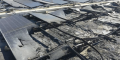
Was the panel which burned in the photo fitted with fuses between it and the MPPT? Was it isolated from parallel strings by diodes?
I do not think a fuse anywhere matters sheeet there. The panel gets destroyed itself and the wiring or other panels are not affected at all. It does not increase current. When short-circuited, that panel is NOT generating, lowering the current ! It is just a piece of conductor on fire IF still has continuity !
The current does not come from anywhere. It is internal to the panel.
Unrelated to the subject; there is zillions of fuses and breakers on the utility grid wiring and houses. NONE can protect their generator from internal failure as arcing or insulation degrading. I think.
The fuse is for back feeds of other panels in parallel into a short on one single string. I have few thousand watts of panels in series strings connected with several parallel strings of the same voltage going to the charge controller. The combined current (in excess of a single panel fuse) of the other non shorted parallel strings would blow the fuse on the shorted parallel string, protecting the wiring from a possible fire
I do not think a fuse anywhere matters sheeet there. The panel gets destroyed itself and the wiring or other panels are not affected at all. It does not increase current. When short-circuited, that panel is NOT generating, lowering the current ! It is just a piece of conductor on fire IF still has continuity !
The current does not come from anywhere. It is internal to the panel.
Unrelated to the subject; there is zillions of fuses and breakers on the utility grid wiring and houses. NONE can protect their generator from internal failure as arcing or insulation degrading. I think.
So why is it on fire? Is it caused by an excess of current flowing through it? Or is it caused by the plastic parts being ignited by an external source?
Am I wrong to believe that a total wiring short-circuit external to a panel is a bearable situation, (and part of manufacturing tests) as in the specifications "Short circuit current"
An internal short-circuit (arcing?) is what triggers the fires and see no way a fuse can do sheeet about it.
A short circuit on a single panel causes no more current to flow through the panel than its own short circuit current, that won't cause a fire.
Either something else (lightning perhaps) has set the plastic parts on fire, or a short circuit within a panel has led to the panel taking current from elsewhere, either the battery or other parallel connected panels, which could have been prevented by a fuse on the individual string. If the short circuit current of the panel is 10.05A, then a 10A fuse would be correct, as any MPPT would be keeping the panel at maximum power point where the current is less than the short-circuit current.
Am I wrong to believe that a total wiring short external to a panel is a bearable situation, (and part of manufacturing tests) as in the specifications "Short circuit current"
An internal short-circuit (arcing?) is what triggers the fires and see no way a fuse can do sheeet about it.
The per-string fuse can stop the fire from spreading to the other panels via wiring being overloaded from the rest of the arrays energy on the shorted string connection wiring. It's the same as having per house breakers for the main utility feed. A one house short circuit doesn't take down the entire feed line from the blocks distribution transformer.
To the OP. the fuse here is for wiring electrical safety (a standard fusing application), not protection of the device (solar panels) from self destruction. You size the fuse with the expected normal current flow of the device (it won't blow in normal service of a current source like a solar panel) and the device wring gauge is selected for the current and to minimize voltage drops. The wiring size selected, for each individual string, with a it's own fuse, won't usually be able to handle the combined current (X times the normal current of one string) of several parallel strings of panels during a short condition in a individual string safely. So the fuse blows to stop external energy compounding the problem as was said by others and likely reducing any fire damage from "An internal short-circuit (arcing?) is what triggers the fires".
In summary, a fuse is inserted in a circuit to prevent damage from excessive current. In addition, they are often convenient points to interrupt a circuit for many reasons.
Hi I,
On the solar panels I have there is a reverse diode for protection reverse voltage at night.
I think the fuse is for over voltage protection, as mentioned.
C
Hi I,
On the solar panels I have there is a reverse diode for protection reverse voltage at night.
I think the fuse is for over voltage protection, as mentioned.
C

 Facebook
 Google
 GitHub
 Linkedin




 It is just a piece of conductor on fire IF still has continuity !