What is the charging time constant (Tau) of the capacitor in this circuit?

Thread Starter

raziell122

Joined Mar 28, 2023
85
Given the following half-wave rectifier:
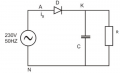
1718454841292.png

Givens: C=100uF, R=100Ohm, Ron(diode)=2Ohm
What is the charging time constant (Tau)?

Thanks in advance!
 

crutschow

Joined Mar 14, 2008
38,322
The name of this forum is Homework Help, not Homework Do, so you have to show us an effort to solve the problem.

The charging Tau is the time it takes for C to charge to (1 - 1/e) of it's final voltage, where e is the natural logarithm.
Do you know the equation for the charging time of a capacitor?
 

Thread Starter

raziell122

Joined Mar 28, 2023
85
The name of this forum is Homework Help, not Homework Do, so you have to show us an effort to solve the problem.

The charging Tau is the time it takes for C to charge to (1 - 1/e) of it's final voltage, where e is the natural logarithm.
Do you know the equation for the charging time of a capacitor?
I am not looking for numerical answer, I just want to understand whether Tau = Ron * C
or Tau = (Ron || R) * C
 

Thread Starter

raziell122

Joined Mar 28, 2023
85
It's the equivalent resistance that the capacitor sees.
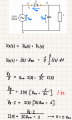
So here is my problem, if I try to use Thevenin's law to check what is the equivalent resistance that the capacitor sees so I really get Ron || R. But if I try to develop the ODE for the circuit then I find that Tau = Ron * C. I am confused about that.

Attaching my ODE:
1718457156993.png

Edit: I think that I got my mistake, I should separate the currents of C and R and I can't say that ic(t) = i(t).
 
Last edited:

Papabravo

Joined Feb 24, 2006
22,058
The name of this forum is Homework Help, not Homework Do, so you have to show us an effort to solve the problem.

The charging Tau is the time it takes for C to charge to (1 - 1/e) of it's final voltage, where e is [the base for] the natural logarithm[s].
Do you know the equation for the charging time of a capacitor?
 

MrAl

Joined Jun 17, 2014
13,667
So here is my problem, if I try to use Thevenin's law to check what is the equivalent resistance that the capacitor sees so I really get Ron || R. But if I try to develop the ODE for the circuit then I find that Tau = Ron * C. I am confused about that.

Attaching my ODE:
View attachment 324722

Edit: I think that I got my mistake, I should separate the currents of C and R and I can't say that ic(t) = i(t).
Hi,

I think you are close to the right result but there are a few more things you have to think about here.

First, the cap does not charge until Van is greater than Vkn. You may or may not care about that just yet, but when you try to get a solution you'll want to think about that too.

Second, the result you got where R is in parallel with Rd is right. You can prove this by doing a simpler equation and then looking at the exponential in the result. It's simpler though if you consider Van to be a constant voltage to start with, and this will not change when you move to another source.

It's also simpler to do this using differential forms rather than integral forms.
You can still call the input Van for now, but then you use the differential form for the capacitor:
i=C*dv/dt

where 'i' is the capacitor current and 'v' is the capacitor voltage. Since you are after an ODE anyway this leads you right to the solution.
I'll give a quick partial example...

If the input voltage is "E" and the voltage across the capacitor is 'v', then the current through the diode resistance (2 Ohms when 'on') is:
Id=(E-v)/Rd

and now you work out the rest knowing the current through R must be subtracted from Id to get the current 'i' through the cap, and since then know the current 'i' through the cap you can form an ODE right then and there.

See if that helps.

After you get the solution for a constant input voltage "E", look at the exponential part and you'll see why Rd is in parallel with R for the time constant.
Also note that when you see this form:
e^(-t/RC)
"RC" is the time constant, so if you see something else then you know what the time constant should be. Anything in the numerator though must be inverted so that if you see:
e^(-t*a/b)
the time constant is b/a.
I think you know this already but thought I would mention that too just in case. This way you can prove what the time constant is.

Once you get that far you'll have to deal with a half wave rectified sine wave input. That gets a lot more involved if you are after the full time domain solution. There is a general solution but the form is kind of advanced so you might as well work it out yourself.
 
Top