What is special about Flyback?

Thread Starter

William Johnson

Joined May 25, 2024
34
Say, I want to get an isolated DC voltage of 15V from an input DC voltage of 5V (wrt ground). Now I can either use a simple inverter and rectifier topology, in which I use an H-bridge to get +-5V square wave, feed it to a transformer with a 1:3 turns ratio to get +-15V square wave and then use a simple rectifier to get a 15V isolated output. Or, I can go for the more complex topology, the Flyback. But the simulation results show that the first topology gives the desired output (15V) for a wide range of load resistance (even if I connect no resistor but only a capacitor) instantly, whereas the Flyback converter output takes about 4 ms to settle to the desired value for a 100 ohm load, 8 ms for 200 ohm, and it does not settle even till 1s for a 1 kilo-ohm load. I am using an open loop configuration in both these topologies. I know that using a feedback from output will make it settle much faster for the Flyback, but why this difference? Why does it take the same amount of time (<100 us) to get the desired output from the first topology for a 100 ohm or a 1 mega ohm load, but the response of the Flyback configuration is so slow?
 

MisterBill2

Joined Jan 23, 2018
27,164
Consider that the flyback scheme is using 100% energy stored in a magnetized core. The transformer scheme is using energy being constantly driven.
 

crutschow

Joined Mar 14, 2008
38,316
As MB2 noted, a flyback transformer has to store all the energy transferred in the inductance of the magnetic core.
The energy is stored when the primary is active, and transferred to the secondary when the primary is off.

A normal transformer just immediately transfers the energy from input to output without storing any significant amount in the core.
 
I have designed many flybacks which went into production. My alias in this forum refers to boundary mode operation of (mostly flyback) power converters.

The above comments are true. But keep in mind that a flyback can be controlled to vary output voltage with a given input voltage, or hold a constant output voltage with varying input voltage. That being said, if you were to build either one of the two techniques you are likely to be unfavorably surprised by the result. A major issue is that you need to deal with transformer leakage inductance. This would require maybe a couple of chapters in a textbook, more than I want to write about here.
 

Ian0

Joined Aug 7, 2020
13,097
If you use a "simple rectifier" without an inductor between it and the capacitor, you are placing a huge capacitive load on the H-bridge, which is likely to make it fail.
A flyback converter can be produced using a control IC, two semiconductors (one MOSFET and one diode) and one magnetic component, and the control IC (UC3842) costs next to nothing.
An H-bridge requires eight semiconductors and two magnetic components. Which is the more complex technology? There's a reason everyone used flyback.
Your mistake is trying to use open-loop control.
 
If you use a "simple rectifier" without an inductor between it and the capacitor, you are placing a huge capacitive load on the H-bridge, which is likely to make it fail.
A flyback converter can be produced using a control IC, two semiconductors (one MOSFET and one diode) and one magnetic component, and the control IC (UC3842) costs next to nothing.
An H-bridge requires eight semiconductors and two magnetic components. Which is the more complex technology? There's a reason everyone used flyback.
Your mistake is trying to use open-loop control.
I do not know that device failure will be the issue if they are all reasonably rated. But..with a square wave driving a transformer, the output waveform is likely to exhibit overshoot and ringing. If we have a diode bridge rectifier directly feeding an output filter capacitor, this will cause the rectified output voltage to vary greatly with load current. I think that I have "been there and done that" although it has been a few years.

For the square wave driving the transformer, I remember that two things (both together) helped significantly.
1) A snubber to dampen the overshoot and ringing.
2) An output inductor between the rectifiers and the output filter capacitor.
3) "Synchronous rectification" to insure continuous conduction mode. (oops I cannot count).

But synchronous rectification in a bridge rectifier suggests using 2 Pch and 2 Nch FETs so this is getting complicateder. I prefer two Nch FETs and two inductors in a "current doubler" configuration. I have been there and done that.

If this altogether sounds too complicated, then you may well decide that the flyback sounds better. But the number one way to spoil a flyback design is with too much leakage inductance in the transformer.... :-(
 

LowQCab

Joined Nov 6, 2012
5,101
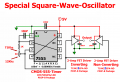
My Vote will always be Push-Pull, with an Inductor-Input-Filter-Section.
There's never a need to use a Full-Bridge.

There's way too much Bench-Tweaking required to get a Flyback arrangement working acceptably,
this may be totally justifiable when Pinching-Pennies for a Mass-Production-Product,
but not so much when totally predictable, smooth, and quiet behaviors are the goals.

When Price is not necessarily the main-goal, other possibilities open-up for a "one-off" design,
FET-Gate-Drivers are available that will operate at ~8-Amps-Continuous are readily available,
and are Blazing-Fast for operating smaller-sized, High-Frequency-Transformers.
.
.
.
Special Power Supply .png
.
 

Ian0

Joined Aug 7, 2020
13,097
My Vote will always be Push-Pull, with an Inductor-Input-Filter-Section.
There's never a need to use a Full-Bridge.

There's way too much Bench-Tweaking required to get a Flyback arrangement working acceptably,
this may be totally justifiable when Pinching-Pennies for a Mass-Production-Product,
but not so much when totally predictable, smooth, and quiet behaviors are the goals.

When Price is not necessarily the main-goal, other possibilities open-up for a "one-off" design,
FET-Gate-Drivers are available that will operate at ~8-Amps-Continuous are readily available,
and are Blazing-Fast for operating smaller-sized, High-Frequency-Transformers.
.
.
.
View attachment 326537
.
In a similar vein, have a look at SN6505.
 

MisterBill2

Joined Jan 23, 2018
27,164
This discussion verifies the wisdom of using switcher supplies sold by those known to deliver well designed products. The design of a switcher of any type is not s simple task. (I am aware of the qualified sites offering help, but there still exists the actual layout which is also critical.)
 

LowQCab

Joined Nov 6, 2012
5,101
Transformers were imported here from another Planet,
they are complex living creatures with a special, individual personality, all their own.
.
.
.
 

MisterBill2

Joined Jan 23, 2018
27,164
In a similar vein, have a look at SN6505.
REgardless of what is presented as commercially available, including a switcher supply into a product is not a trivial thing. At the very least, including the PCB pattern into another product demands aboard producer willing and able to meet all of the requirements for the PCB part. Not all suppliers can, and those who can't, or won't, are not likely to tell you that part.
 
Top