What is considered acceptable constant current draw on a vehicle?

Tonyr1084

Joined Sep 24, 2015
9,744
Some interesting comments. Opening MY eyes for sure. But then again I rarely leave a car sitting idle. Last car left sitting idle was two instances; We went to South Dakota for four nights. That meant leaving a car home for four nights. This car is an 09 Venza, and had no issues. More recently we spent three nights in Arizona. Grand Canyon and Meteor Crater. Again, the Venza had no issues.
A car that you cannot leave sitting for a month without the battery dying is not a car I would ever want to own.
Neighbor had a 95 Chevy that had to be started at least every two days. Otherwise it was "Jump" time. We eventually traced a parasitic drain to the power locks. Yup! Pulled the power locks fuse and the car could sit for days. Maybe even weeks, but the car rarely sat that long.

The TS might have a parasitic drain that has nothing to do with the computer. But one thing for sure, if I ever have to leave a vehicle un-started for days I'll put it on a trickle charger, or get a solar charger and hook that up. At my age I just don't see myself being away from the vehicle that long. (nearly 67. Yeah - yeah - I know. Some of you are older)
 

WBahn

Joined Mar 31, 2012
33,047
Not all vehicle batteries are so very new!! A few years back there was one nationally marketed brand that would go weak sitting on the shelf for a month or two. And certainly towards the end of life battery charge does tend to vanish much sooner. There are also some after-market sound system products, subject to incorrect installation, that will seriously increase the "off-state" current draw. And some USB outlet devices as well. Understand that some products are JUNK even while totally new, still on the shelf.
Agreed, but all of that only makes the situation worse. But if the starting point is a car that, on the showroom floor, drains a brand-new, quality battery to the point where it won't start the vehicle in about a week's time frame....
 

MisterBill2

Joined Jan 23, 2018
27,905
Puling fuses is still a valid way to narrow the search realm when seeking the cause of the excess drain. An interesting but unexpected cause in one instance was a slightly leaky "noise reduction condenser" on an older vehicle. The ancient mechanics called them that. It was on the horn circuit feed. Because the horn sounding caused noise in the AM radio when listening to distant stations.
 

WBahn

Joined Mar 31, 2012
33,047
Puling fuses is still a valid way to narrow the search realm when seeking the cause of the excess drain. An interesting but unexpected cause in one instance was a slightly leaky "noise reduction condenser" on an older vehicle. The ancient mechanics called them that. It was on the horn circuit feed. Because the horn sounding caused noise in the AM radio when listening to distant stations.
I would think that the sound coming from the horn would have constituted a far greater source of interference. I know that on the rare occasion that I hit my horn, that the last thing I'm interested in is trying to listen to, let alone the quality of, my AM radio that is tuned to a distant station.
 

Tonyr1084

Joined Sep 24, 2015
9,744
I've actually experienced horn noises through the radio. Also alternator whine. Especially on the CB radio.

When pulling the fuses we didn't monitor the current. Rather, we watched the battery voltage. If pulling a fuse resulted in a significant jump in voltage (from 12.4 to 12.6V) that circuit would be marked for further investigation. Some fuses pulled a 100mV jump but the locks resulted in over 200mV jump. It was the only circuit that had a significant jump in voltage. So we pulled that one. Days later the car would still start - even after not starting for a week. Results proved out we found the culprit. Now, maybe it had a leaky cap in the system - we don't know. Didn't care to go after it. Was enough just to pull the fuse and manually lock and unlock the doors.

Maybe the TS's flapper motor circuit has a leaky cap. I thought (without going through all the posts again) we were told it was a used item.
 

Tonyr1084

Joined Sep 24, 2015
9,744
I am using the same actuators that came with the car. Just using a different controller in which I am trying to mimic the OEM functions.
Maybe the TS's flapper motor circuit has a leaky cap. I thought (without going through all the posts again) we were told it was a used item.
I went through all three posts. This is where I came up with the notion the actuator is used, not new.

If it is OEM (Original Equipment Manufacture) then it should work the way intended. If it's drawing more current than it should then it's faulty. Adding the remote seems unnecessary. Likely there's a dedicated wire going to the actuator already present.

Questions for @dox777
Is this a 'Used' actuator?
Is this actuator going on the same model vehicle?
Or is it being put on a different vehicle?
Any OTHER modifications? If so - what else?
 

Tonyr1084

Joined Sep 24, 2015
9,744
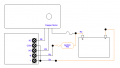
Was discussing this with another AAC member and started wondering if having both the Black wire AND the White wire grounded at the same time is what's causing the extra power drain. Try this as a bench test and see what happens:
Screenshot 2024-12-28 at 6.14.27 AM.png
Until now the black wire has always been grounded. Perhaps the black wire is meant to close the butterfly and the white is meant to open the butterfly. Having both black and white grounded at the same time may be making the unit want to draw more power. You can bench test it by simply applying positive to the red wire and negative to the white wire (black wire not connected to anything). If the butterfly opens then disconnect the white wire. The butterfly should stay open. At least that's my theory. Then ground the black wire (white not connected to anything). The butterfly should fully close.

As for exactly how the controller is working - first though is that powered or not COM & NO should be open. And COM & NC should be closed. I don't know if the controller is switching those settings only when powered or if the internal relay is latching type where it takes a moment of power one way or the other to switch it. You could have both black and white competing to move the motor. That's the reason for the test.

Pay attention to how I have the wires hooked up. The change is subtle and you might not notice it at first. Try it on the bench as described above and let us know what happens. There may be a need for further testing of the controller as well. We'll get to that once we've resolved the actuator.
 
Last edited:
Top