Facebook
 Google
 GitHub
 Linkedin
Hello, for my GCSE electronics I am making a solar powered phone charger. I came across this circuit on the internet. I recreated it on circuit wizard.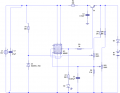
The 12V DC power supply on the left represents the solar cell and the 5v battery on the right represents the 5v USB output. I can't seem to understand what the 555 does or what the circuit does in general. The website I got it from has this as an explanation, but I can't understand it. Layman's terms of some sort would be helpful.
Here is how the website explains it:
"Charging of the cellphone battery is a big problem while travelling as power supply source is not generally accessible. If you keep your cellphone switched on continuously, its battery will go flat within five to six hours, making the cellphone useless. A fully charged battery becomes necessary especially when your distance from the nearest relay station increases. Here’s a simple charger that replenishes the cellphone battery within two to three hours. Basically, the charger is a current-limited voltage source. Generally, cellphone battery packs require 3.6-6V DC and 180-200mA current for charging. These usually contain three NiCd cells, each having 1.2V rating. Current of 100mA is sufficient for charging the cellphone battery at a slow rate. A 12V battery containing eight pen gives sufficient current (1.8A) to charge the battery connected
across the output terminals. The circuit also monitors the voltage level of the battery. It automatically cuts off the charging process when its output terminal voltage increases above the
predetermined voltage level.
Working
Timer IC NE555 is used to charge and monitor the voltage level in the battery. Control voltage pin 5 of IC1 is provided with a reference voltage of 5.6V by zener
diode ZD1. Threshold pin 6 is supplied with a voltage set by VR1 and trigger pin 2 is supplied with a voltage set by VR2. When the discharged cellphone battery is connected to the circuit, the voltage given to trigger pin 2 of IC1 is below 1/3Vcc and hence the flip-flop in the IC is switched on to take output pin 3 high. When the battery is fully charged, the output terminal voltage
increases the voltage at pin 2 of IC1 above the trigger point threshold. This switches off
the flip-flop and the output goes low to terminate the charging process. Threshold pin 6 of IC1 is referenced at 2/3Vcc set by VR1. Transistor T1 is used to enhance the charging current. Value of R3 is critical in providing the required current for charging. With the given value of 39-ohm the charging current is around 180 mA. The circuit can be constructed on a small general-purpose PCB. For calibration of cut-off voltage level, use a variable DC power source. Connect the output terminals of the circuit to the variable power supply set at 7V. Adjust VR1 in the middle
position and slowly adjust VR2 until LED1 goes off, indicating low output. LED1 should turn on when the voltage of the variable power supply reduces below 5V. Enclose the circuit in a small plastic case and use suitable connector for connecting to the cellphone battery."
What I am wondering about the most is how the 555 creates pulsing for the LED. The website says that when no battery is connected, the LED flashes at 765Kh (unnoticeable to eye). When there is a battery connected it flashes at 4.5Hz and when the battery is fully charged it turns off. I don't see how it does this as it doesn't utilize pin 2,6 or 7 for monostable/astable function. I can't actually see the flashing since Circuit Wizard doesn't really simulate charging batteries.
Thank you for helping. If you'd like to see the website I got the circuit from, here it is.
http://electronicseveryday.blogspot.co.uk/2009/07/mobile-cellphone-charger.html
The 12V DC power supply on the left represents the solar cell and the 5v battery on the right represents the 5v USB output. I can't seem to understand what the 555 does or what the circuit does in general. The website I got it from has this as an explanation, but I can't understand it. Layman's terms of some sort would be helpful.
Here is how the website explains it:
"Charging of the cellphone battery is a big problem while travelling as power supply source is not generally accessible. If you keep your cellphone switched on continuously, its battery will go flat within five to six hours, making the cellphone useless. A fully charged battery becomes necessary especially when your distance from the nearest relay station increases. Here’s a simple charger that replenishes the cellphone battery within two to three hours. Basically, the charger is a current-limited voltage source. Generally, cellphone battery packs require 3.6-6V DC and 180-200mA current for charging. These usually contain three NiCd cells, each having 1.2V rating. Current of 100mA is sufficient for charging the cellphone battery at a slow rate. A 12V battery containing eight pen gives sufficient current (1.8A) to charge the battery connected
across the output terminals. The circuit also monitors the voltage level of the battery. It automatically cuts off the charging process when its output terminal voltage increases above the
predetermined voltage level.
Working
Timer IC NE555 is used to charge and monitor the voltage level in the battery. Control voltage pin 5 of IC1 is provided with a reference voltage of 5.6V by zener
diode ZD1. Threshold pin 6 is supplied with a voltage set by VR1 and trigger pin 2 is supplied with a voltage set by VR2. When the discharged cellphone battery is connected to the circuit, the voltage given to trigger pin 2 of IC1 is below 1/3Vcc and hence the flip-flop in the IC is switched on to take output pin 3 high. When the battery is fully charged, the output terminal voltage
increases the voltage at pin 2 of IC1 above the trigger point threshold. This switches off
the flip-flop and the output goes low to terminate the charging process. Threshold pin 6 of IC1 is referenced at 2/3Vcc set by VR1. Transistor T1 is used to enhance the charging current. Value of R3 is critical in providing the required current for charging. With the given value of 39-ohm the charging current is around 180 mA. The circuit can be constructed on a small general-purpose PCB. For calibration of cut-off voltage level, use a variable DC power source. Connect the output terminals of the circuit to the variable power supply set at 7V. Adjust VR1 in the middle
position and slowly adjust VR2 until LED1 goes off, indicating low output. LED1 should turn on when the voltage of the variable power supply reduces below 5V. Enclose the circuit in a small plastic case and use suitable connector for connecting to the cellphone battery."
What I am wondering about the most is how the 555 creates pulsing for the LED. The website says that when no battery is connected, the LED flashes at 765Kh (unnoticeable to eye). When there is a battery connected it flashes at 4.5Hz and when the battery is fully charged it turns off. I don't see how it does this as it doesn't utilize pin 2,6 or 7 for monostable/astable function. I can't actually see the flashing since Circuit Wizard doesn't really simulate charging batteries.
Thank you for helping. If you'd like to see the website I got the circuit from, here it is.
http://electronicseveryday.blogspot.co.uk/2009/07/mobile-cellphone-charger.html