What did you repair today ?

wayneh

Joined Sep 9, 2010
18,133
I finally "fixed" my water softener - by replacing it entirely. Despite years of saving the old one from the dump, including a recent bed recharge and o-ring overhaul, I just couldn't get soft water. It would run through its cycles just fine, taking up salt on the recharge cycle, but no soft water.

I speculate that the plastic valve head has shrunk slightly with age and somehow hard water was bypassing the bed. The only other explanation is that the new resin is no good, but that seems highly unlikely.

A new valve head is over a hundred bucks, and I decided that was just too much to invest in such an old appliance without an absolutely positive diagnosis.

The new one is online and working great. It even has wifi and an app I can use to monitor water flow rate, gallons used, all of that stuff. Kinda fun.
 

crutschow

Joined Mar 14, 2008
38,674
My Hart (Walmart) battery-powered, manual-push, rotary mower, that I've had for a few years, suddenly quite a few days ago.
I stopped the mower to remove a weed from the lawn, and it then would not restart -- totally dead.
I confirmed that the battery was okay and could not see any other obvious problems.
I checked the switches on the mower handle for continuity and they were functional.
I then opened the mower housing to examine the wiring/electronics, and could see nothing amiss, so my conclusion was that something in the control electronics had failed, which is in a potted module.
Since there was no Hart repair facility within a 100 mile radius of me, I decided to try my own repair.

My solution was to bypass the electronics with a solid-state relay that would control the motor from the handle mounted switch, since that was the primary function of the electronics.
Of course the original electronics had safety features, such as low-battery cutoff, rapid electronic braking of the motor when stopped, and motor overload protection if the blade stalled, but I figured I would just make sure the battery never ran down, and shut off the power by releasing the dead-man handle switch quickly if the blade stalled on some obstruction.
The rapid motor braking was just a convenience that I don't require.

I selected a 40A, 60V DC output SSR with a heat-sink from Amazon, as that seemed sufficient for the relatively small motor in my 18" mower powered by a 40V, 6AH Li-ion battery.
I wired the handle switch to control the SSR.
It started when I pressed the switch, but unfortunately it didn't stop when I released the switch.
I then measured the SSR resistance between the terminals and it was near zero. Apparently either the motor starting current surge or a transient voltage spike when the motor tried to turn off zapped the SSR (so much for my "seemed sufficient" estimate :oops:) .
Back to the drawing board.

So next I bought and tried a 100A, 240Vdc SSR, attaching the heat-sink that came with my dead SSR.
I connected four 12V, 5W Zeners in series across the switch side to protect from any transient voltage.
Also added about 70mΩ of resistance from a short piece of steel wire in series with the switch's 13mΩ measured on-resistance and the motor's 200mΩ measured stall resistance, to reduce the starting surge current to about 130A max.
(The resistances were determined by measuring the voltage drop from a 1A current through the device, which gave me 0.1mΩ resolution with my multimeter on the 200mV range)
That all worked.
I mowed my small lawn, starting and stopping the motor several times with no failure so, fingers crossed, hoping that fix will last.

Edit 7-2-26: Mowed my lawn twice now with no issues. :D
SSR heatsink stayed cool, so there is no dissipation problem with that.
 
Last edited:

cmartinez

Joined Jan 17, 2007
8,830
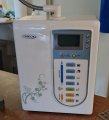
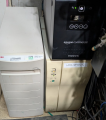
My brother in law brought me this water ionizer because it produced some "magic white smoke" the last time he tried to use it.

IMG-20260624-WA0035.jpg
He said that although he was still able to power it up and dispense water from it, he could tell it was no longer performing its ionizing function.

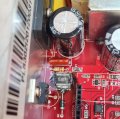
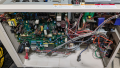
So I opened it up, and quickly found the culprit.

IMG-20260624-WA0031.jpg

A 10 milliohm resistor had overheated and burned up. The resistor was close to a high capacity nFet and a rectifier which were both mounted on a large heat sink. So my conclusion was that the resisor was part of a current sensing circuit, and that it had failed because of thermal fatigue after several years of service. The device costs more than $1,000 dlls when new, and so attempting to repair it was very much worth the effort.

I didn't have any 10 milliohm resistors with me at the moment, and ended up ordering one (of a higher rating, I believe) from Amazon for a little over $5 bucks ... kind of expensive I think, except that the minimum order value that I can make from Digikey, Mouser or Newark is about $120 dlls. Otherwise I'd have to pay $30 bucks just for S&H.

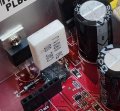
The part arrived after a couple of days. And I decided to solder it directly to the legs of the TH resistor and diode that it was originally connected to instead of relying solely on the PCB's traces, which looked very much affected by the previous thermal disaster.

IMG-20260624-WA0034.jpg

The machine is now happily back to normal operating condition. And my brother in law owes me and the wife a barbecuing evening at his place enjoying a few ribs and beers.
 

SamR

Joined Mar 19, 2019
5,526
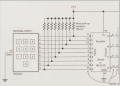
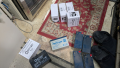
Started working on some digital circuits and one called for a keypad. But all of my keypads are matrix type and needed to be individual NO contacts. Apparently these are no longer an on-shelf item for sale or at least the few I did find were very pricey. So time to build one. Need 5V pull up resistor on each so that contact pulls the 5V to GND to trigger the logic chips. Only needs 9 lines in the circuit but added the 0 contact just in case I need it later.
IMG_1601[1].JPGIMG_1602[1].JPG
Not the prettiest solder job with my old shaky hands but works perfectly. Only found one error on testing but a kludge wire fixed it quickly. Still need to wash the flux residue off...
1782735861617.png
 
Last edited:

AlbertHall

Joined Jun 4, 2014
12,640
I made a board with an LED but the LED didn't work. Investigation showed I had fitted it the wrong way round. So I checked how tell LED polarity and removed and refitted it. It still didn't work. I wondered whether all the solder, de-solder had damaged it but no, I had fitted it the wrong way round AGAIN!

Doh!
 

SamR

Joined Mar 19, 2019
5,526
The only other explanation is that the new resin is no good, but that seems highly unlikely.
Actually not. I've had to replace the zeolite bed on our softener after many years of service it does chemically "wear" out and must be replaced.
 

wayneh

Joined Sep 9, 2010
18,133
Actually not. I've had to replace the zeolite bed on our softener after many years of service it does chemically "wear" out and must be replaced.
I think you missed the part about me having recently replaced the old resin with a fresh bed. For the resin to be the problem, it would have to have been no good when it was delivered to me. That could happen but it seems quite unlikely.
 

wayneh

Joined Sep 9, 2010
18,133
I made a board with an LED but the LED didn't work. Investigation showed I had fitted it the wrong way round. So I checked how tell LED polarity and removed and refitted it. It still didn't work. I wondered whether all the solder, de-solder had damaged it but no, I had fitted it the wrong way round AGAIN!
Murphy's Law is powerful!
 

MisterBill2

Joined Jan 23, 2018
27,980
Murphy's Law is powerful!
Depending on the applied voltage in the circuit that did not work because the polarity was reversed, the LED may have been destroyed by "reverse voltage breakdown". Reverse voltage breakdown of diodes is a very real limitation that is not limited to power circuits. It is almost never mentioned by most on-line sellers, which is unfortunate.
The really bad news is that the reverse voltage of some LEDs is well below 10 volts. At least it was the last time I examined a DETAILED LED data sheet, which was a few years ago.
Sp now there is a bit more information for everybody! LEDs are quite fragile in te reverse polarity direction. We seldom think about that because we very seldom use them in the reversed polarity mode. NOW it is clear why !!
 

SamR

Joined Mar 19, 2019
5,526
Rant ON!
It really ticks me off that my local ISP provider has constant almost daily outages including a recent 1-week email server outage. Call them up and get told "Oh, they had a power outage at the main building". HUH! Power Outage at the main building of a TELCO!?!?! Federal regulations (if I'm not mistaken) require them to have backup power if not common good sense operating practices! If I had not put into place and had scheduled maintenance backups and reliable UPS for our operating areas redundant control computers, I'd have been fired! The ISP has buried fiber distribution fer Christ's sake which makes it inherently lightning protected so why have ANY outages! Arrrgh...
Rant OFF!
 
Rant ON!
It really ticks me off that my local ISP provider has constant almost daily outages including a recent 1-week email server outage.
Did you know that for about $10 a month, you can rent a VPS and run your own secure, private email system that is managed by you, has 5 9s uptime, and can host as many email addresses as you want at no additional charge (excepting the value of your time)?

And I bet any one of a dozen AIs can tell you -- step by step -- how to set it up, configure, secure, and maintain it.

I currently run four different email systems. And they're a joy compared to ISPs or gmail or outlook.
 

nsaspook

Joined Aug 27, 2009
16,430
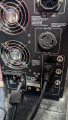
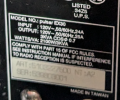
NUT ups monitor systems. https://networkupstools.org/

Server UPS to one of two redundant power supplies on each HPE computer.
root@hp:/etc/nut# upsc mge_SMA2@localhost
Init SSL without certificate database
battery.charge: 100.0
battery.charge.low: 20
battery.runtime: 02438
battery.voltage: 109.0
battery.voltage.nominal: 096.0
device.mfr: MGE UPS SYSTEMS
device.model: Pulsar EX 30
device.type: ups
driver.debug: 0
driver.flag.allow_killpower: 0
driver.name: mge-utalk
driver.parameter.pollinterval: 20
driver.parameter.port: /dev/ttyS0
driver.parameter.synchronous: auto
driver.state: updateinfo
driver.version: 2.8.4
driver.version.internal: 0.99
input.frequency: 60.00
input.voltage: 121.9
output.current: 004.0
output.voltage: 120.4
ups.delay.shutdown: 120
ups.delay.start: 000
ups.firmware: 5
ups.id: Pulsar EX30 5
ups.load: 020.0
ups.mfr: MGE UPS SYSTEMS
ups.model: Pulsar EX 30
ups.status: OL CHRG
ups.test.interval: 1008

Networking UPS to switches and 5GB fiber interface.

root@hp8:/etc/nut# upsc UPS1@localhost
Init SSL without certificate database
battery.charge: 100
battery.charge.low: 20
battery.charge.warning: 40
battery.mfr.date: CPS
battery.runtime: 7590
battery.runtime.low: 300
battery.status: 100%
battery.type: PbAcid
battery.voltage: 24.0
battery.voltage.nominal: 24
device.mfr: CPS
device.model: ACMT1500
device.serial: FCMNQ2000297
device.type: ups
driver.debug: 0
driver.flag.allow_killpower: 0
driver.flag.ignorelb: enabled
driver.name: usbhid-ups
driver.parameter.interrupt_pipe_no_events_tolerance: -1
driver.parameter.offdelay: 60
driver.parameter.ondelay: 0
driver.parameter.override.battery.charge.low: 20
driver.parameter.override.battery.charge.warning: 40
driver.parameter.pollfreq: 12
driver.parameter.pollinterval: 15
driver.parameter.port: auto
driver.parameter.synchronous: auto
driver.state: quiet
driver.version: 2.8.4
driver.version.data: CyberPower HID 0.84
driver.version.internal: 0.67
driver.version.usb: libusb-1.0.30 (API: 0x0100010C)
input.frequency: 60.0
input.sensitivity: normal
input.transfer.high: 131
input.transfer.low: 102
input.voltage: 121.1
input.voltage.nominal: 120
output.frequency: 60.0
output.voltage: 121.1
ups.beeper.status: enabled
ups.delay.shutdown: 60
ups.delay.start: 0
ups.firmware: CR02002A4
ups.load: 14
ups.mfr: CPS
ups.model: ACMT1500
ups.productid: 0601
ups.realpower.nominal: 1100
ups.serial: FCMNQ2000297
ups.status: OL
ups.test.result: No test initiated
ups.timer.shutdown: -60
ups.timer.start: -60
ups.vendorid: 0764
 
Top