What Are The Units Of Absolute Temperature?

Thread Starter

Glenn Holland

Joined Dec 26, 2014
703
It's well known that the "absolute temperature" is a measure of the velocity or kinetic energy of the particles in matter.

However, what are the actual units of measurement of absolute temperature? Rather than using degrees as the basic unit, it seems the absolute temperature would be correctly expressed in the units associated with velocity -such as as meters/second.

As a common example, neutrons in a reactor are said to be "Thermalized" when their velocity is equal to the velocity of the surrounding moderator (such as water). So if the absolute temperature must be used to determine the velocity for the proper moderation for neutrons, how would the temperature in the entire reactor be expressed?
 

Papabravo

Joined Feb 24, 2006
22,082
Absolute temperature is expressed in degrees Kelvin. Temperature and kinetic energy are related by the Boltzmann constant which is expressed in Joules/°K. When T = 0, the mean kinetic energy is also zero. Kinetic Energy in Joules has units of mass times velocity squared. Freshman Physics.
 

BR-549

Joined Sep 22, 2013
4,931
The unit is called the kelvin. It is only a related measurement......not a definition or explanation.

Modern science can not define the physical cause of energy or the physical process of energy transfer. They can only measure the effects/results.......and try to mathematically relate the measurements.........to a cause.

For instance......science defines inertia by it's measured action(which is a result).....not it's cause. Modern science does not have a clue as to the physical cause of inertia. The same with mass and the same with gravity.

This science strategy always fails. Nature does not use math or information. Nature uses only force and the reaction to it. Force can not be defined as a vector.

All natural force and the reaction to it....is the same constant process and predictable, and un-breakable results. This applies to stars, star systems and galaxies.

Now for the booger. Life is NOT natural. If it were......we would see and find it everywhere.

Life has the amazing ability.....thru structure.....to modulate the components of force/reaction. Science calls this structure.......information. So with life....results are not constant and predictable....the result depends on structure/information.

All the processes on mars are natural. A lot(probably most) of the "natural" processes on earth are modified by life structures/information.
 

Thread Starter

Glenn Holland

Joined Dec 26, 2014
703
Just my observation: the absolute temperature is a "natural temperature scale" as radians are a "natural unit of measure" of an angle and "e" is the base of the natural logarithm. So it seems (at least in my humble opinion) that there should be a unit of absolute temperature that could be substituted directly into any equation involving temperature without using "degrees". So why not just use Joules (or other appropriate measure of KE) to express the molecular velocity?
 

WBahn

Joined Mar 31, 2012
32,823
Just my observation: the absolute temperature is a "natural temperature scale" as radians are a "natural unit of measure" of an angle and "e" is the base of the natural logarithm. So it seems (at least in my humble opinion) that there should be a unit of absolute temperature that could be substituted directly into any equation involving temperature without using "degrees". So why not just use Joules (or other appropriate measure of KE) to express the molecular velocity?
The units of absolute temperature don't use "degrees". The unit is Kelvins (or Rankines).

Why isn't Kelvins an appropriate measure of kinetic energy?

Would YOU like the weather forecast to tell you to cover your plants tonight because the air is going to dip down below a mean energy of 5.6 zeptojoules?
 

MrAl

Joined Jun 17, 2014
13,702
Just my observation: the absolute temperature is a "natural temperature scale" as radians are a "natural unit of measure" of an angle and "e" is the base of the natural logarithm. So it seems (at least in my humble opinion) that there should be a unit of absolute temperature that could be substituted directly into any equation involving temperature without using "degrees". So why not just use Joules (or other appropriate measure of KE) to express the molecular velocity?
Hi,

As WBaln pointed out, it is not "degrees Kelvin" it is just "Kelvin".
So to say we measured the temperature in degrees Kelvin is not correct, we must say we measured the temperature in Kelvin.

The symbol is "K" and it's in a lot of equations already, like for example the equation for a thermistor.
We sometimes convert from degrees C to K or vice versa by adding or subtracting a constant, so we will see equations with degrees C in it but we will often see the constant with it too. The constant is approximately 273.
K=C+273 approximately.

K is considered absolute because it starts at the LOWEST possible temperature that matter could ever reach, so it's the start of the natural temperature scale. There's no way to go lower, and in fact in one theory you cant even reach absolute zero exactly.

What we perceive as heat is actually movement of sub atomic particles. If you stop all movement, you reach the base line temperature (absolute zero) of all matter in the universe. Thus it is referred to as absolute temperature.

Compare the definitions of the two words, "absolute" and "relative".
 

Papabravo

Joined Feb 24, 2006
22,082
Since all of this happened while I wasn't looking I'm tempted to say that it is a distinction without a difference. Calling them "degrees Kelvin" had absolutely no effect on any theoretical or experimental activities that I engaged in prior to this semantic tour de force.
 

WBahn

Joined Mar 31, 2012
32,823
Since all of this happened while I wasn't looking I'm tempted to say that it is a distinction without a difference. Calling them "degrees Kelvin" had absolutely no effect on any theoretical or experimental activities that I engaged in prior to this semantic tour de force.
In large part it is -- but it is also addressing a point as asked explicitly by the TS in post #5.

By general convention in the units community, a measure is denoted with degrees when it is arbitrarily defined for convenience, and especially when neither its zero nor the scale of it unit quantity has any special significance in terms of other physical quantities. In the case of kelvins, the scaling of the unit is arbitrarily defined for convenience, but it is also directly related to other physical quantities. In that regard it is very much like most other units of measure, such at the meter. The formal definition of the meter is in terms of wavelengths of a certain transition in a certain atom, but that is scaled to match the prior definition that was the distance between two scratches on a certain hunk of metal.

But, as you say, for the overwhelming amount of everyday usage, it is a distinction without a difference and there is plenty of sloppiness in this regard in otherwise exceptional work.
 

nsaspook

Joined Aug 27, 2009
16,321
Just my observation: the absolute temperature is a "natural temperature scale" as radians are a "natural unit of measure" of an angle and "e" is the base of the natural logarithm. So it seems (at least in my humble opinion) that there should be a unit of absolute temperature that could be substituted directly into any equation involving temperature without using "degrees". So why not just use Joules (or other appropriate measure of KE) to express the molecular velocity?
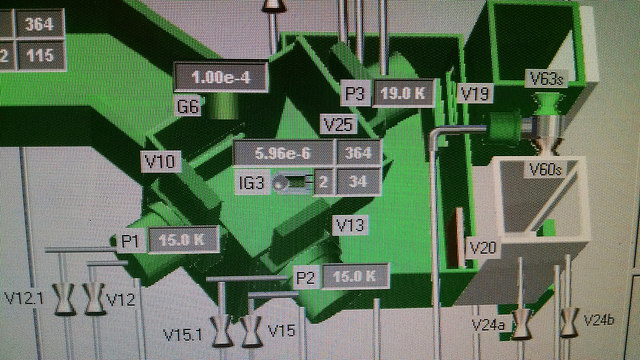
K does equate to KE or molecular velocity in applications like this were K is also a indication of the effectiveness of gas capture in UHV systems. Pumps 1,2,3 are absorption pumps that trap gasses in a cryogenic array of pure carbon. K gives the required information for a quick mental calculation of pump efficiency, pumping speed and array condition for each type of pump. P3 seems to need a little attention as the upper limit is 20 K for normal operation.


NescoM

Joined Jun 13, 2017
1
Absolute temperature is expressed in degrees Kelvin. Temperature and kinetic energy are related by the Boltzmann constant which is expressed in Joules/°K. When T = 0, the mean kinetic energy is also zero. Kinetic Energy in Joules has units of mass times velocity squared. Freshman Physics.

Maybe freshman phisics but it's so easy to forget... :) I for example.... Have a good memory but a short one.
 

Motanache

Joined Mar 2, 2015
652

Perhaps kg*Square meter/ Square second is better.

I do not belive that m/s (speed) is the same thing with m*m/(s*s). We need a measurement unit for energy!

Temperature depends on molecule (or atom) velocity and nature of gas (material). We can not neglect molecule mass.

So,
If you want to express E=m*c*c. you can express that mass with an energy unit (Square meter/ Square second)
 

WBahn

Joined Mar 31, 2012
32,823
Perhaps kg*Square meter/ Square second is better.

I do not belive that m/s (speed) is the same thing with m*m/(s*s). We need a measurement unit for energy!
We do have a unit for energy -- we have several, in fact. The primary one is the joule.

1 J = 1 kg·m²/s²

Energy units are the same as units of work, which is force through a distance. So other common units of energy are the electron-volt, the newton-meter, and the foot-pound. There are plenty of other units of energy from older and/or more field specific systems, such as the british-thermal-unit, the erg, the calorie, the Calorie. The list goes on and on.
 
Top