Your understanding is incorrect.
The surface-mount ferrite beads must indeed be connected in series between the two points for noise suppression.
They have no useful effect if they are just mounted over a solid trace.
Ferrite beads when placed in series with a trace of snapped over a cable appear as a lossy impedance in series with the conductors. These are useful in suppressing radio interference and damping ringing.
In the case of two or more conductors going through a ferrite bead there is the added advantage that over a ranger of frequencies the current through all of the wires going one way is forced to match the current in the wires going in the opposite direction. This helps reduce the tendency of the wires to radiate our pick up electromangetic interference. This "magic" effect is achieved by magnetic coupling among the conductors.
Ferrite beads when placed in series with a trace of snapped over a cable appear as a lossy impedance in series with the conductors. These are useful in suppressing radio interference and damping ringing.
In the case of two or more conductors going through a ferrite bead there is the added advantage that over a ranger of frequencies the current through all of the wires going one way is forced to match the current in the wires going in the opposite direction. This helps reduce the tendency of the wires to radiate our pick up electromangetic interference. This "magic" effect is achieved by magnetic coupling among the conductors.
True. The point is not the flux in the core, it is the fact that the use mentioned tends to balance the current and as a result reduce radiation and susceptibility.
In order for a ferrite bead to be effective, it needs to form a closed magnetic path around the conductor. If you simply place a piece of ferrite on a conductor, you have a path whose length consists of the ferrite across the conductor and air through the board and around the other side of the board. The effect is to hugely reduce the effective "permeability" of the magnetic path and make the ferrite almost totally ineffective. An actual ferrite bead is topologically a toroid with a single "turn" (a conductor passing through the hole in the toroid counts as a turn, even it it is just a straight wire).
Beads for noise suppression are generally made of "lossy" ferrite - high frequency energy is actually dissipated as it would be in a resistor. There is inductance, but that is usually not the dominant contributor to noise reduction. Small beads are usually effective for frequencies of at least a few megahertz.
Adding any sort of impedance in series with a signal is only effective it it has some other impedance "against" which it can operate. This might be the impedance of a transmission line or the radiating impedance of an antenna (more often than not something that isn't intended to be an antenna, but acts like one even though you would rather it didn't). Calculating the the actual attenuation that would be achieved with a ferrite bead isn't easy because it can be very hard to quantify that "other" impedance in many cases.
Sometimes a ferrite bead in series with an inductor can be useful. This seems silly, but inductors always have some sort of capacitance across them simply due to proximity of the turns of the winding. That capacitance means that above some frequency the part will begin to look more like a capacitor than an inductor (just as capacitors begin to look like inductors above some frequency) and the impedance will actually fall as the frequency rises. A ferrite bead can keep the impedance rising to higher frequency.
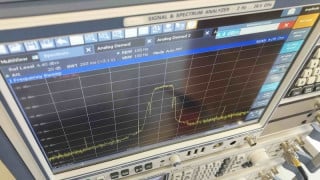
An electrical network analyzer can be a useful tool for measuring performance, but they can be obscenely expensive.
Fair-Rite has some useful information on suppression ferrites on their website. Laird does, too.

 Facebook
 Google
 GitHub
 Linkedin