Welding Thermocouple Wire

Thread Starter

jpanhalt

Joined Jan 18, 2008
11,087
Specifically, I need to weld Type K wires. In the lab years ago, we just used a hydrogen torch. In retirement, I do not have other use for such a torch, but I do have oxy-acetylene, MIG, TIG, and low-power capacitor discharge for battery tabs.

To date, I have used the capacitor-discharge welder. It makes working TC's, but they do not have the nice rounded tip.

Has anyone used TIG? I was thinking of striking the arc on a copper plate. Then carrying the arc to the TC wires to weld them. The wires themselves will not carry the welding current.
 

Thread Starter

jpanhalt

Joined Jan 18, 2008
11,087
Basically, I plan to establish the arc and use it like a very hot torch to fusion weld the wires. It makes sense that an arc instead of a torch is used commercially; although, I thought they might use hydrogen torches. I have plenty of PTFE covered wire from a surplus dealer in Idaho. I prefer that to the more fibrous coverings one often sees.

I don't think copper will be a real issue from a functional standpoint*, but copper salts might be a slight concern as these TC's will be used in food. In any event, I think the amount that might be transferred will be small. I'll taste test them afterwards.

Thanks for responding. I figured you had more experience than most anyone else around here.

John

*The "Law of Intermediate Metals" (https://sciencing.com/thermocouple-laws-5517216.html ) means basically you can use any filler metal, and it won't affect results, just so you have a good electrical connection. I am not about to use solder for lots of reasons, but another choice I was considering was brazing, assuming I could find a suitable, non-toxic flux (borax/boric acid?). Chromel and alumel are not the easiest metals to work with.

EDIT: I just got a 3" x 3" x 1/2" C110 copper plate locally. Should be enough to adsorb a little TIG heat. Will post results after it warms up a little.
 
Last edited:

Reloadron

Joined Jan 15, 2015
7,880
Before I retired I welded a few every now and then for doing furnace surveys. Usually using #12 or #10 TC wire and the insulators. I just used oxy-acetylene and a small torch head,

TC Junctions.png

Ron
 

Thread Starter

jpanhalt

Joined Jan 18, 2008
11,087
My TC wires are 24 awg each. #12 and#10 each would be awfully thick. Was that the total approximate gauge for both?

I will try oxy/acetlyene when I open my shop in the Spring. My attraction to TIG is that I find it relaxing to do and suspect the heat-affected zone will shorter. I want to keep carbonization of the insulation on the individual wires to a minimum.
 

Reloadron

Joined Jan 15, 2015
7,880
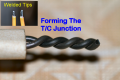
The AWG 12 and AWG 10 (pictured above is AWG 12) was used to make thermocouples used for high temperature furnace surveys. The wire was run through ceramic insulators, twisted and welded. The thermocouples in the small inset photo are AWG 24 solid conductor Type K with welded tips. Actually prior to my retiring I also used a small kit for making thermocouples, small ones like in the inset, made by I think it was L&N which included a crimp tool and what I believe were called Quick Tips which came in a few sizes. I found the quick tips under the L&N name. The tool was a ratcheting crimp type tool which I see some on E-bay. Years ago that kit was about $300 to $400 USD but I see them pretty cheap now.

Ron
 

shortbus

Joined Sep 30, 2009
10,050
Don't you need to figure in the number of contact points when twisting the wire together. Seems to me I read that somewhere, more contact points in the twist makes a larger output voltage, that needs to be taken into consideration.
 

Reloadron

Joined Jan 15, 2015
7,880
Don't you need to figure in the number of contact points when twisting the wire together. Seems to me I read that somewhere, more contact points in the twist makes a larger output voltage, that needs to be taken into consideration.
Not that I was ever aware of. When the ones I made were used for furnace surveys (Furnace Uniformity Surveying) they were made with calibrated certified wire (sample from beginning, and end of roll) we also had to certify each lot we made for a furnace. They always agreed with the published tables. I saw where you mentioned that in another thread and was unsure what you were getting at and I should have asked. I twisted just as you see in my image and then hit the end with oxy acetylene forming a welded bead and that was it. At the time it was MIL-H-6875 which I believe they now adhere to AMS-2750, quite a few years have passed since those days. :) Anyway, we would use the manufactured thermocouples once and that was it. Typically at 200 degree F cardinal points between 1,000 and 2,000 degrees F. I was buying my certified wire at the time from Marlin Mfg here in the Cleveland suburbs. Anyway, no recollection of number of twist?
Ron
 

shortbus

Joined Sep 30, 2009
10,050
Hi Ron, maybe I was miss understanding what I said earlier, can't seem to find it again.

But here is something similar - "Twisting thermocouple wires is the easiest method and does not require any special tools, but it produces the least reliable connection. Since the wires are not actually bonded together, corrosion or vibration can interrupt the electrical contact over time. Twisting can also lead to acquiring erroneous temperature readings. Several turns are required to get a secure junction, so the first point where the two wires touch is a certain distance away from the point of measurement. As a result, a surface measurement reading can be different from the actual temperature because the measuring junction is not in contact with the surface. A twisted thermocouple is usually satisfactory for liquid or air measurements where the whole twisted area is submerged."
From here - https://www.designworldonline.com/thermocouple-types/ There's a lot of good information on that page, didn't realize there are so many types of wire used in them, all with different temp ranges but the meter device has to suit the type of wire too.
 

Reloadron

Joined Jan 15, 2015
7,880
Hi Ron, maybe I was miss understanding what I said earlier, can't seem to find it again.

But here is something similar - "Twisting thermocouple wires is the easiest method and does not require any special tools, but it produces the least reliable connection. Since the wires are not actually bonded together, corrosion or vibration can interrupt the electrical contact over time. Twisting can also lead to acquiring erroneous temperature readings. Several turns are required to get a secure junction, so the first point where the two wires touch is a certain distance away from the point of measurement. As a result, a surface measurement reading can be different from the actual temperature because the measuring junction is not in contact with the surface. A twisted thermocouple is usually satisfactory for liquid or air measurements where the whole twisted area is submerged."
From here - https://www.designworldonline.com/thermocouple-types/ There's a lot of good information on that page, didn't realize there are so many types of wire used in them, all with different temp ranges but the meter device has to suit the type of wire too.
Good link and I agree that just twisting the pair is not adequate at all which is why we create a weld bead at the end of the twist. Years ago, more years than I care to recall I wrote this page up and yes, using the same un welded tip in my picture. :) Granted also my ice bath is not quite a perfect Dewar flask but note I was using a high end mercury thermometer to monitor my crummy ice point. :).

Ron
 

Thread Starter

jpanhalt

Joined Jan 18, 2008
11,087
Hi Shortbus,

My understanding of the Seebeck effect (https://en.wikipedia.org/wiki/Thermoelectric_effect) is that the voltage observed is only related to the difference in temperature between the hot junction(s) and the cold junction(s). Multiple junctions at the same temperature would only lead to geater current capability, if that. A thermopile is made of multiple hot and cold junctions in series. Twisted wires would, at best, give multiple junctions in parallel at the same temperature. Thus, the voltage would be the same. Almost by definition, measurement of TC voltage has to draw almost no current to be accurate. The device I am using has a correction factor for resistance of the leads.

John
 

Reloadron

Joined Jan 15, 2015
7,880
Hi Shortbus,

My understanding of the Seebeck effect (https://en.wikipedia.org/wiki/Thermoelectric_effect) is that the voltage observed is only related to the difference in temperature between the hot junction(s) and the cold junction(s). Multiple junctions at the same temperature would only lead to geater current capability, if that. A thermopile is made of multiple hot and cold junctions in series. Twisted wires would, at best, give multiple junctions in parallel at the same temperature. Thus, the voltage would be the same. Almost by definition, measurement of TC voltage has to draw almost no current to be accurate. The device I am using has a correction factor for resistance of the leads.

John
John,
Don't know if you recall Gopher but this is a thread he started about an old L&N 8690 Milli-Volt pot which is about what I grew up with. :) You used a calibrated liquid in glass thermometer across the cold junction for the CJC (Cold Junction Compensation). They were still popular for lab use in the early 80s. In the link I gave shortbus I show using a thermometer measuring the cold junction. My wife was out of town the week I did all of that so I had access to the kitchen stove less any supervision. :)

Ron
 

Thread Starter

jpanhalt

Joined Jan 18, 2008
11,087
UPDATE (success)
Summer chores gave me a break yesterday, and I was able to resurrect my 1983 Miller Dialarc 250A TIG welder after a 20+ year sleep. It still worked. Had to use the argon I keep for preserving wine, but didn't waste much of it (see below). Today, I did some welding.

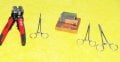
The hardest part was getting the TC wire (Teflon insulated and wrapped) cleanly stripped. This first photo shows the tools I used. Small curved "hemostats" (second from left) often have a space between the jaws between the pivot and where the teeth start. That space was perfect for holding the slippery wire without damaging the insulation. Held the wire there, then rimed the insulation with a razor held against the jaws. Finally, the stripper (far left) was used to pull both the outer and inner insulation in one step leaving nice, parallel wires. The next forceps (second from right) had smooth jaws. They were used to grasp the wires right where the insulation ended and the far right forceps were used to twist the pair. It was then trimmed so about 1/8" of twist remained.
Tools used.jpg

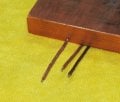
The welding jig consisted of a piece of copper strip that had been cut with ordinary shears (not sawed) so the legs formed a shallow V. The TC was slid into the V for welding (a practice piece is shown). An arc was started on the large copper heat sink and carried to the TC to be welded. Welding was almost instantaneous and formed a nice ball. This close up is with my older Canon camera, and the image is not very sharp. The balls are shiny and insulation showed no burn back.

Balled ends.jpg
 
Top