Ways to clean and safeguard old AC motors?

Thread Starter

skeer

Joined Oct 28, 2022
134
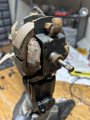
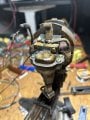
So I'm trying to rescue and restore an old desk fan. I pulled the motor and did a simple ohm reading between the leads and there's no shorts. I then tested it with 24vac and then 120vac and it operates like it should
So since I'm pretty certain I cannot source a new motor for this I wanted to ask, what are some basic tips and tricks on properly cleaning old motors and their windings?
Adjacent to that would be, are there any steps a person can perform to help keep it operational? Like I notice the two leads originally had multi-strand wires soldered to the winding leads. So stranded to solid. IMO they should be reinforced somehow.. inhibit any chances for bending or flexing the solid wire ends so they don't break off.
 

Attachments

MisterBill2

Joined Jan 23, 2018
27,361
Certainly excess flexing will break the solid wire. Often the junction is supported so that is not allowed.Or there may be a suitable glue holding the joint from moving and insulating it as well. Usually when a fan is assembled the external cord is somehow prevented from flexing that connection.
 

LowQCab

Joined Nov 6, 2012
5,101
I would carefully disassemble the Motor,
being especially careful to not bend any connected Wires.

Blow-Off with low-pressure compressed-air.

Clean it by carefully blasting liberally with CRC-Lectra-Clean-Solvent.

Lay-out a work area with Wax-Paper.
Use a Paint-Brush to thoroughly soak the Windings and the Field-Core in Epoxy.
Walk-away for ~24-hours.
Conceive of a way to support the Windings on a Table, on Wax-Paper such that
no pressure is exerted on any connected Wires.
Apply Epoxy to the other side of the Windings.

Wipe-away any excess Epoxy on surfaces that will be
used for mounting of other Parts/Brackets/etc., before the Epoxy starts to set-up.
Wipe-away any Epoxy that gets into the interior-Bore of the Field-Armature.

Sorry, but the insulation on all of the Wiring will crumble and fall-apart.
This is almost sure to create a dangerous Short-Circuit at some unexpected point.
I would replace all of the Wiring with modern equivalents, including the Power-Cord.

If You look hard enough, there are Power-Cords available with "Old-Looking" Cloth-Braid-Coverings.

The Bearings should be thoroughly Blasted with CRC-Lectra-Clean.
Then go to Walmart and buy a quart of the heaviest-weight
Mobil-1-Synthetic-Motor-Oil that You can find to to lube the Bearings,
and to soak the Felt-Pads that are designed to hold Oil.
It only takes ~4 or ~5 drops of Oil for each Bearing.
A few more drops of Oil should be added every year.
Use a "Q-Tip" to apply the Oil.

Any exterior-finish that will not be re-Painted should be rubbed-down with "Boiled-Linseed-Oil",
then do not touch for ~48-Hours,
repeat the rub-down a second time,
do not touch for ~48-Hours.
This will provide bullet-proof, natural protection for up to ~2-years or more,
then apply again, every 2-years or so.

Most Paints will NOT stick to a Boiled-Linseed-Oil-finish.
But, Boiled-Linseed-Oil will protect existing Paint-finishes,
even if they are in really poor condition.
Boiled-Linseed-Oil leaves a transparent "semi-gloss" clear-finish on Bare-Metal or Paint,
it will NOT "hide" any existing imperfections in the Surface.

Read-up on Boiled-Linseed-Oil ........
Under certain very-odd conditions it can become self-igniting during the drying procedure.
Wadded-up wiping-rags can spontaneously combust into flames inside a Trash-Can.

All Wiping-Rags must be laid-out-flat for at least several hours after use to allow a "cooling-off" period.
The Rags will NOT be re-usable for any other purpose, ever, they are now trash.
Boiled-Linseed-Oil is completely inert, like plastic, when dry.

If the Fans have a Gear-Box for making the Fan Oscillate,
scrape-out most of the old-dried-up-animal-fat-based-grease
and replace with Synthetic-Wheel-Bearing-Grease from your nearest Auto-Parts-Store.
.
.
.
 

MisterBill2

Joined Jan 23, 2018
27,361
"Engine Oil" has a variety of additives, some intended to keep contamination suspended. I would not suggest it for use in an electric motor. Rather use straight #30 oil or plain gear oil, NOT the severe-duty oil.
 

Thread Starter

skeer

Joined Oct 28, 2022
134
"Engine Oil" has a variety of additives, some intended to keep contamination suspended. I would not suggest it for use in an electric motor. Rather use straight #30 oil or plain gear oil, NOT the severe-duty oil.
While I can't verify the idea of suspended particulates... in my experience synthetic doesn't last as long which I'd attribute to the thinness.
 

Thread Starter

skeer

Joined Oct 28, 2022
134
I would carefully disassemble the Motor,
being especially careful to not bend any connected Wires.

Blow-Off with low-pressure compressed-air.

Clean it by carefully blasting liberally with CRC-Lectra-Clean-Solvent.
.......
Super information! I'm familiar with CRC electronics cleaner but not wax paper or linseed oil. And for the epoxy.. Im pretty sure but just to be 100% you are talking about the expoy/resin yeah? I've never used that type, the purpose being to cover the outside of the windings but not so much penetrate into the windings right?

For the single, solid feed wires I had the idea of using various sizes of heat shrink to build up.. not like a lot but a few 2-3 layers to add rigidity. Once it's mounted back inside the housing, figuring out a way to bend them as little as possible back into the original positions.
 

MaxHeadRoom

Joined Jul 18, 2013
30,605
As per previous posts, you want to clean the Oilite bearings thoroughly , if the motor is quite aged, replace the bearings, soak in oil overnight.

I wanted to ask, what are some basic tips and tricks on properly cleaning old motors and their windings?
https://www.emersonbearing.com/oilite-bushings/#:~:text=Maintenance of Oilite Bushings,and replace them as needed
Oilite are superior over ordinary bronze.
You can also buy winding varnish after the windings have been blown off and cleaned as much as possible.
 
Last edited:

LowQCab

Joined Nov 6, 2012
5,101
There are a million different types of 2-Part-Epoxies.
The objective is, immobilizing every single Wire in the Windings so that they can not vibrate during use.
Thin, Soft, Epoxy is more important than Strong/Hard, Thick, Epoxy.
It is desirable for the Epoxy to fill all the spaces between all the individual Wires,
for this reason, it is important NOT to use a Fast-Curing-Epoxy,
the Epoxy needs time to thoroughly "soak-in" to the Windings, and all the tiny cracks between them.
The objective is to make the Windings in to one solid part, that can not vibrate.

Replace the internal connecting Wires with new-Wires.
You can't install Shrink-Tubing without disconnecting the Wires first.
And disconnecting the Wires will cause the ancient insulation to crack, crumble, and fall off.

Standard, generic, PVC-Insulated, 18-Gauge, (~1mm ),
"Stranded-Hook-Up-Wire", will last forever and work just fine.

Replace the Wires one at a time to avoid confusion as to where they are supposed to go.

After installation of the new Wires,
wrap the Wires together to prevent them from vibrating during operation,
vibration may cause failure of the individual wire-strands near Solder-Joints.
.
.
.
 

LowQCab

Joined Nov 6, 2012
5,101
"Engine Oil" has a variety of additives, some intended to keep contamination suspended. I would not suggest it for use in an electric motor. Rather use straight #30 oil or plain gear oil, NOT the severe-duty oil.
.
That used to be the standard advice ~50-years ago,
things are much different now owing to huge advancements in Oil-Technology.

Toyota has been shipping Cars with "0W-8" Oil from the factory, for several years now.
I think Toyota knows a few things about Cars and Oil, and they provide a substantial warranty to back it up.

One of the things that I've been studying is new Lubrication-Technologies, from 2 independent sources.

There is absolutely zero-advantage to ever using a non-detergent-Oil in anything that needs Oil.
This is, and always has been, ( since the '50's at least ),
an "Old-Wives-Tale", which is based on absolutely nothing.

A Synthetic-Based-Oil will ALWAYS do a superior job of protecting any Bushing-type-Bearing,
and do it while generating less friction.
The only exception is Bearings designed for use with a Grease, instead of a Liquid-Oil.
.
.
.
 

Thread Starter

skeer

Joined Oct 28, 2022
134
I have another fan, slightly old so like about a decade or so. Also used bronze bushings instead of actual bearings but, anyway soaking the felt pads on it with regular 'ol 5-30 full synthetic.. I was re-applying a few drops probably 3-4 times a year. granted there could be numerous reasons but I attributed it to the thinness of it. Defintely lubricated better but was less sticky or adhering to the bronze and felt. IMO
 

MisterBill2

Joined Jan 23, 2018
27,361
There are other additives in engine oil aside from just the detergents. Many of them will not make much of a difference either way. BUT it can be things like the anti-varnish additive that could be hard on the varnish insulation.
Aside from that, there is a bit of cost difference, which may not even be obvious in the stores where everything is costly.
 

LowQCab

Joined Nov 6, 2012
5,101
The "Varnish" that may develop inside an Engine
is an entirely different compound than the "Varnish" insulating the Windings.

The words are similar only because the two have vaguely similar color and appearances.
They are not even remotely similar in Chemical-make-up, effects, or usages.

Modern-Engines don't care much about "Varnish",
because the Modern-Oil-Formulations simply don't break-down as quickly,
or in the same manner, like they used to ~30-plus-years ago.

These things aside,
the minuscule amounts of Oil being used are not likely to ever come in to contact with the Windings,
especially when the Windings have just been thoroughly coated in Epoxy.
.
.
.
 

ulms

Joined Mar 19, 2024
179
This poor thread has become a thread on tribology and thixotropic adhesives. I want to add this, using 0-20 synthetic results in being two quarts low at next change interval. Using 10-40 stays topped up. Manufacturers are scrambling for low MPG numbers and low viscosity was a dirty quick fix.
 
Last edited:

Thread Starter

skeer

Joined Oct 28, 2022
134
How did You determine that more Oil was needed ?
.
.
.
I'd begin to notice when the fan is turned off the blades not free spinning as long. Looking back, it might have been bushing age or wear that the oil was covering up.
 

LowQCab

Joined Nov 6, 2012
5,101
ulms
There's nothing "quick & dirty" about it.
You have an old worn-out engine that burns Oil.
If You have a Catalytic-Converter, it's way past burned-up/melted, or clogged-up with Carbon.

Engines are not made the same as they used to be.
They're running MUCH tighter clearances everywhere, using different Alloys everywhere,
they even have very exacting tech for Honing the Cylinders, and the Piston-Rings are only 1mm thick now.
They run 10.5 to 1, or higher Compression-Ratios on Regular-grade Gasoline,
and have Fuel directly injected into the Combustion-Chambers.

Lubricating-Oils have been going through changes that are easily just as as radical as the Engines have been.

There's absolutely nothing "wrong" with Low-Viscosity-Motor-Oils.
Higher-Viscosity-Oils are "sometimes" useful for "covering-up" sloppy, worn-out, clearances.
.
.
.
 

LowQCab

Joined Nov 6, 2012
5,101
Erroneous-Information must not go uncorrected,
regardless of whether or not it's pertinent to the Thread it's found in,
or hurts any ones feelings, it should be welcomed by all, at all times.
.
.
.
 

MaxHeadRoom

Joined Jul 18, 2013
30,605
I'd begin to notice when the fan is turned off the blades not free spinning as long. Looking back, it might have been bushing age or wear that the oil was covering up.
A down side to shaded pole motors is they tend to run hot due to their low efficiency.
This does not help with bearing temp etc
 

sdowney717

Joined Jul 18, 2012
805
Use some twine, thread or something, to tie the multistrand wire to the copper coils if they are loose.
If they are not supported can break the solid copper winding wires where joined. Copper coils are tied to prevent movement, which can break them or wear off their insulation when motor is running.
One time I fixed a shorted coil wrap, was on the outermost coil, somehow it melted the copper coil wire a little to another coil, had to separate it, then I dipped whole coil armature in old school varnish to reglue it all together. That was 20 years ago on a large air compressor motor, it still runs fine today.
 
Top