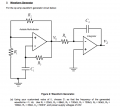
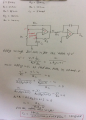
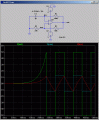
Do you mind me asking how you got that?I got C1=0.1 uF.
That is not correct either. The first opamp is acting as a multivibrator, so the inputs are almost never at the same voltage...It is incorrect to say that the inputs of the first opamp are at virtual ground. The term "virtual ground" means that the voltage is 0V (i.e., the same voltage as your "ground") even though that node isn't connected to ground. That is not the case here. These two nodes can be at a voltage other than 0V, but they have to be at the same voltage even though they are not connected to each other. This is known as a "virtual short". The distinction is important.

\(Do you mind me asking how you got that?
That's true if the op amp is operating in the linear mode but here it's operating as a comparator in a square-wave relaxation oscillator circuit, so the two inputs are only at the same voltage at the instant the output changes state.It is incorrect to say that the inputs of the first opamp are at virtual ground. The term "virtual ground" means that the voltage is 0V (i.e., the same voltage as your "ground") even though that node isn't connected to ground. That is not the case here. These two nodes can be at a voltage other than 0V, but they have to be at the same voltage even though they are not connected to each other. This is known as a "virtual short". The distinction is important.
Hello! Homework HELP!I got C1=0.1 uF.
True. I didn't consider the circuit beyond seeing the notation -- only had a few seconds to make a reply when I got called away.That is not correct either. The first opamp is acting as a multivibrator, so the inputs are almost never at the same voltage...
View attachment 91232
Wouldn't it be even more helpful if you wrote up the entire solution and submitted it for the TS?\(
f=\frac{1}{T}
T=\frac{1}{f}
f=82 Hz
\)
Find T.
T is known.
R3 is known.
Find B.
Plug everything in and solve for C1.
\(
T=2*tau*ln\frac{1+B}{1-B}
tau=R_{3}*C_{1}
B=\frac{R_{1}}{R_{1}+R_{2}}
\)
The dude is too clueless. Me solving this one little problem is not going to make him finish that class with an A. I will be very surprised if the dude can get a B for this class. My bet is on C or D.Wouldn't it be even more helpful if you wrote up the entire solution and submitted it for the TS?
\(
f=\frac{1}{T}
T=\frac{1}{f}
f=82 Hz
\)
Find T.
T is known.
R3 is known.
Find B.
Plug everything in and solve for C1.
\(
T=2*tau*ln\frac{1+B}{1-B}
tau=R_{3}*C_{1}
B=\frac{R_{1}}{R_{1}+R_{2}}
\)
I wasn't looking for a answer more an explanation. Why have a homework help section on the forum if you ***** are going to criticize me asking for some help?!Wouldn't it be even more helpful if you wrote up the entire solution and submitted it for the TS?
How the **** would you know what my academics capabilities are? Yes some questions are challenging for others hence why I approached this forum for clarification. You're just an old American wanker that loves to assume stuff without any knowledgeThe dude is too clueless. Me solving this one little problem is not going to make him finish that class with an A. I will be very surprised if the dude can get a B for this class. My bet is on C or D.
Watch the language -- that will get you banned pretty quickly.I wasn't looking for a answer more an explanation. Why have a homework help section on the forum if you ***** are going to criticize me asking for some help?!
The you are always free to go elsewhere. But obscene language won't be tolerated here.How the **** would you know what my academics capabilities are? Yes some questions are challenging for others hence why I approached this forum for clarification. You're just an old American wanker that loves to assume stuff without any knowledge