Water distiller draws too much current

Thread Starter

twister007

Joined Feb 29, 2012
93
Fun fact. Boiling water draws 10x more energy density than lead acid batteries can store.

It takes at least 1700 kJ/kg to boil water from 25'C.
Car batteries might hold about 180 kJ/kg of energy.

So the battery might weigh 10x more than the water to boil it. Is that Ok?

I thought @crutschow 's solution of a large run cap sounded good until you compare 120V/6A= 20 Ohms with a 10 uF Run cap at 60 Hz is 265 ohms. But Princess Auto (CDN) has big 50uF caps for $20 which might still not boil water.

A 10A diode might work and drop the nichrome heater current 50% but the controller might not work and the inverter might make some bad noises.

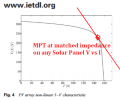
Max Power Transfer occurs when your inverter impedance matches to the load.
I only use battery power at nite because battery power is expensive! That's why I want to reduce the current.
It does boil the water at half the current now, but I'm going to have to run another line to bypass the diodes, to power the fan and the timer.
 

BobTPH

Joined Jun 5, 2013
11,546
It may run on half the current, but you will not save any energy. It still takes the same amount of energy to boil the water.

Does the inverter shut off when it can’t supply the current, or does the voltage just reduce? If the latter, then leave it alone, it is giving you all it can produce.
 

MisterBill2

Joined Jan 23, 2018
27,611
Electric heating to boil water powered by an inverter is rather inefficient. What voltage is the battery supply? Or is it just a single 12 volt battery??
Is the need to distill the water or just to kill all the germs in it?
If the battery is charged by solar cells then the power is "free", but the system is not.
It seems like there is a lot about this project that we are not aware of. Does the water distilling system run all day also??
 

tonyStewart

Joined May 8, 2012
238
That's a common misconception when using the maximum power theorem.
It doesn't work both ways.
You adjust the load to the source impedance, but if the source impedance is adjustable, then you make it as close to zero as possible.
Overload is when the boiler R is less than matching the rms ratio of Vout/Imax before inverter shutdown. It is assumed there is some source impedance from load regulation error.

In this case, the 1st problem is lack of capacity, so a large battery is essential to provide the energy to boil the water over a desired period of low solarity. The PV controller charges the battery independently at MPT according to solarity power of sun at matched incremental resistance.

Sizing of the battery (Joules or Wh or V*Ah) must exceed the demand load for energy for some desired period of time.

My previous comment indicated the total mass of water to be boiled over this period will determine the weight of the lead-acid battery by a factor of 10x min. more than the H2O.

1722648108348.png
The MPT theorem for matched impedance still applies unless limited by the current source. This does not apply to voltage sources with 0 ohm yet the RMS ratio of Vout/Imax impedance ratio if matched to the load resistance, it will run at max power.

The 2nd issue is lack of PV array energy with Solarity and array size.

At least it works with a diode at half power.

For killing germs the duration of time above Pasteur temperature is reduced with the differential temperature. Milk boilers use super-heated steam in high pressure and time duration very short at high velocity.
 
Last edited:

crutschow

Joined Mar 14, 2008
38,536
The MPT theorem for matched impedance still applies
Certainly that applies to the apparent inverter input impedance for getting the most power out of a solar panel, but I assumed we were talking about the inverter output impedance versus the load impedance which is unrelated to its input impedance.
 

MisterBill2

Joined Jan 23, 2018
27,611
So we have a system that uses a solar cell array to charge a battery that powers an inverter that powers a water distilling device. What is not completely clear is if the requirement is for operating that water distilling system continuously, 24 hours a day.

Several choices exist: Increase the capability of the solar cell array, or increase the efficiency of the inverter, or improve the efficiency of the battery charging system, or improve the efficiency of the distilling system.
Increasing the battery capacity will not help unless there is more charging capacity than the present battery can accept.
 

wayneh

Joined Sep 9, 2010
18,115
A solar-powered still would be FAR more effective than messing around with electronics. Use the electricity to power the control system, but use the solar power directly. You won't need to run at night because you'll have made 5 times more water during the day.
 

Tonyr1084

Joined Sep 24, 2015
9,744
Actually distilled water is not the best for drinking. It's devoid of all minerals, good and bad. And I can't remember there being much of a taste to the water.

Let me ask why you are distilling water?
 
Last edited:

MisterBill2

Joined Jan 23, 2018
27,611
I would choose to avoid minerals such as arsenic and lead, and a host of nasty alkaline chemicals that are rather toxic. In addition, there are a lot of assorted biological nasties to be found in the water in many parts of the world. And even nice clean sea water, which has all sorts of minerals, should not be consumed in large quantity.
AND, take my advice, and NEVER drink from the Mississippi River. That water contains ALL of the above!!
 

Tonyr1084

Joined Sep 24, 2015
9,744
I've never seen it but I've heard from people I'd consider reliable sources that PURE water - devoid of all minerals can be used as an etchant. Can even dissolve metals. Like I said, I've never seen it but - - - .

As for drinking water, I've tasted "Distilled" water. I love water but distilled left a bad taste in my mouth. Nor would I drink raw water from ANY river. Never mind minerals, bacteria can kill you!
 

MisterBill2

Joined Jan 23, 2018
27,611
Consider that especially "distilled" water is able to pick up tastes from the allegedly "clean" container it is put in, that is not at all surprising.
Aside from that problem, (contamination AFTER distillation), there are a whole lot of misrepresentations and out-right LIES presented as true. And certainly "DE-IONIZED water" is difficult to deal with. Fortunately that has never been what I had to deal with, or even learn about.
BUT, way back in high school chemistry class, we did have a demonstration of distilling water, complete with explanations about the physics of what was happening. And we were also shown that distilling a mix of denatured alcohol and water was not able to make it drinkable. We learned that there is a whole lot more science to distillation than the very basics.
 

crutschow

Joined Mar 14, 2008
38,536
PURE water - devoid of all minerals can be used as an etchant.
When I took college chemistry 101, the prof showed us a large glass ampule with a cloudy liquid in it.
He said that it was filled with pure water and then sealed about 30 years before, and the water was cloudy from the glass it had dissolved.
 

MisterBill2

Joined Jan 23, 2018
27,611
Back to the issue of the power supply for the water still machine. Which we have no details about, nor any description of a problem, except that it draws more current than they like.
Then a branch wandering off about distilled water. Far off topic and becoming rather boring.

Heading back to the issue:
So how to get more power for the system. OR any cheap and easy ways to reduce the power required.
 

Tonyr1084

Joined Sep 24, 2015
9,744
Haven't heard from the TS since Thursday. Here it is four days later and we're waiting for information.

As for going off topic, I mentioned that drinking distilled water is not so palatable. Then I asked why he was distilling water, which we haven't heard back yet. That was back in post #29. Since then it went off the rails talking about the Mississippi River and other things.

I'm wondering if we're going to hear again from the TS. But the question remains, is he boiling it to kill bacteria or is he distilling it to get clean water without harmful minerals. OR is it that he's after the minerals in the water and merely wants to extract the water from the minerals and leave behind a concentrate of those minerals. Exactly what is the goal? We don't need an answer to that question but it would help us direct the TS toward a solution that will suit his/her needs.
 

MisterBill2

Joined Jan 23, 2018
27,611
It happens that in some parts of Colorado safe water is hard to find. in addition, there are areas that are off the grid. Based on Mapquest, I see that KEOTA is a quite small community with a lot of open spaces. There may not be a municipal water system for the entire area.
 
Last edited:
Top